Folk tales creep through the cracks of the memory of the place, spoken by lips that have memorized them by heart, and began to repeat them for fear of being lost, after history books excluded them from mentioning them, so they remained locked in their chests. Complex stories that link generations together, through a vivid narrative that pulsates with the experiences of travelers and storytellers.
Those who were stars in their time, moving between cafes and palaces on winter nights, telling stories as if they were reviving them with their voices, until the story became the work of its Shahbandar, and “Hanna Diab” is one of its most prominent forgotten faces.
Read also
list of 2 itemsend of list
The memory of a woman in a time of devastation
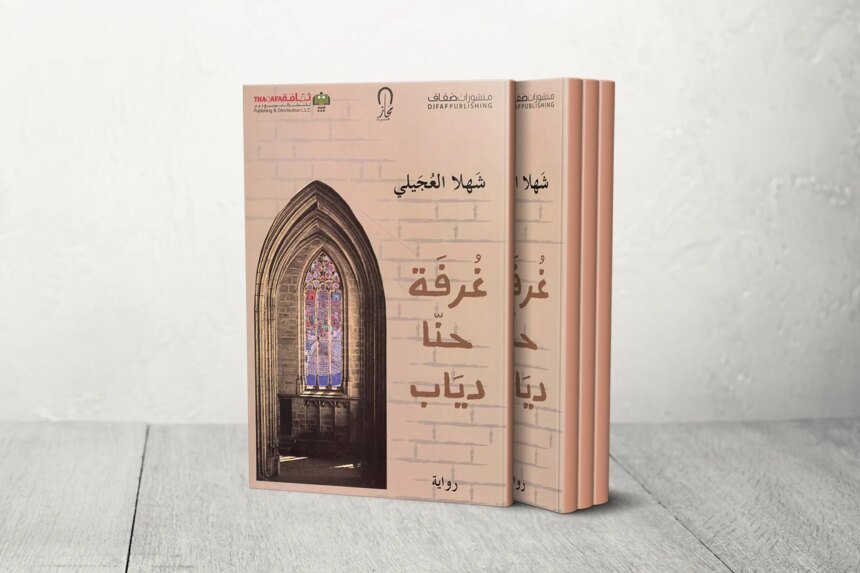
The novel “Hanna Diab’s Room” by the Syrian Aleppo novelist Dr. Shahla Al-Ajili, which is fragrant with the history of Aleppo, presents a contemporary vision of a past time estimated at two hundred years ago. We are not reading a fictional story, but rather a real history written with feelings, full of events, and inscribed with heritage.
Through it, we get to know people brought together in a room that breathes stories, and in which times intersect. A room in the middle of a city that speaks through its walls, its castle, its markets, its houses, its palaces, its women, its merchants, its intersecting times, and its forgotten hero.
A room like a miniature universe that accommodates Aleppo in the 17th century, and the memory of a woman (Kinda Al-Ashqar) searching for her murdered father in the current era, and for the meaning of the story in a time of devastation.

Aleppo identity and power struggle
Hanna Diab’s novel The Room is considered one of the most distinguished historical and contemporary novels in which the author reviewed the history of the city of Aleppo by narrating folk tales and stories from two different times, but they still constitute the Aleppo identity with a unique popular character. Whether in people’s relationships with each other (Futuh Al-Arifin, Maysar Al-Uzbekia, Ghassan Al-Qazzaz, the grandson of Hassan and Futuh, Kinda Al-Ashqar, daughter of Muhammad Abed), or in the relationship of Aleppo people with power over the past decades (the relationship of Mahmoud, Kinda’s husband and the son of her wealthy cousin, with the regime in Syria, and the relationship of Al-Jawhari, Fattouh’s father, and Namiq Bey with the Ottoman governor and the Sublime Porte).
Aleppo appeared in the novel as a small, narrow neighborhood despite its geographical and social breadth, but the novelist painted Aleppo within the framework of an epic painting, especially as she focused on the smallest daily details in the lives of the Aleppine people on the one hand, and immersion in the landmarks of the places on the other hand.
As for Hanna Diab, his mysterious character in the first chapter attracted the reader’s attention through the difficult mission that Kinda went through; Hanna and his forgotten room awakened Kinda’s sense of research discovery, like a thin thread left by her late father, Dr. Muhammad Abed al-Ashqar, in his literary research. She had no choice but to take it to achieve her goal. She even took us to an interesting fantasy adventure (necromancy) through the character of the simple young woman Fatima – Ghassan’s sister’s daughter and grandfather Hassan’s granddaughter – who began to fulfill Kinda’s desires due to her sense of the injustice that befell her, following the murder of her father, Muhammad. Abed, who was a friend of Abdel Rahman, Ghassan’s older brother.
Memory Sisters
Women are always the faithful guardians of the memory of the place, and they weave stories around their families that remain stuck in the web of their minds. They are the nuns to whom the novel gave a central voice, starting with the voice of the narrator, Kinda Al-Ashqar, searching for the truth about the unknown room.
Despite the multiple characters of the novel, and the overlapping of its events, they have become mirrors that reflect different dimensions of women, and they are “Ftouh, Maysar, and Helen,” three mirrors of the woman, the city, and disappointment. Not as subjects of the story, but as narrators, sages, and exiles, as if they were reshaping the world from the cracks of memory. Three female figures intersect in the room, each of them carrying a moral dimension. They are:
Futouh Al-Arifeen (Deep Voice of the City)This wise woman and mystic, who loved poetry and music, and believed that stories were predictions and signs from heaven, was an indomitable spirit of resistance. She is a sad woman who returned to Aleppo after the death of her mother in Istanbul, and her husband before, to live under the care of her father, the great Aleppo merchant.
While she was on the return trip on the ship, she overheard the voice of a young man telling a story from the book One Thousand and One Nights. She fell asleep to the sound of this narrator’s quiet voice, and when she woke up she searched for him but did not find him, and knew nothing about him other than his name (Hanna). When she entered Aleppo, she began to move between its neighborhoods until she found him, and she lived in the house of her friend Helen, the daughter of the Italian consul, whose house was separated from Hanna’s house by a wall and eyes.
Critic and writer Thaer Al-Nashif analyzes the character of Fattouh as the daughter of wealthy Turkish Aleppo families close to the higher authorities. She was not just a traditional woman confined to the walls of the house until a suitor arrived, but rather appeared as a woman passionate about science, knowledge, music, and literature. Fattouh, who got to know Hanna Diab and listened to his stories, and met the English doctor Patrick, who provided her with treatment during her serious infection with the Aleppo pimple (the common popular name for the disease skin leishmaniasis), and her openness to the men of the Orthodox Church in Aleppo, and her contribution to completing and copying the wonderful lines begun by her late husband, Sheikh Musa, reflects, from the writer’s point of view, the characteristics of the Aleppo woman and her open and tolerant society with others.

Maysar Al Uzbek (Challenging the Pain of Loss): The wounded woman, Fattouh’s friend, refuses to be a victim, so she reveals her wounds and rewrites herself through the pain of loss, defying all kinds of authorities, as she chose to open a new page in her life after the captivity and injustice she suffered. When she meets the English doctor, she falls into the net of his love, and begins another chapter of her life with him, writing stories in the book One Thousand and One Nights.
Critic Thaer Al-Nashif analyzes the character of Maysar, the Uzbek granddaughter of Tamerlane. Despite her disappearance in the novel after her jealousy and emotional shock with her secret lover, Dr. Patrick, after she saw him examining the body of the murdered Hungarian bear tamer, Anastasia, the direct and strong presence of Maysar in the text of the novel makes it clear that the neighborhoods of Aleppo once received immigrant Asian peoples, as the Turkmen, Uzbeks, and Caucasians form an important part of Aleppo’s contemporary identity.
Italian Helen (overcoming the language barrier): The other side of Hanna Diab, the daughter of the Italian consul, the one with influence, power, and foreign privileges, this spoiled girl who made her room adjacent to Hanna Diab’s room the palace of her companions’ dreams, because the stories that crossed the separation wall blended their cultures, transcending the language barrier.
In his interview with Al Jazeera Net, Al-Nashif points out that there are important references that the writer mentioned during the narration, as if they were messages about the characteristics of the Aleppo people. The first is the contribution of Syrian Christians to the renaissance of Aleppo despite their marginalization from the Sublime Porte and their rejection of the policies of the Ottoman governor, which exhausted the people. The second is the highlighting of the nationalist feeling among the Christians (the dialogue between Fattouh and Father John the Syrian, who answered her about his identity as a Syriac-Arab). This feeling continued to affect Fattouh after her father Al-Jawhari found himself in conflict with the Ottoman governor over the arrest of his friend Namiq Bey.
While scattered stories with significance and connotations enriched the novel; Such as the story of Empress Theodora, Anastasia of Hungary, Helen of Italy, and Maysar of Uzbekistan. As for Dr. Patrick of England, he appeared as a European orientalist in Aleppo who did not hesitate to record the details of events and things in his volume.
When the city speaks
At the heart of the novel woven by the novelist Shahla Al-Ajili, “Hanna Diab’s Room” changed from an overlapping architectural space into an intense narrative universe, throbbing with the memory of a city that knows its people and its paths as well as its intertwined handwritings, and breathes with the breaths of those who lived in it and left it while carrying it between their ribs. It is a room where stories live and sleep between its bars and doors. It turns into a symbolic space in which the times of Aleppo and Istanbul intersect, and in which the souls of the forgotten reconcile with their plundered history.
Through the walls of Hanna Diab’s room, the city speaks and becomes a mirror of its outside world, a vessel for its collective memory, and a space to rewrite its history from the perspective of those who lived in it, not those who ruled it.
Al-Nashif believes that the novel presented Aleppo in the time of European consuls, a time that was considered one of the most important stages in which Aleppo knew foreign languages and European cultures. The bearer of that culture is the character of Helen, the daughter of the Italian consul. Helen is not just an Arabic-speaking European tongue, but rather a part of the demographic and genetic identity of Aleppo. The writer chronicled here a pivotal point in the history of Aleppo, which embraced to her heart, as a compassionate mother, an Italian community (the Venetians, residents of Venice and Florence). This community became an integral part of the social fabric of Aleppo.
In this narrative space, the writer Al-Ajili recalls a forgotten character who was lost in the mazes of time. He is Hanna Diab Al-Halabi, born in 1688, where he became a cultural bridge between the East and the West. He is the Maronite narrator who mastered the languages of the world, traveled to Paris, and told the orientalist Antoine Galland the stories of “Aladdin” and “Ali Baba,” so that his stories became part of the fabric of the global imagination in “One Thousand and One Nights.”
The novel came to restore his reputation as a symbol of the marginalized voice and the absent memory in a city called Aleppo, which turns into a major character in this narrative fabric as a living being that bleeds, dreams, and remembers, and a commercial and cultural center that connects worlds together, before it turns into an arena for European and Ottoman influence struggles.
The novelist Shahla Al-Ajili was not the only one who wrote about Aleppo. She was preceded by novelists who mentioned it, and it was the scene of their works. The roots of Aleppo’s presence in the Arabic novel extend back to the Renaissance era, such as Newroz Malik in the novel (Kafka’s Flowers), and the portraits of the late Khaled Khalifa in (The Deception Keeper in 1990, The Qurbat Notebooks in 2000, Praise of Hatred in 2006), and the novel (Aleppo Metro) by Maha Hassan (2016), which presented Aleppo with renewed visions that made the city a heroine no less important than the characters in the novels.
The rebellion of the story as an existential act of resistance
The writer built her fictional world on a bridge connecting the two sides of the story, between a present narrated by Kinda Al-Ashqar, and a hidden past of Hanna Diab’s room and his story-loving girls, through her narration of a recent, dilapidated past, and how she met Ghassan the architect, while they were determined to lift the veil on the history of the room, moving between Aleppo’s neighborhoods and its markets until she found the thread that linked Ghassan Al-Qazzaz to the past of her murdered father.
Then events continue and she marries Mahmoud, and after years she discovers that he has betrayed her, she leaves her marital home and moves to her father’s house in the center of Aleppo, but the effects of devastation during the time of the Syrian revolution cast a shadow over her, which led to her taking care of her returning husband and they live together in her father’s old house.
During the mutual bombing between the military forces conflicting over the fate of Syria and Aleppo, they go down to the basement of the house to hide, and there they come across recordings of her father, in his own voice, telling about the room and the biography of three women whose meeting the room brought about, and through them Aleppo appears as a city of history, civilization, crises, earthquakes, love, beauty, betrayal, and tears…
This overlap between the two times creates a sense of parallelism while forming an existential dialogue between the past and the present. Kinda’s search for Hanna Diab’s room is, in essence, a search for herself, for a missing father, and for the meaning of the story in a time when all meanings have been destroyed.
After finishing writing down her father’s stories, she writes them down, knowing with certainty that Ghassan, whom she loved, took over the room with her help without her knowing. However, she now possesses the truth, the truth that Ghassan Al-Qazzaz does not possess.
In this work, the “story” transforms from a mere tool for entertainment into an existential act of resistance and a weapon against oblivion, and giving a voice to those whose ears have been deaf.
Narration in this novel comes as an act of resistance to time, so the stories rebel against the authority of history that tells them, until they emerge from under its robe, pass through guarded lips and settle in hearts before pages. The novel is a reaffirmation of the role of the popular storyteller, the bearer of the collective memory, who creates from imagination a more truthful history than official history.
The narration here uses the techniques of retrieval, historical imagination, and multiple voices, to give the novel a voice-forming character, where no voice is superior to the other. Rather, visions juxtapose, and times overlap, and the story becomes a painting dyed with memories, for self-understanding, and for reshaping the world from the perspective of a woman returning to her role in making history, not just living in it.