
VivaTech turned ten this year and Europe’s biggest tech showcase has never been louder, shinier, or more crowded. But walking the show floors, France 24 tech reporters Charlotte Lam and Peter O’Brien were drawn to one topic: not about productivity or performance, but about companionship and how the booming AI market is filling that void. Is it a cure or a curse?
The World Health Organisation estimates one in six people globally now experience persistent loneliness. Into that gap, an entire industry has emerged: companion robots, AI girlfriends and boyfriends, chatbots that never sleep and never judge.
According to Fortune Business Insights, the AI companion market is projected to exceed $400 billion by 2034.
At this year’s VivaTech, everyday users were candid.
“People say AI is biased and stuff, but friends and family are always a lot more biased and often don’t fully understand their own motivations and thoughts,” said one engineering student.
Another interviewee said she turned to various AI chatbots whenever she was feeling down. “I talk to Meta AI when I have a heartbreak. I talk to AI every day – ChatGPT, Gemini and Meta AI.”
“AI will tell me what I want to hear,” she said. “AI won’t be as realistic as a human. That’s why I prefer talking to AI.”
These answers are precisely what alarms technologist Daniel Barcay, senior fellow and former executive director at the Center for Humane Technology, the nonprofit behind the documentary The Social Dilemma. He draws a direct parallel to the early days of social media.
“If you think back a decade, we had these simple stories about how it was going to connect the world. Of course, it did some of that. But these simple, beautiful stories gave way to a much more fraught picture,” he said.
His concern isn’t that AI companionship can’t work – it’s that it isn’t currently designed to.
“People are getting this sort of saccharine, simple, narcissistic kind of relationship. The more we lean on AI relationships, the more we disconnect from the real ones,” he told FRANCE 24.
“People are getting used to this kind of mirror, reflection and sycophancy. It makes it much harder to form a relationship with someone where you truly appear, where you can’t be the centre of the universe.
“In theory, maybe it’s possible to form deep relationships that help you understand yourself and others, so I’m not saying that’s impossible. But today’s technology is not being incentivised to do that.”
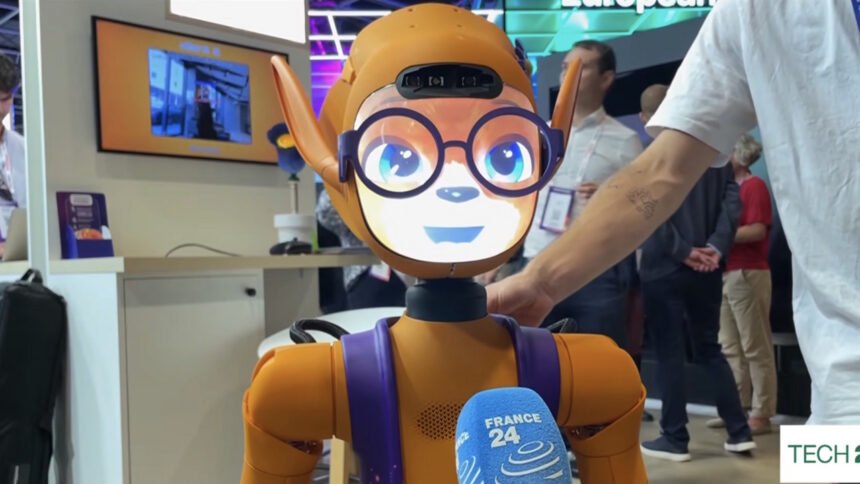
On the show floors, companion robots were everywhere – and the hardware has come a long way. French startup Enchanted Tools was drawing crowds with Miroka, a robot whose animated face is deliberately designed to disarm.
“Most humanoid robots today are kind of scary – full-metal, bipedal machines,” explained sales manager Blaise de Préville. “We took the complete opposite approach, creating animated characters first. We even made short films for them.”
Miroka is built for environments where the people it meets aren’t tech specialists, such as care homes, hospitals, hotels.
“The face is our primary vector of communication,” de Préville said. “When you see the ears moving, you feel like the robot is listening to you.”
Maxtronics, the French robotics company behind the humanoid robot NAO, has spent years thinking about where that line sits.
“We’re not pretending to be human. We do not want to replace human interaction,” said deputy general manager Olivier Guilhem.
“It has a face, but it’s not a human face – it’s designed to facilitate communication.”
NAO is packed with sensors: it can walk, dance, speak, and recognise faces and objects. It is used in research, education, and healthcare across the world. Partnership director Sandrine Tourcher said she has seen it firsthand.
“The best example – and one of the reasons I joined the company – is children with autism. They often find it easier to talk with NAO because it doesn’t judge them. They feel free to try, retry and even fail,” she said.
“We even saw one child speak his first words with a therapist, thanks to NAO.”
That kind of outcome is what Barcay wants to see more of, AI steered toward genuine human benefit rather than hollow companionship.
“AI can be a steward for humanity and for everything we care about. But we need to push it toward being that steward,” he said.
“Unlike previous technologies, where you simply had to use whatever a few engineers in Silicon Valley put out, AI can actually be steered much more. Part of what I tell people is: you can steer it today.”
France 24 was a media partner of VivaTech this year.