Published on 6/18/2026
|
Last update: 17:09 (Mecca time)
When the English astronomer Edmund Halley discovered that a bright comet returns to the vicinity of the sun every about 76 years, he did not realize that his name would become synonymous with the most famous comet in history.
Since its return was predicted in 1758, Halley’s Comet has become an event that people await, generation after generation, as if every appearance had a date between heaven and human memory.
Read also
list of 2 itemsend of list
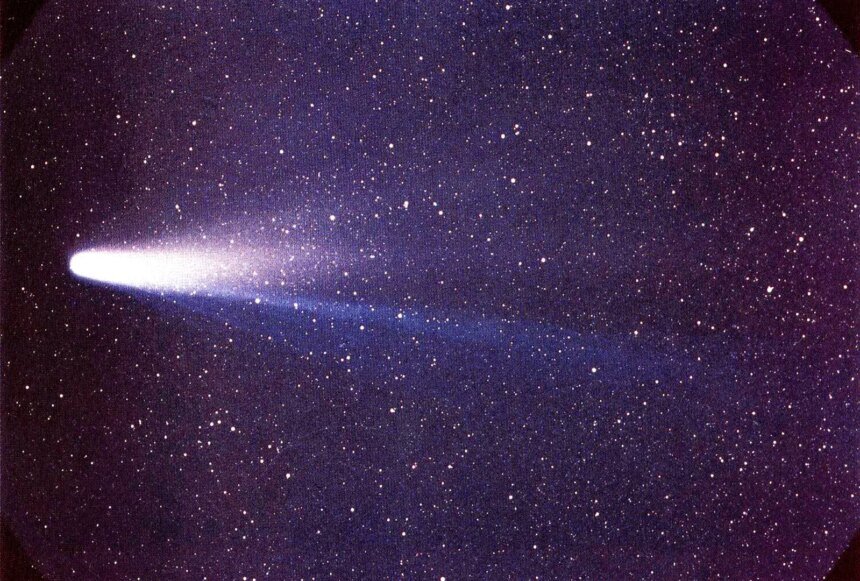
In the spring of 1910, the world experienced one of the greatest waves of astronomical enthusiasm. Halley’s Comet appeared bright with a long tail that extended across the sky, until it became the talk of newspapers and people in cities and villages.

This rare page from the magazine “Scientific American”, issued on April 16, 1910, shows how the comet was decorating the dawn sky above the eastern horizon, drawn between the constellations Aquarius, Capricorn, and the Great Persians, and how it was gradually increasing in brightness until it became easily visible to the naked eye, and for this reason the pictures and drawings of its appearance remained part of the visual memory of the history of popular and scientific astronomy together.
This was the image that stuck in the imagination of astronomers for decades. Pictures and drawings tell of a massive comet splitting the sky with a luminous tail, to the point that some people at the time were afraid of its passing, while others stood and contemplated it with admiration.
Because astrophotography was still in its infancy, drawings and newspaper prints became precious documents that conveyed to generations what this great celestial visitor looked like.
A long-awaited return and an unexpected disappointment
After 76 years, Halley’s Comet returned again in 1986 amid widespread global interest, especially with the beginning of the era of space exploration and the sending of several spacecraft to study it closely. The European probe Giotto was able to photograph the comet nucleus for the first time in history.
Many amateur astronomers who had heard the stories of 1910 or seen pictures of it were eagerly awaiting that return. Some of them spent years reading about the comet and dreaming of seeing it as their ancestors saw it.

However, the scene was not as impressive as many amateurs expected, as the comet appeared relatively faint due to engineering and astronomical conditions different from the appearance in 1910. The long years of waiting for many turned into a bit of disappointment, after they discovered that the most famous comet in history did not always resemble the legendary images associated with its name.
Haley in Arab memory
In the Arab world, Halley’s experience was more specific. In the 1980s, the culture of astronomical observation was not as widespread as it is today, and celestial maps and digital applications were not available to general amateurs.
However, the name of Halley’s Comet was strongly present in science school textbooks, as many students recognized it as the most famous periodic comet in history, and they awaited its expected return in 1986 with great eagerness. Some of them even dreamed of being among the lucky ones who would witness this rare cosmic spectacle with their own eyes.

But the number of people who were actually able to see it remained very limited. Some interested people wrote about it and promoted its appearance, including the late Jordanian astronomer Dr. Abdul Rahim Badr, while others spent long nights searching for it in the sky without success.
Some amateurs even bought telescopes specifically to receive it, but its dimness and difficulty in determining its location made the experience very different from the dazzling picture that childhood books and scientific magazines painted in their minds.
A new date with a guest who waits for no one
Halley in 1910 was not only a comet, but a memory passed down through generations. Those who saw it glowing above the cities of the world at the beginning of the twentieth century were mostly not there when it returned in 1986, but their stories, pictures and drawings remained alive.
Thus, the longing for the comet passed from a generation for its first date to a generation that waited for its second date, and today’s generation will in turn pass on the story to those who will be anticipating its next return in 2061. In the end, Halley does not measure time only by the movement of the sky, but also by the memory of humans that extends from one appearance to the next.