The Israeli political environment is heading toward an extremely dangerous legislative and strategic turning point, placing both the ruling right-wing coalition and the opposition camp alike in a simultaneous storm of internal disintegration.
Four months before the date of the supposed elections (October 2026), the language of numbers in opinion polls turned into a primary driver of a “war of survival” and bone fracture among the leaders of the political and military elite in Tel Aviv, amid the outbreak of a silent internal revolution in the ruling party. The Haredi parties led an unprecedented escalation step that completely paralyzed parliamentary work and threatened to unravel the government’s contract.
Read also
list of 2 itemsend of list
In a news report published by journalist Noa Spiegel in Haaretz on June 15, the head of the United Torah Judaism party, Yitzhak Goldknov, stated: “We are tired of the tricks and evasions designed to attract media attention and mislead nothing more. What the government did not do in 4 years, it will certainly not do now.” Accordingly, Goldknov demanded that the proposal to dissolve the Knesset be put to a vote in its second and third readings immediately to dismantle the coalition. Governor.
This Haredi anger was translated procedurally; The Shas and United Torah Judaism blocs announced a boycott of the coalition votes, forcing its president, Ofir Katz, to withdraw all laws from the agenda, including an amendment to the draft permanent service law in the Israeli army submitted by Defense Minister Yisrael Katz.
Engineering a dictatorship for the party
In an attempt to ward off the repercussions of this failure, political correspondent Moran Azoulay revealed in an exclusive report to Yedioth Ahronoth on June 15 a secret plan that Netanyahu is studying to cancel the primary elections scheduled for July, and expand the national list to the 40th seat, while eliminating the representation seats allocated to women, youth, immigrants, and minorities.

On the other hand, Netanyahu requires obtaining 9 reserved and guaranteed seats for him (3 seats out of every 10 seats out of the first three dozen) to appoint those close to him and his son Yair, using the excuse that “he is no longer satisfied with representatives who are only good at passing the Premiers, but rather he is looking for additional qualifications to face the opinion polls and defeat Ben Gvir in attracting the youth.”
This plan is supported by expedient deals with senior mayors, led by the head of the Local Government Center, Haim Bevas, who supports the abolition of internal democracy in exchange for granting him a guaranteed seat in the Knesset, to empty his position for other Likud mayors.
However, this “engineering” faces a strict legal veto. Azoulay revealed that Likud’s internal auditor, lawyer Shai Galili, issued a decisive report in which he confirmed that “the prime minister’s request to cancel the primaries is illegal” and requires mandatory approval from party members, which sparked widespread anger.
deal
This partisan “dictatorship” coincides with structural financial corruption scandals. Political and economic analyst Avi Bar-Eli revealed in The Marker newspaper (June 17) that the Audit Bureau’s report proved that 41% of the credit cards used to pay Likud membership fees were suspicious co-payments to buy votes and organized fraud.
Bar-Eli links Netanyahu’s attempts to dismantle Likud’s democracy with the panic prevailing in the corridors of the Knesset. There is a conviction among MPs that Netanyahu “will not run again” following the “surrender agreement with Iran” and the imminent strategic defeat, stressing that “the phrase that is currently at the forefront of the Knesset is ‘a plea deal’.” That is, Netanyahu is paving the way for a legal settlement to exit political life, which has prompted his allies to panic.

Opinion poll earthquake
This joint erosion in the two camps was accurately reflected in a poll by statistician Yossi Tatika published by journalist Tal Schneider on the Zaman Israel website on June 11, which documented a historical moment in which the Jewish opposition crossed the threshold of 61 seats to reach 62 seats, driven by the “disastrous week of crises” represented by Trump’s description of Netanyahu as “completely crazy,” the issuance of Washington’s orders to stop the attack on Lebanon, and the neglect of the residents of the north.
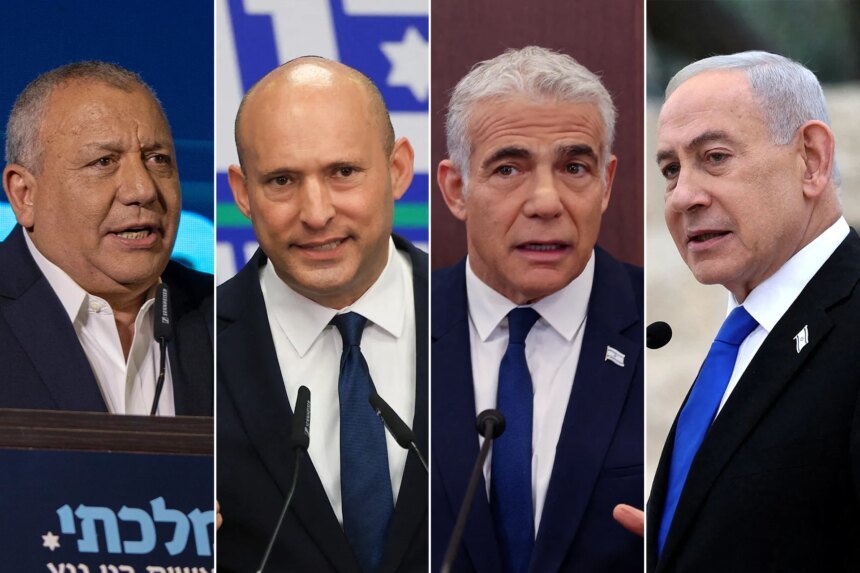
This trend was reinforced in mid-June polls; In a poll conducted by Kan 11 under the supervision of analyst Shahar Celik on June 16, Likud fell to 23 seats following the US-Iranian agreement, compared to a jump for Eisenkot’s Yashaar party to 21 seats, and Bennett fell to 17 seats.
In the same context, the i24NEWS poll revealed a dramatic, historical equality at the top when the public was asked about the most suitable person to be prime minister. Gadi Eisenkot received 45%, completely equal to Benjamin Netanyahu, while the Channel 13 poll confirmed Eisenkot’s lead over the opposition with 20 seats and Netanyahu’s bloc’s combined decline to 51 seats.
Despite the opposition’s mathematical superiority, it faces a structural dilemma that prevents it from deciding power in the future. In an analytical article in the Israel Hayom newspaper on June 15, right-wing writer Daria Shleifer deconstructed this impasse, stressing that the opposition lives in an “echo chamber” and speaks only to itself without the ability to attract “reluctant voters” who oppose Haredi privileges but are satisfied with the government’s firm policies against Iran and reject Washington’s dictates.
Schleifer criticized the protest movement’s arrogant rhetoric, which treats right-wing voters and undecided groups with superiority and portrays them as evil and stupid, which prevents the opposition from winning the 61 stable seats without having to ally with the Arab parties (Ra’am).

In stark contrast to this impasse, Netanyahu’s camp – if he continues and does not go for a plea deal – is betting on his strategic ability to maneuver. Writer Nova Dromi confirmed in Yedioth Ahronoth newspaper on June 16 that Netanyahu is capable of turning the threat and the Iranian agreement into a slogan for his election campaign, describing it as an “American, not an Israeli, collapse,” beginning his battles against Washington to restore the center right, and inspired by the example of “Bush Jr.” in the 2004 elections, who succeeded in exploiting the circumstances of the war to change the rules of the game in the final meters.
Intersecting digital and political indicators show that Israel is facing a complex zero-sum scene. While General Eisenkot has the numerical momentum and growing party legitimacy to reject sectarian and political blackmail, Netanyahu remains a manipulative fox betting on engineering a “regional security crisis” in the next four months to shuffle the cards and reformulate the collective consciousness, making the political arena on the verge of a state of structural paralysis incapable of producing sustainable stability.