
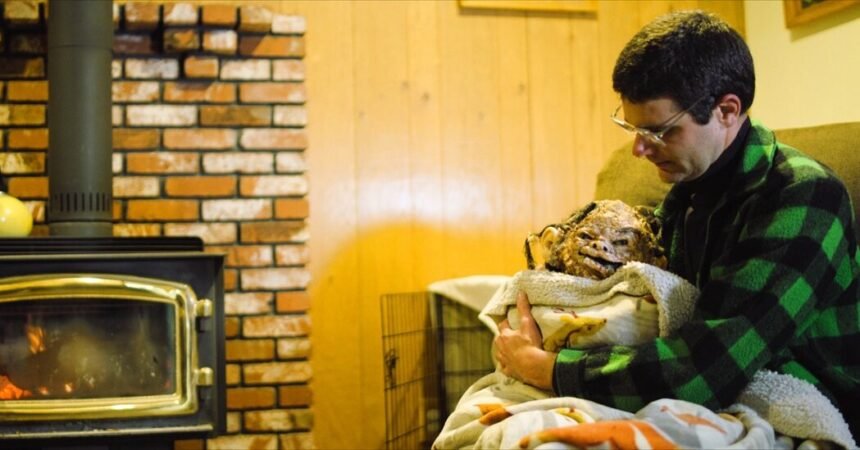
‘Hoagie’
Stream it on Night Flight Plus.
It’s been a notably deep and deranged year for genre films that defy description. (I’m looking at you, “Buffet Infinity.”) I’m pleased to add to that list Matt Hewitt’s wackadoo creature feature comedy that will thrill fans of marauding little monster movies of the ’80s, chiefly “The Deadly Spawn” and “Ghoulies.”
The critter here is Hoagie, a homunculus zygote that a suburban dad named Brendan Bean (Ryan Morley) finds in his trunk. Even though Hoagie has the looks of charred Chucky in “Child’s Play,” he and Brendan strike up a friendship. And why wouldn’t they? Hoagie’s wish-granting powers include materializing pizza out of thin air and decorating a she-shed for Brendan’s wife with A.I. speed. Unfortunately for Brendan, Hoagie is being sought by Benny Piazza (Stephen Heath, hilarious), a white supremacist who wants to use Hoagie’s powers for global domination. Or something like that.
Despite a few talky detours, “Hoagie” is a freaky thrill ride from an assured filmmaker with an adventurous appreciation of VHS-era practical effects and cutting, disgusting humor that is under no circumstances suitable for kids. If your taste in horror is on the stupid and sicko side, do yourself a favor and eat this “Hoagie” up.
In 1977, an Indianapolis man named Anthony Kiritsis was so distraught over a real estate deal gone wrong that he took hostage Dick Hall, an executive at a mortgage company, and rigged a sawed-off shotgun to Hall’s head that would go off if Hall tried to escape. Kiritsis’s demands included an apology from Hall’s father (Al Pacino) and $5 million. As if this horrific situation weren’t bad enough, parts of the saga were broadcast on television.
The events of that bizarre day are recreated to thrilling effect in Gus Van Sant’s lithe re-enactment starring Bill Skarsgard as Kiritsis and Dacre Montgomery as Hall. Written by Austin Kolodney, the film draws fascinating through lines between real and fictional transgressions — from hostage taking in “Dog Day Afternoon” and death machines in the “Saw” films to the glorification of Luigi Mangione — to explore what happens when desperate humans seek improbable justice.
Skarsgard and Montgomery share a tortured captor-captive energy that throws sparks. Also giving terrific performances are Myha’la as a TV reporter and Colman Domingo as a DJ and hostage negotiator.
Two years ago, I got my heart broken by “Grieve,” a devastating horror film from the director Robbie Smith that featured a small, but memorable turn from the actor Jacob Nichols. Smith and Nichols have teamed up again, this time in a darker and more gruesome movie that uses deliberate pacing, experimentalist flourishes and an adventurous score with music by the composer known as Foie Gras to build a sinister story about redemption and forgiveness.
Nichols plays Paul, a 20-something who gets the cold shoulder in his hometown after he returns from prison. He senses a presence in his house, and we see it: a shadowy figure that watches Paul from doorways as he tries to get acclimated to his old life. The radio warns that a killer may be on the loose, but it’s unclear if that’s Paul’s threat.
About halfway through, Smith’s film does a not-quite successful switcheroo that takes the story, which Smith wrote with Dashiell Arkenstone, to a predictable place that further confuses the weirdness that came before. But then Smith takes a third turn, driving the story into experimentalist territory that set my eyeballs ablaze.
Pénélope (Rose-Marie Perreault) takes her crying baby to the corner store late one night when she’s caught up in a violent robbery at the hands of a woman she recognizes. Struggling with postpartum depression and haunted by the memory of the crime, Pénélope has a hard time sleeping and dealing with the baby’s pothead father, Gaspard (Simon Landry-Désy). A fling with a former lover (Saladin Dellers) brings fleeting relief until Pénélope mysteriously receives photos of their trysts taken by a possibly supernatural god knows who.
That’s the foundation of this creepy psychological thriller from the French Canadian writer-director Chloé Cinq-Mars. The film recalls “Birth/Rebirth” and other recent horror movies about madness and new motherhood, but it does so with a nightmarish visual style — fantastic work from the cinematographer Lena Mill-Reuillard — that sets it apart. Despite a gruesome finale, evil here mostly comes from inner traumas, not outside forces. Fans of emotionally-driven, slow-burn terror will be in for a dark treat.
I was less taken by Sam Raimi’s horror comedy than other horror fans were. I find it to be an unwieldy combination of survival-revenge thriller and gory meet-cute rom-com with little of the radicalness that made Raimi’s 1981 shocker “The Evil Dead ” one of horror’s darkest and best comedies.
Still, it’s worth watching for two leads who have chemistry to spare: Rachel McAdams as Linda Liddle, a mousy corporate workhorse, and Dylan O’Brien as Bradley, her new beefcake boss she ends up sharing an island with after they survive a plane crash. Raimi and his screenwriters Damian Shannon and Mark Swift wring decent comedy out of the pair’s romantic mismatch; Linda’s got mad “Survivor” skills, Bradley withers in the absence of bro comforts.
The film’s many shocks of gruesome violence are tonally awkward, landing the film somewhere between “Swept Away” (Guy Ritchie’s, not Lina Wertmüller’s) and a more grisly “Cast Away.” That’s why I recommend this one for fans of “Spider-Man”-era Raimi who have extra strong stomachs and for horror fans who go weak for the Hallmark Channel.