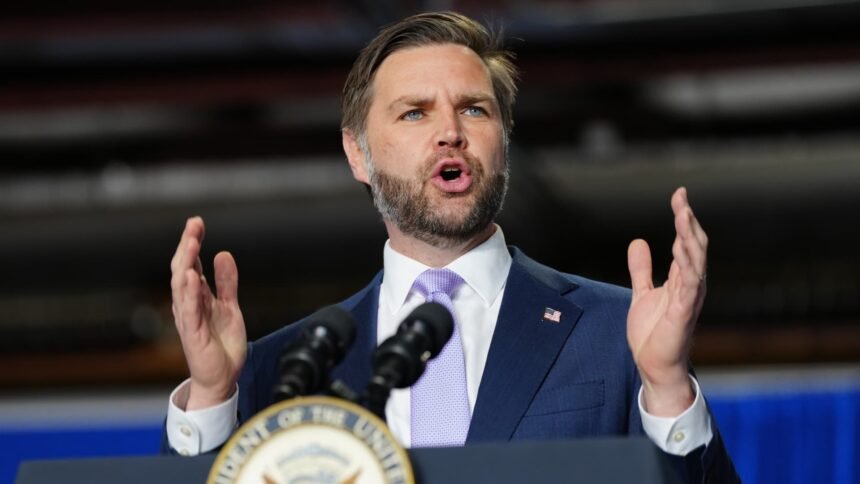
U.S. Vice President JD Vance delivers remarks at Bangor International Airport May 14, 2026 in Bangor, Maine. Vance is traveling to Maine to promote the administrations’ anti-fraud initiatives.
Tierney L. Cross | Getty Images
Hello, this is Justina Lee writing to you from Singapore. Welcome to another edition of CNBC’s Daily Open.
U.S. President Donald Trump and Vice President JD Vance pushed back against criticism that the U.S. gave “too much” in its interim agreement with Iran, which includes a proposed $300 billion reconstruction plan.
Yet oil markets have responded with remarkable restraint. Prices barely budged even after Vance said that tankers with more than 12 million barrels crossed the Strait of Hormuz overnight, following the end of the U.S. blockade of Iran’s ports and coastal areas.
Investors are increasingly focused elsewhere. With new Fed chair Kevin Warsh signaling a more hawkish stance, traders are now reassessing the path for interest rates and whether borrowing costs could stay elevated for longer.
What you need to know today
Vice President JD Vance is insisting that the U.S. is not paying Iran and that any economic benefits for the Islamic Republic will depend on full compliance with a 14-point memorandum of understanding. “The United States isn’t giving up a cent of money to Iran,” Vance said in defense of President Donald Trump‘s approach.
The comments come amid backlash from Republicans questioning if Trump might have given too much to Iran in the interim U.S.-Iran agreement, which includes a proposed $300 billion reconstruction plan.
Trump also fought back against criticism over the interim U.S.-Iran peace deal‘s terms. “These fools, who think I haven’t been tough enough on Iran, when the Stock Market Just Hit A RECORD HIGH, and Oil prices are ‘tumbling’ down, are either jealous, bad people, or stupid,” Trump said Thursday on Truth Social.
Following the interim deal, the U.S. Navy ended its blockade of Iran’s ports and coastal areas under Trump’s direction. Iran, meanwhile, is required to allow commercial vessels to transit the Strait of Hormuz without tolls for 60 days. The move marks a significant easing of tensions in one of the world’s most important energy chokepoints.
Oil prices fell after news of the interim deal and the end of the blockade, but markets reacted relatively calmly to signs that shipping activity is recovering. Vance said that tankers with more than 12 million barrels crossed the Strait of Hormuz overnight, yet crude prices saw only modest moves. The muted reaction suggests investors are waiting for clearer evidence that the agreement can lead to a lasting deescalation in the region.
Separately, OPEC Secretary General Haitham Al Ghais told CNBC in an exclusive interview that the organization does not see a peak oil demand on the horizon, dismissing the International Energy Agency’s forecast of an upcoming supply glut. “[We focus] on fundamentals and not putting many ifs and buts in our forecasts, but rather focusing on actual numbers,” he said.
Investors are also recalibrating expectations for U.S. monetary policy. New Fed chair Kevin Warsh struck a more hawkish tone this week, reinforcing concerns that interest rates could start rising over the coming few months. “Persistently high prices are a burden for the American people, but the recent past need not be prologue,” he said.
Meanwhile in the AI space, Amazon has launched investigations into three engineers who spoke at recent Seattle City Council meetings in support of a one-year moratorium on AI data centers. The employees criticized what they described as an “all-costs-justified AI build out” driven by the industry’s race to expand computing capacity. Amazon previously told CNBC that it respects employees’ rights to voice their opinions.
— Justina Lee
And finally…
Kalshi passes $2 billion in annualized revenue, holds informal IPO talks
Prediction market platform Kalshi is holding informal IPO talks, after it achieved $2 billion in annualized revenue which establishes a new financial benchmark for the company, according to the Information.
Kalshi, which has entered early informal IPO talks, will provide the company access to broader capital markets for future expansion.