Published on 6/17/2026
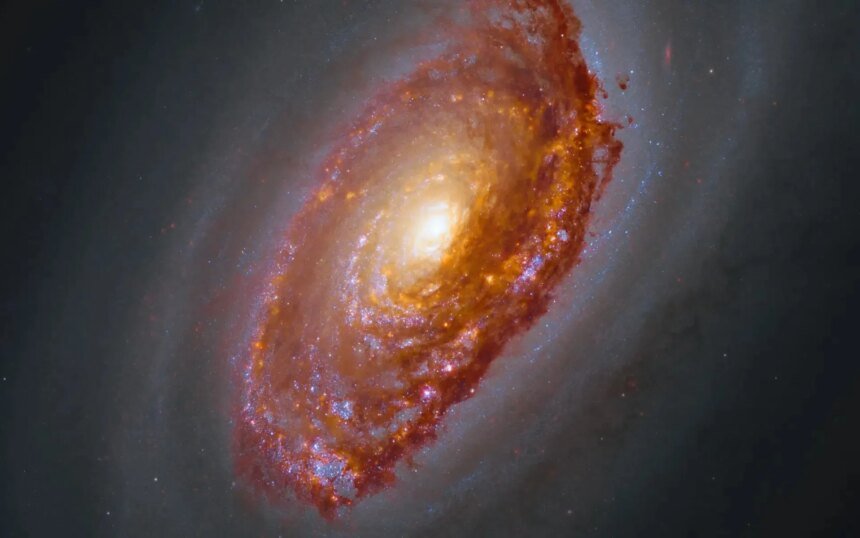
The US Space Agency (NASA) announced the publication of one of the most detailed images of the Black Eye Galaxy, known scientifically as Messier 64, by combining observations from the James Webb Space Telescope and the Hubble Space Telescope.
This galaxy is one of the most famous spiral galaxies that have been observed since the eighteenth century, as it was discovered by the British astronomer Edward Pigot in 1779, before it later became a permanent target for astronomical studies because of its unique appearance and unusual behavior.
Read also
list of 2 itemsend of list
A galaxy different from most galaxies
The Black Eye Galaxy is located about 17 million light-years from Earth in the Berenice Pigtail constellation, and is famous for the dark dust belt surrounding its bright central region, which gives it its famous name. But what interests scientists is not only its appearance, but also its rare internal behavior.

Studies have shown that the gas in the outer regions of the galaxy rotates in a direction opposite to the movement of the gas and stars near its center. This pattern is known as “opposite rotation,” and it is a very rare phenomenon among spiral galaxies.
This situation creates a complex, dynamic environment in which the components of the galaxy move in different directions around the galactic core, providing researchers with a unique opportunity to study its evolutionary history and understand the events that shaped it over time.
Webb and Hubble collaboration reveals hidden details
The new image was based on a combination of data collected by two of the most powerful space observatories in the history of astronomy. The James Webb Telescope used near and mid-infrared rays to penetrate dense dust clouds and reveal hidden structures within the galaxy.
In contrast, the Hubble Telescope provided ultraviolet, visible light, and near-infrared data, allowing the observation of different types of stars and regions of active star formation.
Combining the data produced a high-resolution composite image that shows the distribution of stars, dust trails and gas interactions within the galaxy in an unprecedented way. This multi-wavelength approach allows scientists to trace the relationship between gas, dust and stars and more accurately reconstruct the history of the galaxy.
Evidence of an ancient cosmic collision
NASA indicates that the most likely explanation for this opposite movement is due to a galaxy merger that occurred more than a billion years ago, and astronomers believe that the Black Eye Galaxy swallowed a smaller galaxy whose matter was rotating in a different direction.

During the merger, part of the small galaxy’s gas settled in the outer regions of the larger galaxy, retaining its original motion rather than conforming to the general direction of rotation. As a result, the opposite structure arose that is still observed today.
Although galaxy mergers are common in the universe, the importance of the Black Eye Galaxy lies in its preservation of clear traces of this process after more than a billion years, making it a natural laboratory for studying the effect of cosmic collisions on star formation and the redistribution of matter within galaxies.
A window to understanding the evolution of the universe
Scientists believe that the importance of these results goes beyond the boundaries of one galaxy, as they contribute to improving scientific models of galaxy formation and evolution. Galaxies are not fixed objects, but rather constantly changing systems affected by collisions, gravity, and various cosmic interactions.
The Black Eye Galaxy shows how violent events can leave their mark for billions of years, becoming a preserved record of the history of the universe. As the James Webb Telescope continues to send more detailed data, scientists expect to discover more galaxies bearing similar effects, which will help paint a clearer picture of the history of the universe and its evolution over time.

This image reveals that the universe retains memories of its major events even after billions of years have passed. Just as experiences leave their traces in human lives, cosmic collisions leave their mark in galaxies, telling stories from the distant past.
Through advanced monitoring tools and continuous scientific research, man continues to decipher these stories, stressing that curiosity and exploration are the way to understand our place in this vast universe, and that every new discovery opens a wider window on a history that we knew little about.