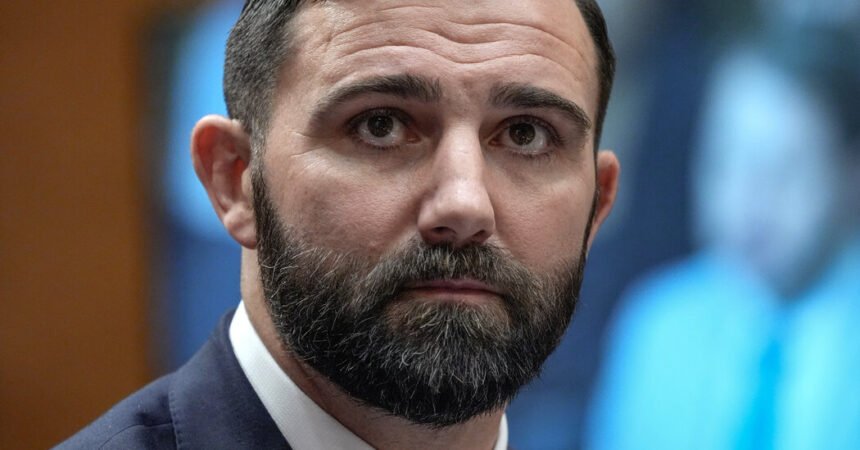
President Trump’s nominee to lead the Federal Emergency Management Agency, Cameron Hamilton, acknowledged Wednesday that sharp staff cuts may challenge the nation’s readiness for disasters, but said the agency was moving to fill critical vacancies and that he had “full faith” in its employees.
“Certainly FEMA operates in a unique environment where there are challenges and setbacks that impact our ability to respond,” Mr. Hamilton told a confirmation hearing in response to questions from Senator Richard Blumenthal, Democrat of Connecticut, about the staff cuts. “What I can tell you is I have full faith and confidence in the FEMA work force. I believe they are an exceptional group of public servants.”
Staffing cuts have reduced FEMA’s work force by about 20 percent over the past year and a half.
Nominated last month to take over the disaster agency, Mr. Hamilton served briefly as acting FEMA administrator at the start of Mr. Trump’s second term. But Kristi Noem, then the Homeland Security secretary, fired him a day after contradicting the president’s assertion that the agency should perhaps be abolished. Ms. Noem has since been replaced by Markwayne Mullin, and the Trump administration now appears to be retreating from plans to eliminate FEMA.
A former Navy SEAL, Mr. Hamilton previously oversaw emergency medical technicians on the southern border for the Homeland Security Department and worked as an emergency management specialist in the State Department. He ran unsuccessfully for Congress from Virginia in 2024.
He faced no questions about his background Wednesday, despite criticism from some disaster survivor groups that he lacks the extensive résumé that federal law requires of FEMA’s leader. A 2006 statute requires FEMA administrators to have at least five years’ experience leading disaster response and managing large staffs and budgets.
Mr. Hamilton pledged Wednesday to speed the flow of disaster aid while keeping a closer eye on how states and cities spend it. He said he planned to overhaul information technology systems to improve financial oversight and that he believed state and local governments have incentives to spend more federal disaster money than necessary, including on projects that aren’t directly related to catastrophes.
“We would need to strike a new balance to encourage cost reasonableness and cost savings,” Mr. Hamilton said in response to questions about costs from Senator Rick Scott, Republican of Florida. If confirmed, Mr. Hamilton said, he would review “areas where FEMA can reform” within his first 30 days.
Damage from the largest disasters in the United States reached about $115 billion last year, driven in part by wildfires in Los Angeles and thunderstorms that spawned tornadoes, large hail and damaging winds, according to Climate Central, a nonprofit group. Those costs have surged as a warmer planet delivers more destructive weather, more often.
Mr. Hamilton would assume responsibility for a disaster agency the Trump administration has dramatically slimmed down, with plans to significantly curtail the role it plays and shift more of the responsibility — and costs — to states and local governments. An administration task force last month recommended changes to FEMA that it said would speed the flow of federal aid while limiting that assistance to the most severe disaster scenarios.
In response to another question from Mr. Blumenthal, Mr. Hamilton disavowed a memo he had written last year while he was the acting administrator that explored quadrupling the threshold for when the White House should approve disaster declarations.
Mr. Hamilton said that memo “was not intended for any immediate action” and “is not my position.”
Democrats focused most of their questions on data showing that the Trump administration has approved fewer disaster declaration requests for states that tend to vote for Democrats than for states that typically vote Republican.
“What other conclusions can one draw other than the president is using federal disaster assistance to punish states that elect Democrats?” asked Senator Gary Peters, Democrat of Michigan. “Does a disaster survivor in a blue state deserve less support than a survivor in a red state?”
“I certainly appreciate your concern,” Mr. Hamilton responded. “If confirmed, my focus will be to ensure that FEMA is objective, is fair and reasonable, follows the law, and is consistent in the approach to how we adjudicate and process claims of requests for disasters.”
Senator Maggie Hassan, Democrat of New Hampshire, asked Mr. Hamilton what he would do if Mr. Trump rejected a disaster declaration request because it came from a state that voted for Democrats.
“I don’t believe the president would do that,” he responded. “But I will tell you that my oath of office requires that I follow and obey the law.”
Federal law gives the president discretion to approve or deny disaster declarations, regardless of a FEMA administrator’s recommendation.
At least two nominees under consideration on Wednesday by the Senate Homeland Security Committee, including Mr. Hamilton, had not yet been subject to FBI background investigations, Mr. Peters said, raising concern the Republican-led Senate was acting as “a rubber stamp for the president.”
No nominees would receive a vote until after that vetting occurs, said Senator Rand Paul, Republican of Kentucky and the committee’s chairman.