
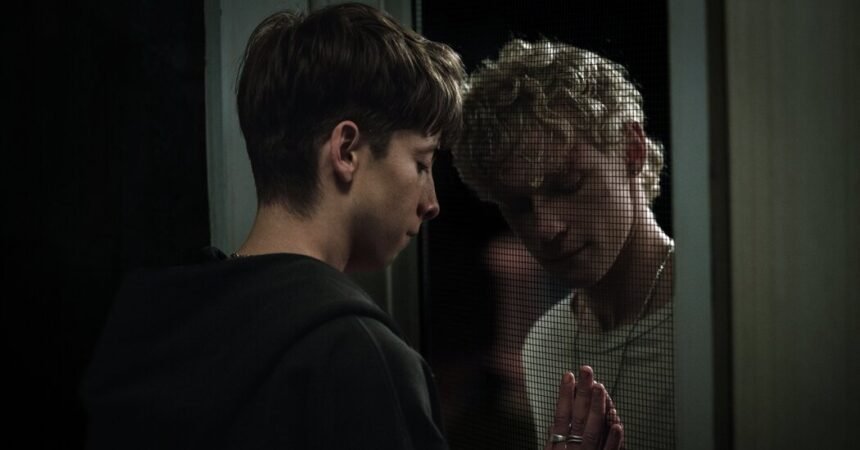
Conceptually intriguing if somewhat standard in execution, “Leviticus” borrows from “It Follows” (2015) the conceit of a relentlessly stalking entity and a tormented relationship to sex. This brooding chiller from Australia, however, forges its own path in a few crucial ways: The curse is bestowed upon gay teens by a “deliverance healer” recruited by their small town’s religious community, and the ghouls unleashed shortly after this “cleansing” ritual take the form of the person the victim desires most.
Movies like “The Miseducation of Cameron Post” (2018) and “Boy Erased” (2018) have depicted the horrors of Christian conversion therapy with (dramatically pumped-up) realism. And yet, “Leviticus” proves that a dose of the supernatural can get at something more slippery — and powerful — about the psychological violence conversion therapy inflicts on those it claims to treat. Desire can’t be zapped away. But it can be twisted into something ugly and dangerous, a self-mutilating mix of pleasure and pain.
Perhaps that’s why the film’s main couple, Naim (Joe Bird, whom you might recognize from another Australian horror hit, “Talk to Me”) and Ryan (Stacy Clausen), seem hostile at the film’s start. Following an obligatory prologue that teases the curse’s capacity for bloodshed, we follow the duo — Naim is the antsy new kid in town while Ryan is a chest-puffing bad boy — as they awkwardly fill up time. It’s the boonies of Australia — rocky flatlands lined with utility poles; dreary, isolated homes beneath cloudy skies — and the two wander into an abandoned warehouse where they trade jabs that turn into kisses. Both boys are intensely closeted, but Ryan turns out to have a few more notches in his belt. When the sensitive Naim catches him canoodling with another guy in their church group, his jealousy gets the better of him, to everyone’s misfortune.
“Leviticus” is the first feature by the writer-director Adrian Chiarella, and you can kind of tell by its formulaic horror beats and the repetitive nature of its scares. Once both boys are saddled with the curse, they’re each, individually, put through a hell of an emotional wringer. Naim, whose perspective dominates the film, thinks he’s seeing Ryan beckon him into dark corners for some smooching, but it’s actually the evil Ryan, hungry for blood. Likewise, Ryan’s monster manifests as Naim. And because the bogeys can only be seen by the cursed, each death or near-death comes off like an act of suicide or self-harm — a convenient explanation for a religious community that would rather their gay members implode with self-hatred than live their truths openly and in peace. Naim and Ryan, essentially, get tricked over and over again by their entities, which is sweet — young love, so naïve and hopeful! — but also dull with diminishing returns.
What Chiarella does get right is a bit more subtle. Even before the wicked doppelgängers arrive, there’s an atmosphere of aggression — of pent-up feelings expressing themselves through tension and cruelty — that flows naturally into the more spectacular forms of violence offered by the film’s kills and thrills. And, arguably, one indelible scene of Ryan and a soon-to-be-slaughtered lover throwing rocks at each other’s bodies as foreplay, disturbs more than any of the coming carnage.
In this regard, “Leviticus” has something in common with recent films and series about the power dynamics of gay sexuality, from “Heated Rivalry” to the French art-house drama “Misericordia.” Each, in its own way, tells us that there’s a fluid boundary between making love and war, and that keeping things angry is a way of keeping things safe (and, for what it’s worth, sexy).
Whether or not that’s a good thing is another question, but Chiarella, at least, understands that such behaviors are born of a desperate kind of loneliness, not unlike the alienation created by the curse itself. Played by an eerily fidgety Mia Wasikowska, Naim’s mom is essential here in underscoring his solitude. Concerned as she may be with his salvation, her love for Naim is governed by fear and dogma. We know from innumerable slashers that when a character is alone, trouble is around the corner. But “Leviticus,” with its gloomy, isolated setting and dogmatic parents, manages to turn this vulnerability into an existential issue, too. To make matters worse, the only glimmers of human warmth our boys receive are from each other — and that opens yet another can of worms.
Leviticus
Rated R for sexual activity and bloody violence. Running time: 1 hour 28 minutes. In theaters.