Published on 6/16/2026
Since the beginning of the twentieth century, the famous physicist Albert Einstein laid the foundations of general relativity, which describes gravity on cosmic scales, while quantum mechanics developed to explain the behavior of tiny particles. Despite the amazing success of the two theories, reconciling them within one framework remains one of the biggest challenges in modern physics.
Meanwhile, other mysteries have emerged, such as dark matter and dark energy, which make up most of the universe but cannot be fully explained by the four known forces: gravity, electromagnetism, the strong nuclear force, and the weak nuclear force.

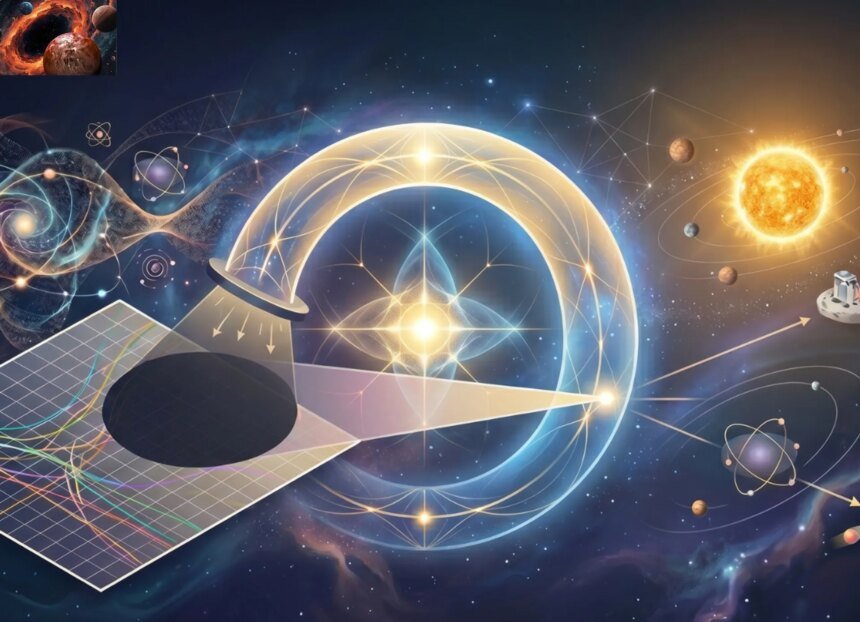
In this context, a new study conducted by researchers from the Italian National Institute of Astrophysics (INAF) presented a different vision that combines these two research paths. It suggests that the theory of “quantum gravity” may help narrow the search for a possible fifth force of nature, an idea that for decades has been among the most exciting hypotheses in theoretical physics.
Read also
list of 2 itemsend of list
When quantum gravity leads the search for new forces
Researchers Alfio Bonanno and Emiliano Glaviano relied on a theoretical framework known as “asymptotic safety,” a hypothesis that proposes that gravity remains stable and consistent even at the very enormous energies that prevailed in the early universe.
Instead of the traditional approach of proposing a new force and then trying to observe it experimentally, the team took the opposite approach; They used the requirements of the theory itself to rule out some possible properties of the fifth force.

The results suggest that any fifth force, if it exists, must fall within a limited range of intensity and extent, while the theory rules out a large number of possibilities that were previously considered possible.
Bonanno says that the biggest challenge was not technical but intellectual, because quantum gravity is often viewed as an abstract subject far from direct testing. However, the study attempts to show that phenomena that occur on the smallest scales may leave observable effects in the real world.
Minor deviations from Newton’s law
The research focuses on the possibility of the fifth force appearing in the form of very small deviations from Newton’s law of gravitation at very short distances. These deviations are described by two basic parameters: the strength and extent of the effect.
According to the new calculations, some regions of this theoretical space have become completely excluded because of the internal consistency requirements of the theory, not because of the results of the current experiments. Interestingly, some of these excluded regions have not yet been tested in practice, which means that future experiments will be able to directly test the new predictions.
This is an important development, because physical theories become more valuable when they produce predictions that can be experimentally falsified or confirmed, rather than remaining within the framework of abstract mathematics.
How can the idea be tested?
The study suggests that the effects of the fifth force, or quantum gravity, may appear in a wide range of precise measurements. These methods include “atomic interference” and quantum sensors, in addition to experiments measuring the distances between the Earth and the Moon using lasers.
Its effects can also be investigated by studying the orbits of the planets and the movements of bodies in the solar system, and even through extensive astronomical observations. If small deviations from known expectations are observed, they may represent the first evidence of new physics beyond the current model.

The researchers believe that these results make quantum gravity more closely related to the observed world, after it had long been linked to energy measures beyond the reach of experiments.
Despite the importance of the results, the researchers emphasize that the study does not prove the existence of a fifth force, but rather places new restrictions on its possible properties. Also, the boundaries of the theoretically permissible region may change as models are developed and new fields and particles are added to the calculations.
However, the real value of the work is that it turns a deep philosophical question about the nature of gravity into a set of predictions that can be tested. Instead of waiting for massive future technologies, some answers may become possible through experiments that are already being developed today.
Science is approaching the most profound secrets of the universe
This study reminds us that scientific progress does not always occur through sudden discoveries, but sometimes through narrowing the unknown, step by step. Every possibility eliminated brings us closer to a deeper understanding of how the universe works. Perhaps attempts to unify gravity with the quantum world will lead us to more than just solving an ancient equation; It may reveal new forces, explain dark matter, or redraw our picture of the universe itself.
Thus, the journey of scientific research continues, not only in search of final answers, but also in a constant effort to expand the boundaries of human knowledge.