Published on 6/16/2026
|
Last update: 17:38 (Mecca time)
The phenomenon of planetary conjunction and apparent alignment has always attracted human interest since ancient times, when the first astronomers monitored the sky for signs of the seasons, planting dates, and navigation. With the development of modern astronomy, scientists have come to realize that these objects do not actually line up on one line in space, but rather appear close together from the perspective of the observer on Earth.
During this June 2026, the sky is preparing to present one of its most beautiful visual displays, as the moon meets the planets Venus, Jupiter, and Mercury in a scene that will attract the attention of amateurs and professionals alike.
Read also
list of 2 itemsend of list
A celestial show lasting three days
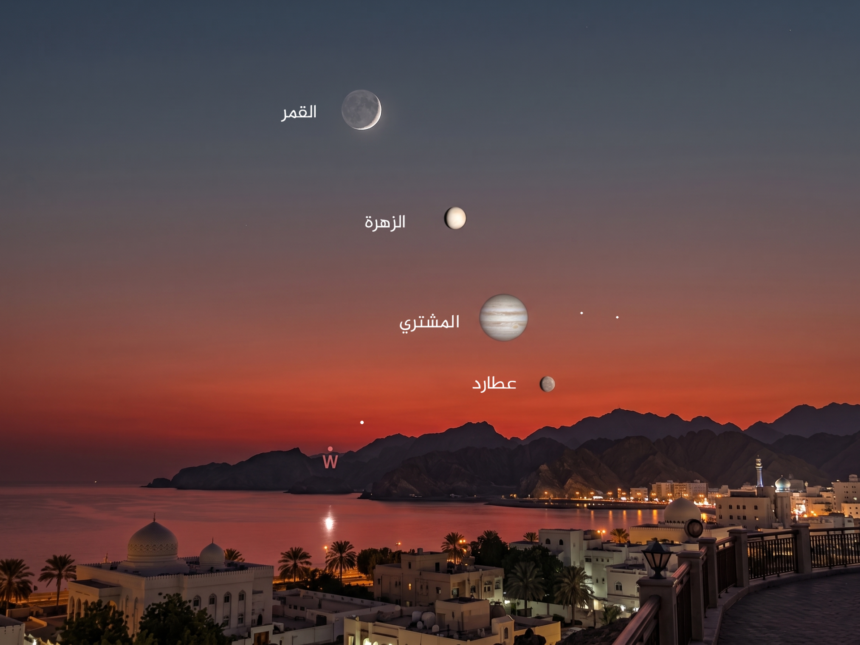
The period from June 16 to 18 witnesses the appearance of the planets Venus, Jupiter, and Mercury in a relatively small area of the sky, with the moon passing near them, forming an attractive celestial painting that can be easily followed after sunset.

In a statement to Al Jazeera Net, astronomer Ibrahim Al Mahrouqi, Vice President of the Omani Society for Astronomy and Space, said that this event is sometimes described as a “planetary alignment,” but it is in fact an optical astronomical gathering resulting from the effect of geometric perspective, as the objects do not lie on a single straight line in space, but rather appear close when viewed from Earth.
This type of astronomical phenomenon is one of the most popular events among the public, because it brings together several very bright objects in a limited area of the sky, making it easy to observe them with the naked eye without the need for specialized equipment.
Jupiter, Venus, Mercury and the Moon in a cosmic procession
The celestial show begins, as the astronomer Al-Mahrouqi says, about 30 to 60 minutes after sunset, when the thin crescent of the moon appears on the western horizon alongside the low planet Mercury near the horizon, while the planets Venus and Jupiter appear in the same patch of sky.
He added that the locations of the objects will gradually change from one night to another during the period from June 16 to 18, leaving observers with a renewed celestial painting that brings together four of the brightest objects in the sky in one scene.
With the arrival of evening, the crescent of Muharram 1448 AH adorns this scene, completing what is known as the “Planet Parade,” where several planets appear close together in a small patch of sky.

Al-Mahrouqi points out that this phenomenon represents a golden opportunity for astrophotographers and amateurs, especially with the possibility of photographing the four objects within one frame, and incorporating terrestrial elements such as mountains, towers, or coasts to add an aesthetic dimension to the images, especially with the appearance of Earth’s glow on the dark part of the moon, which gives the scene more visual charm.
The importance of the event is not limited only to its visual beauty, but it also represents an important educational opportunity that helps the public learn about the positions of the planets and their apparent movement in the sky, and understand the nature of the phenomenon of planetary alignment away from common misconceptions.
The astronomer Al-Mahrouqi concludes that this prominent optical gathering lasts for three main days, from June 16 to 18, while the clarity of the summer skies in many regions enhances the chances of observing it clearly, which makes the current days among the best times to follow one of the most beautiful astronomical shows of the year.
Heaven is an open book to everyone
These recurring astronomical phenomena reveal that the sky is still capable of inspiring people and arousing their curiosity, despite tremendous scientific progress. Every conjunction or planetary procession reminds us that we are part of a vast universe in which objects move according to precise and harmonious laws.

Perhaps the true value of such events lies in their ability to bring people together around a common passion for knowledge and discovery, and to push new generations to raise their eyes to the sky, question and search. Science often begins with a simple question, and a fleeting glance at this beautiful celestial display may be the beginning of a long journey toward a deeper understanding of the universe and our place in it.