Published on 6/17/2026
Rising inflation and a 30% jump in oil prices are slowing global growth, but leaders of the world’s largest economies are unlikely to blame US President Donald Trump for the war-induced slowdown when they meet in France to discuss economic files on Wednesday.
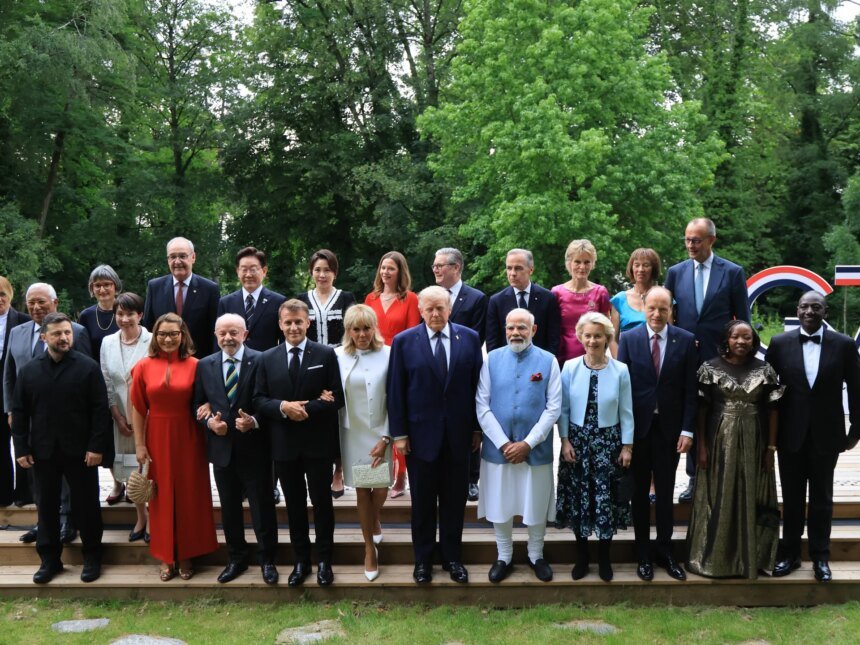
The G7 summit will be held from June 15 to 17 in the French resort of Evian-les-Bains overlooking Lake Geneva.
Today, Wednesday, leaders will also focus on critical minerals and global economic imbalances.
Leaders of the Group of Seven major industrialized nations, already hurt by US tariffs and disputes over NATO and Greenland, publicly criticized Trump’s decision not to consult with them before the US-Israel launched war on Iran in late February and warned of the potential economic fallout.
The United States and Iran announced over the weekend that they had reached an agreement to stop the conflict and open the Strait of Hormuz, which led to a state of optimism in global markets.
But the impact of the war on the global economy has become clear. It has led to a sharp rise in energy prices, renewed inflationary pressures, and raised fears of a major food crisis in developing countries.
Central banks have tightened monetary policy, with the European Central Bank and the Bank of Japan raising interest rates last week to avoid a harsher inflation blow.
British Prime Minister Keir Starmer expressed his dissatisfaction with the impact of the war on energy costs, and Italian Prime Minister Giorgia Meloni warned of the economic and social repercussions of the war.
The rise in prices also led to a decline in the popularity of Starmer, German Chancellor Friedrich Merz, and French President Emmanuel Macron.

But the leaders largely ignored the debate over the economic fallout from the war during a G7 meeting this week, given their desire to avoid a clash with Trump, whose cooperation they need on many issues including Ukraine, NATO and trade.
The result, analysts say, is that the G7, which emerged out of the 1973 oil crisis to help manage economic crises, is now avoiding the world’s biggest economic challenge, which could lead to its decline in importance.
Marcelo Estevao, chief economist at the Institute of International Finance, said: “US policies are harming global economic activity.”
“You have a country with the largest economy undermining what could have been a cooperation agenda for the G7,” he added, noting that the group’s leaders need to enhance its importance at a time when emerging market economies, which are not part of the group, represent a larger share of the global economy.
Avoid stress
France, as this year’s chair of the group, is keen to avoid any confrontations, and has pre-emptively canceled any attempt to issue a broad final statement or closing statement, focusing instead on announcements on narrower issues.
on a range such as global imbalances, critical mineral supply chains, and shifting development aid to more investment-oriented programmes.
But the prospects for confrontation have diminished given the temporary agreement concluded by American and Iranian officials just before Trump headed to France.
Economists believe that the agreement bodes well for the global economy, but they warn of serious risks if the agreement fails and the severity of the crisis escalates again.
They added that it would take months, if not longer, for trade flows to return to normal. Analysts in the fuel sector and experts in the maritime transport sector say that it may take a year for ship fuel supplies to return to normal.
andIn a blog post I published Monday The head of the International Monetary Fund expressed Kristalina Georgieva –which joined To the G7 leaders in France – about her optimism After reaching the agreement, she retracted her severe warnings Which I launched two months ago.
She said that the global economy is coherent so far, and there are no signs of a global slowdown despite the major repercussions on various regions.

The International Monetary Fund, of which the United States is the largest contributor, will issue updated global forecasts on July 8.
Georgieva’s blog post – which came days after more pessimistic forecasts by the World Bank – indicated that the Fund might settle for the least of the three worst scenarios, one of which assumed a short-term war with Iran and expected growth of 3.1% in 2026, down from 3.4% in 2025, while its worst scenario showed growth declining to only 2%, with inflation reaching 5.8%.
US officials noted that oil prices had fallen from their peak and that the United States, as a fuel exporter, was protected from worse price increases.
They say that the impact of the war on the global economy should decline quickly once the Strait of Hormuz is opened. Sources familiar with the Trump administration’s thinking said that the United States believes that even Europe, a fuel importer, is likely to avoid an imminent fuel shortage.
Doubts about the viability of the group
The group, whose members include major European economies in addition to the United States, Canada and Japan, faces questions about its importance in light of the growth of developing economies such as India, Brazil and China.
The Center for Strategic and International Studies notes that this economic bloc now represents only 44.1% of global GDP, down from 60.5% when it was launched.
But participants say the G7 remains useful when crises strike, such as the 2008-2009 global financial crisis.
“The G7 has been able, if necessary, to reach some real decisions that still govern half of the global economy,” said Martin Molleisen, former head of the IMF’s Strategy, Policy and Review Department, who has participated in previous summits including some attended by Trump.
He added that European leaders will be cautious during highly organized events, but tension is still possible during individual meetings and during meals.
For his part, Eric LeCompte, executive director of the US Jubilee Network, a development group, said that economic issues remained a top priority despite the peace agreement and low fuel prices.
“The economy is in great turmoil, and you don’t have to be in a developing country to see it. You can just go to a grocery store and feel it,” he added.