Published on 6/17/2026
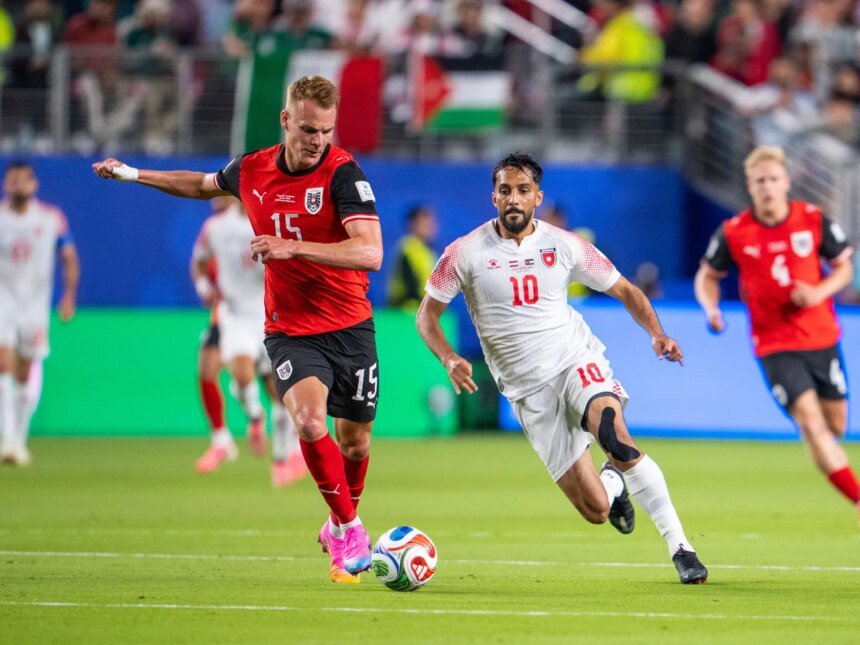
A good version began with the Jordanian national team against Austria in the first “Nashama” match in the 2026 World Cup, under the command of Moroccan coach Jamal Al-Salami.
The Jordanians succeeded in outperforming the Austrians in many stages of the match, with Al-Salami relying on a 3-4-3 formation, which in some offensive situations turns into 4-3-3, with the stability of the attacking trio of Musa Al-Taamari and Odeh Al-Fakhouri, and a more advanced position for the scorer Ali Alwan.
Read also
list of 2 itemsend of list
The Jordanians appeared more dangerous, more ferocious, and more capable of creating spaces in the back of the Austrian defence, and they posed a threat throughout the first half, in which they conceded the first goal via a shot from outside the area, during which the pressure may not have been as intense as required.
At the beginning of the second half, Austrian national team coach Ralf Rangnick brought on the historic Austrian football striker, Marko Arnautovic, who contributed greatly in pushing the ball towards the Jordanian defensive areas.
Jordan weapon transformations
While Al-Salami relied mainly on quick transitions as an offensive strategy, and through the speed of Al-Fakhouri and Al-Taamari, he tried to exploit the weight of movement and the breadth of the spaces of the defense elements and the Austrian midfield in the defensive situation.
Through that strategy, he had what he wanted in the second half, through an attack led by Ali Alwan, who can play on the wings, and is sometimes used as a guard in the presence of Yazan Al-Naimat, who was absent due to injury. He was able to run with the ball a distance of more than 50 metres, then adjusted his body position and fired an unblockable, unanswerable shot that the Austrian goalkeeper was unable to deal with, only to see it land in his net.

Jordanian calm…and Austrian momentum
After Jordan’s goal, it seemed clear that Al-Taamari’s teammates had calmed down a lot regarding offensive activity, and in the 60th minute, Rangnick made three active substitutions, which contributed greatly to moving the ball to Jordan’s court, and posed a great threat to the Jordanian defense.
Austria had the momentum it wanted, and succeeded in scoring through Arnautovic through a goal that was disallowed due to video technology, but the goal was more like a clear warning bell to coach Al-Salami that there was an intervention that had to be made.
After canceling the goal, Al-Salami actually made his first substitution in the Al-Nashama lineup, when he brought on Salim Obaid instead of Muhammad Abu Al-Nada to revitalize the Jordanians’ defense line.
This was of no use as the Austrian momentum continued, and it became clear that Rangnick’s substitutions aimed to create danger through set-pieces, and the Jordanians received the second goal from friendly fire, as Yazan Al-Arab diverted the ball into Yazid Abu Laila’s goal.

Salami is late
During the minutes after the goal, the physical factor played a decisive role in the Austrian superiority, and it appeared that the Jordanians had exhausted a lot of their energy during the beginning of the half during the period of trying to achieve the equalizer, and here Al-Salami had to intervene with refresher substitutions, but they were clearly delayed, resulting in Austrian possession that was evident in the last 15 minutes of the match.

Al-Salami’s substitutions were delayed until the 87th minute, and perhaps the option of abandoning Al-Fakhouri and Al-Taamari at the same time was a gamble to activate the attack while the Jordanians needed an equalizer.
While bringing in Ali Azaizeh, the one who made incursions and strong shots, was logical, bringing in Muhammad Al-Daoud was a bit strange in light of the search for real offensive momentum that would lead Al-Nashama to a draw.
In fact, in the end, Jordan conceded the third from a penalty kick executed by Arnautovic, so the match ended with a score that did not reflect its context (3-1).
In the end, Jordan failed to create the desired threat, and the Austrians won the match of concentration in the first half, and the match of physical struggle in the second half, which are aspects that the Jordanians will certainly gain with successive participations.