Published on 6/15/2026
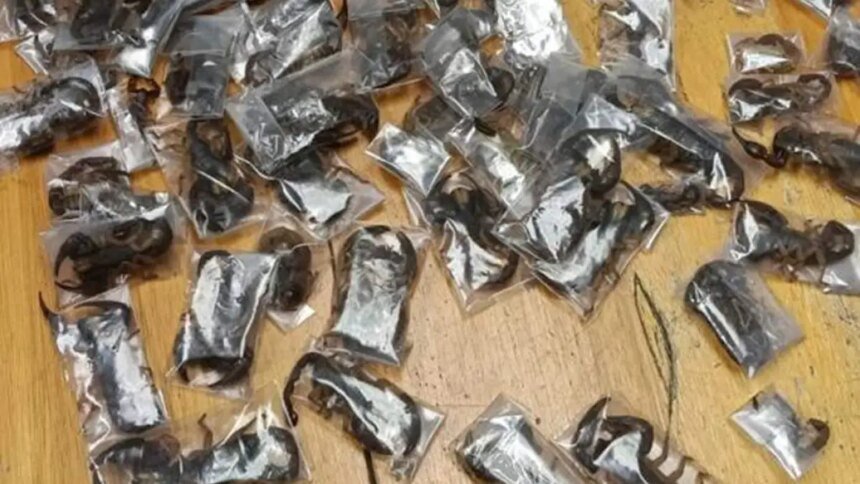
Police in South Africa announced the arrest of a 28-year-old man at Cape Town International Airport, after 150 live scorpions were found hidden among his clothes inside his two bags, in an operation described as a security operation based on intelligence information.
According to police spokesman Sergeant Wesley Twigg, the arrest took place last Friday, in a joint operation between the Quails River Police Livestock and Endangered Species Unit, the Good Cape Humane Society, and the Cape Nature Conservation Service.
The police explained that the man was arrested under the “Environmental and Nature Conservation Decree” on charges of illegal possession of wild animals, and that he will appear before the Belleville District Court on Monday. The authorities have not yet determined the financial value of the confiscated scorpions.
For its part, the Good Cape Animal Welfare Society confirmed that the scorpions were transferred to a safe facility where they are being secured, adding in a statement that it “will continue to work closely with the police and the Cape Nature Authority to ensure that they receive appropriate care, and arrange for their return to their origin whenever possible.” The association described the illegal wildlife trade as “a cruel and illegal trade that causes suffering to animals and threatens biodiversity,” praising the rapid action of the police and the Cape Nature Commission in “preventing the disappearance of these animals as part of the illegal wildlife trade.”
Similar incidents on the continent
The Cape Town incident is not the first of its kind in Africa. Last April, Jomo Kenyatta International Airport in Nairobi, Kenya, witnessed an attempt to smuggle more than 2,000 “garden ants” out of the country, at a time when the Kenya Wildlife Authority had previously warned of the increasing demand for this type of ants in Europe and Asia for use as “exotic” pets.
Previously, in 2025, four people were sentenced after smuggling more than 5,000 ants from Kenya. They pleaded guilty to the crime of illegal possession and smuggling of wildlife under the Wildlife Conservation and Management Act of 2013, and were sentenced to pay a fine of $7,700 or 12 months in prison.

Anti-smuggling efforts in South Africa
The Cape Town incident comes at a time when South Africa continues to implement the National Integrated Strategy to Combat Wildlife Trafficking. The Ministry of Forestry, Fisheries and Environment announced last February that the number of cases of rhino poaching declined by 16% during the year 2025 compared to 2024, after the number of animals killed decreased from 420 to 352 heads, according to Minister Willie Ocamp, who attributed this decline to “dedication and rapid tactical coordination” among the concerned authorities.
South Africa also participated in Operation Thunder 2025, a global operation to combat animal and plant crime organized by Interpol and the World Customs Organization during September and October 2025, which resulted in arrests that included the seizure of pangolins in several provinces, and the seizure of quantities of smuggled abalone shellfish and succulent plants. In December 2025, the authorities, in a joint operation with Singapore, seized 17 rhino horns and a quantity of lion and tiger bones in a warehouse in the city of Kimpton Park, and arrested two people of Nigerian nationality in connection with the case.