IN JANUARY 1969, the Greek artist known as Takis walked into a gallery in New York’s Museum of Modern Art, picked up his electromagnetic “Télésculpture” (1960-62) and carried it outside. The exhibition he was part of, “The Machine as Seen at the End of the Mechanical Age,” broke some new ground — it included a work on video, a first for the institution — but was mostly uncontroversial, with familiar work by Marcel Duchamp, Robert Rauschenberg and Leonardo da Vinci, whose sketches for his proposed “ornithopter” flying machine were on display. Takis insisted that his own contribution, a simple construction of suspended forms animated by an electromagnet, which MoMA had acquired for its collection seven years earlier, no longer reflected his practice; by that point, his art had become more baroque and technologically advanced (often involving hydrodynamics). But his main objection was that “Télé-sculpture” was being exhibited without his permission — a standard practice, then and now. Takis headed out the door, where the artist’s associates formed a circle around the sculpture, holding it hostage until the museum agreed to remove it from view.
In removing “Télésculpture” from the show, Takis, who grew up in Greece during the Nazi occupation and was jailed for resistance activities, began a conversation about the rights artists have (or don’t have) in the art business. Following this first action at MoMA, Takis and some peers formed a loose group, calling themselves, with a bit of proletarian flourish, the Art Workers’ Coalition. Early members included the artists Hans Haacke and Carl Andre, the curators Lucy Lippard and Willoughby Sharp, and the Village Voice art critic John Perreault. Their main concern was the museum’s responsibility to artists, which at that point was close to zero. Like most institutions, MoMA considered its right of property to supersede the whims of artists. As performative as Takis’s gesture may have been, it was the first modern challenge to that dynamic, a fitting salvo for a group that was utopian, prone to agitprop and, perhaps in its sheer impractical idealism, bound to fail.
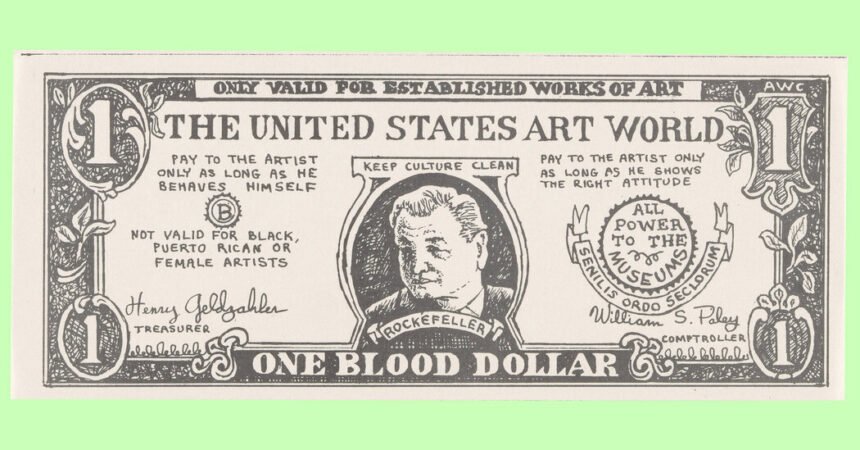
Three weeks after Takis’s initial incursion, the AWC presented MoMA with a list of reforms to what they considered “stagnant policies.” Among their demands were a section of the museum dedicated to Black (and, in a later, amended statement, Puerto Rican) artists, an artist committee granted curatorial power, a “rental fee” paid to artists for the exhibition of their work and free admission for all. When they were rebuffed, they called their first public assembly, at Manhattan’s School of the Visual Arts , at which art workers were invited to “testify.” Among the hundreds who did were some of the major artists of the day, like Sol LeWitt, Faith Ringgold and Lee Lozano.
MoMA was the focus of the AWC’s ire, but the series of polemics that participants delivered formed a wide-ranging critique of the art world. Lozano, whose extreme performance pieces eventually included one where she refused to socialize with dealers or attend events, said she wouldn’t call herself “an art worker but rather an art dreamer and I will participate only in a total revolution simultaneously personal and public.” Haacke, a conceptual artist whose work from the 1970s onward would often look critically at the behind-the-scenes power of museums and galleries, likened MoMA to a mausoleum and its curatorial judgment to that of “the stamp collector’s mind”; he argued for a radical decentralization of the museum away from the “fashionable Midtown ghetto” and into all areas of the city. Andre, a minimalist sculptor, went further, convinced that “the solution to the artist’s problems is not getting rid of the turnstiles … but getting rid of the art world” entirely: “For the most part museum people are hopeless and always will be hopeless,” he said, “and it is best for artists to simply pay them no mind.” Mark Di Suvero, known for his towering metal sculptures, many of them in public areas, summed up his cohort’s position more succinctly: “The trouble is … the museum doesn’t care about us.”
The AWC was animated by the atmosphere of the 1960s, pulling in the tumult of its time — racism, sexism, abortion rights, Vietnam. The group is best remembered for its political activism, pressuring museums into taking a moral stance on the Vietnam War. Its most indelible byproduct was the brutal 1970 poster “Q: And babies? A: And babies,” which showed dead Vietnamese civilians murdered in the 1968 My Lai massacre and included an excerpt from a “60 Minutes” interview between journalist Mike Wallace and U.S. soldier Paul Meadlo, whom Wallace questioned about the people he’d killed. As a kind of olive branch, MoMA’s Executive Staff Committee initially agreed to fund and distribute the poster, but reneged after dissent from the board of trustees, which included New York Governor, Nelson Rockefeller — a staunch supporter of the Vietnam War — and William S. Paley, the head of CBS. So the AWC staged a protest in the museum, holding copies of the poster in front of Picasso’s 1937 antiwar painting “Guernica.” (Ironically, “And babies” is now in MoMA’s permanent collection.)
THE AWC envisioned a better life for artists — one that wasn’t as beholden to wealthy collectors and institutional gatekeepers — anticipating the kinds of debates that would roil the art world in the years to come. The echo of the group’s righteous rage lingers. It could be heard in 2019, when artists demanded their work be removed from that year’s Whitney Biennial in protest of the weapons manufacturer Warren Kanders, then on the Whitney’s board; in the die-ins staged at the Met and Guggenheim by Nan Goldin’s PAIN (Prescription Addiction Intervention Now), which the artist founded in 2017 to protest cultural institutions taking money from the Sackler family, whose Purdue Pharma marketed the highly addictive drug Oxycontin. As forms of dissent, the AWC’s actions varied in efficacy, but they made visible the hidden disconnect between the creative class and the money that keeps it running — and by doing so suggested that gulf was one that artists and an art-viewing public didn’t have to accept.
And yet, at a time when artists are still trying to navigate how the art business functions — and when visual art, unlike every other creative field, largely denies artists any kind of residuals from the resale of their work, the AWC’s most meaningful legacy might be less in its agitation for social justice or its attempts on influencing institutional behavior than in its ideas about equity. Members considered various forms of wealth distribution: Di Suvero, for instance, proposed a tax on the resale of work by deceased artists that could be disbursed to living artists in need. The idea of a basic annual income was batted around. More concrete was the Artist’s Reserved Rights Transfer and Sale Agreement, a sales contract worked up by Seth Siegelaub, a dealer who organized early Conceptual art exhibitions, and Robert Projansky, a lawyer, that sought to give artists a perpetual stake in the value of their work. It called for a 15 percent royalty fee on resale profit, artist approval of loans of their work to any institutions, and the right of an artist to know who purchased a piece of theirs (perhaps the most radical provision, as art buyers often insist on anonymity, a practice that’s only become more opaque as prices have risen.)
The Projansky contract, as it’s sometimes called, was impossible to enforce, and as the art market swelled in the ’80s, it quickly became a historical artifact. (Haacke continues to use it in the sale of his work.) Though it was arguably intended less as a practicable document than a kind of conceptual artwork, it’s had a long afterlife among people imagining a different model for buying, selling and exhibiting art. Collectors like Kasseem Dean, the hip-hop producer better known as Swizz Beatz, have lobbied for a 5 percent cut of auction house profits to go to the artist whose work is being sold on the secondary market, proposing a deal similar to those in the music industry. (If this was more of a kindness than parity, it was also, as Dean noted, an improvement. “If it’s 5 percent, if it’s 10 percent, it’s 100 percent more than what they getting now,” Dean said in 2023.) Agencies like ICNCLST, which represents the artists Futura and Nina Chanel Abney,;and art[cc]corp, which represents Sara Cwynar and Jacolby Satterwhite, now operate similarly to the entertainment industry, shepherding artists through lucrative brand deals and negotiating terms on their behalf. If you squint, these developments look like an extension of the framework AWC proposed 60 years ago.
The AWC was short-lived, lasting just two years before the collective splintered into different groups and then disappeared altogether. Its direct successes were slight. Its biggest triumph may be most visible at MoMA on Friday evenings, when the museum stays open a few hours later and the line for free admission snakes around Fifth Avenue, a practice many other museums have adopted in some form. When the price of admission has increased to $30, a free night can feel like a begrudging concession.
Artists are still an economic class with a few at the top and most at the bottom. And for those at the bottom, it’s only become more difficult to be an artist: harder to find studio space or make rent without a day job; harder to find representation among a dwindling midsize gallery network. Not many artists bought into Andre’s anarchic utopian vision to fully jettison anything resembling a “scene,” but in many respects he was right: AWC’s proposals didn’t go far enough. Yet for all its flaws, the group offered a glimpse of something better — an art world, if not freed from capitalism, then at least on more level footing with it.