Gaza- The Palestinian young man and former prisoner, Abdul Latif Helles (19 years old), found in the courtyard of the Negev prison something that relieved him of the cruelty of captivity, when a small bird approached him, crossing the walls and barbed wire, to open within himself a door that the prisons were unable to close.
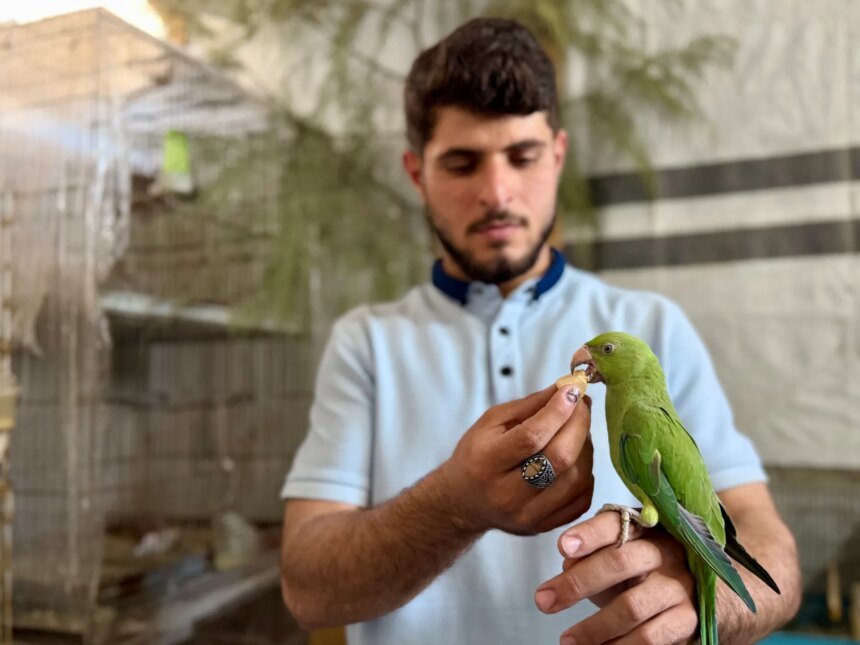
Before his capture, Abdul Latif was an amateur and breeder of birds. He knows their temperament as an old breeder knows the temperament of his birds, and distinguishes the anxiety in their movement, the tranquility in their standing, and the light call in the flutter of their wings.
In the prison yard, the minutes of the “frenzy” passed as if it were a temporary life. The prisoners went out to eat the food allotted to them for the whole day: a few crumbs or a handful of rice, each one of them carrying his fatigue, his silence, and what remained of his strength.
There, the bird approached a small outer opening, and stood close to Abdul Latif. At that moment, it seemed to him like a small guest carrying something of the vastness of the sky into that narrow place.
He offered him some of his little food, and he chose to leave room for his hunger in his body, so that he could fill his eyes with the sight of the bird eating. Since that day, he has been waiting for the moment as he waits for a dear date.
The square turned from concrete, iron, and guarding into a meeting place. The bird returned, then others returned with it, and the minutes in Abdul Latif’s heart grew longer the more wings around him.

A bird relieves the pain of prison
Abdul Latif says – to Al Jazeera Net – as he recalls the scene with a look of mixed pain and astonishment: “I was subjected to severe torture, severe beatings, and physical and psychological pressure. Then I started meeting birds in the square, and all of that was easy for me before the idea of meeting them.”
He speaks as if those birds were still hovering before him; He describes it with the amazement of a breeder who knows the value of getting close. Wild birds, he says, usually maintain their cautious distance from humans, while yard birds became accustomed to captives and approached them to zero distance.
In that small distance, Abdul Latif was regaining his old home and returning to him its cages, the sounds of its birds, the breeding seasons, and the joy of the breeder when he sees a new bird come to life, as if the prison birds carried to him all the birds that he had raised one day, and gathered in their wings the meaning of freedom, humanity, and survival.
After his release from prison, he returned to the birds as if he were returning to a part of himself on his small farm. The cages were lined up on the walls in a modest space built with simple materials.
In this place, birds regain their first meaning to him; As companionship, memory, and an extension of a story that began in the arena of captivity, when the bird opened a window to freedom.
Here, among the tired cages and the few birds, Abdul Latif is trying to restore his relationship with life again, one bird after another.

Elaine in bird form
From Asfour Abdul Latif, the story extends to other prisoners who found a window inside the walls in the birds. Also in Negev Prison, Hassan Al-Mughrabi (33 years old) was experiencing postponed fatherhood. He was captured by Israeli occupation soldiers and his wife was waiting for their baby girl. They had chosen the name “Eileen” for their baby girl, so he began counting the days, day after day, until the date when he imagined her coming into the world.
On that particular day, he was sitting in the prison yard after long torture at the hands of the occupation army, his body heavy, motionless, eyes closed, trying to catch his breath.
While he was immersed in his pain, he felt a slight movement near his feet, so he slowly opened his eyes, and found a small bird chick standing next to him, as if he had reached the most broken place inside him.
In Hassan’s memory, the presence of birds turned into small family news inside the prison. Whenever the birds approached the square, he would call his friend: “Eileen has come, Ahmed, come.” He saw in the little chick a picture of his first daughter, whose features he did not know yet, and he named him Eileen.
Hassan says to Al Jazeera Net: “I wish I knew where she was, how and where she was born, and what she looked like.. I was imagining her features while I was in prison.” Therefore, the bird became his only way to Elaine, and his way to fill the void of postponed fatherhood.
The day came when Hassan was released after two years of imprisonment, and he added that he had imagined his daughter as very young, but she received him at the age of two years, and his grief was gone, but it was still painful in his soul that she called her father “uncle” and not “dad.”

Loss of ornamental birds
What Abdul Latif and Hassan found in the prison bird, many bird breeders in Gaza lost during the war. Birds, which were a source of livelihood, a hobby, and daily companionship for thousands of Gazans, were affected by the effects of genocide. Most of them died under bombing, siege, and displacement, their markets and farms were damaged, and rare species that formed part of the breeders’ memories and lives disappeared.
Over the course of about 15 years, breeder Muhammad Al-Sourani has accumulated his name in the ornamental bird market in Gaza, as a producer, seller, and contributor to the movement of this sector. His birds were known by small rings placed on their feet bearing his name, as if it were a special signature that accompanied every bird that left his farm after long care and careful selection. Over time, raising birds for him turned from a livelihood project into a very close daily relationship, which he describes as a spirit that accompanies him.
Five days before the war, Al-Sourani bought birds worth $12,000 to develop his farm. Then the war came to demolish what he had built over the years. The birds that were with him in the displacement tent died due to the heat, and his birds that remained in Gaza died after his house was bombed and deprived of food. His loss is estimated at about 85 thousand dollars, after he owned a farm that included 70 pairs of birds and a store that included all bird supplies.
Speaking to Al Jazeera Net, the Palestinian citizen describes the loss of his birds as if he lost a member of his family, and says that he entered a state of sadness and brokenness that lasted for two months. After the collapse of his business, he bought 6 pairs of birds today to maintain his closeness to them and continue his connection to them, and he confirms that raising birds is part of his soul, and that he will remain attached to them no matter how circumstances change.
His experience reveals the extent of the transformation that befell the bird market in Gaza. He owned a store in the middle of the Strip with an area approximately 10 meters long and 6 meters wide, with an annual rental value of 4,000 Jordanian dinars (about 5,660 dollars), despite the simplicity of the place, which resembled a “house of stairs.” Today, he sits in a small shop whose area does not exceed 3 meters by 2 metres, with an annual rent of up to $5,000, in an irony that sums up the harshness of the market after the war.
The gap also appears in the prices of the birds themselves; Al-Duwairi (Al-Douri) pies, which were previously sold for approximately 15 shekels (about 5 dollars), have today reached 350 shekels (about 119 dollars). The price of a pair of lovebirds rose from 50 shekels (17 dollars) to 400 shekels (about 136 dollars).
As for a pair of cocktails, their price jumped from 100 shekels ($34) to between 300 and 800 shekels (between 102 and 272 dollars).

Rare breeds are disappearing
Baher Akila, director of the Palestinian Bird Society in Gaza and a breed expert, estimates that only about 10% of ornamental birds remain in the Strip compared to what existed before the war of extermination. Behind this percentage hides the loss of an entire market, small projects that supported families, and rare breeds whose production required years of experience, care, and knowledge exchange between breeders.
But the war hit this sector hard; The market lost breeders and producers, including martyrs, displaced people, and those affected. Farms and cages were damaged, and the exchange of experiences stopped, while many sources of income collapsed.
In his statement to Al Jazeera Net, Akila estimates the losses at hundreds of thousands of shekels, while the losses of some large farms ranged between 50 and 100 thousand dollars.
Rare breeds have also disappeared or declined severely, such as: the African parrot, the cockatoo, the macaw, the Amazonian parrot, the casco, the rosella, the Indian ruffed bird, and others. These are birds of high production and material value, and their loss was a severe blow to breeders.
Akila attributes the death of birds and the decline in their numbers to the severe Israeli bombing, displacement, siege, lack of food and veterinary medicine, and high costs of care. During the famine, bird grains were used as food for humans, depriving sensitive species of their basic needs and leading to the death of large numbers of them.
He confirms that raising birds today has become more difficult and expensive due to the destruction, high prices of food and medicine, and the decline in the financial capabilities of breeders. Thus, the ornamental bird market in Gaza turned into a witness to a loss that affected people, their sources of livelihood, and their small creatures together.