Rethinking society requires imagination. Below are ten American movements from different eras of the country’s history and the defining works of art they produced.
1. The Shakers
When the Shakers (so called for their fits of religious ecstasy) arrived in the United States from England in 1774, their belief in utility led them to construct uncluttered dwellings and simple, functional furniture. Charles Dickens wasn’t a fan. “We walked into a grim room, where several grim hats were hanging on grim pegs,” he wrote in 1842 after visiting the Christian sect’s settlement in Mt. Lebanon, N.Y. But what Dickens found austere, others have celebrated as pioneering expressions of the “form follows function” ethos that modernist designers would espouse decades later. For the Shakers, who believed in racial and gender equality, collective property and strict celibacy, the simplicity of their homes and ladder-back chairs was an extension of their faith. They were hardly the only group rethinking gender roles, labor and religion in the 19th century, when dozens of utopian communities sprang up across the country, but they were among the most successful. At the group’s peak in the 1840s, an estimated 6,000 Shakers lived in 60 agrarian settlements from Maine to Indiana. Because they were celibate and depended on conversion and adoption to gain new members, the Shakers declined in population as revivalism waned in the late 19th century. Shaker furniture, however, grew in admiration as factory-produced goods of worse quality sparked a greater appreciation for handmade crafts — much to the chagrin of some Shakers. “I almost expect to be remembered as a chair or a table,” a Shaker eldress known as Sister Mildred lamented in 1984.
2. The Arts and Crafts Movement
“The joy of a man in the work of his hands is not a mere passing satisfaction, but is an element in all sane life,” wrote the English craft enthusiast Ralph Radcliffe Whitehead in his 1903 essay “A Plea for Manual Work.” Whitehead, whose fortune came from industrial textile mills, was an ironic spokesman for the Arts and Crafts movement, a trans-Atlantic crusade to restore dignity to labor and reform society through thoughtful design. Nevertheless, he and his American wife, Jane Byrd McCall, founded a utopian community for artisans on 1,500 acres of farmland near Woodstock, N.Y., in 1902. At Byrdcliffe, residents could live in cottages and learn vanishing trades. Artisans enjoyed equal access to traditionally gendered crafts — women worked with metal and men wove at the loom. Other Arts and Crafts-related settlements began as hubs for social work. At Chicago’s Hull House, immigrants could take citizenship preparation classes, learn English or use the city’s first public playground. More entrepreneurial figures associated with the movement, such as Louis Comfort Tiffany and Frank Lloyd Wright, catered to elite clientele, while other compounds failed. By World War I, Byrdcliffe had become a relic: In 1915, one visitor found at Byrdcliffe only “the shell of a great life … all empty but for two or three lonely spinsters.” Today, the Woodstock Byrdcliffe Guild maintains the property as a center for the arts.
3. The Harlem Renaissance
In 1925, at the age of 26, the painter Aaron Douglas aspired to create nothing less than a new “art era” for African Americans. “Let’s bare our arms and plunge deep through laughter, through pain, through sorrow, through hope, through disappointment, into the very depths of the souls of our people,” he wrote to the poet Langston Hughes. “Then let’s sing it, dance it, write it, paint it. Let’s do the impossible.” Together with other artists, musicians and writers, Douglas and Hughes challenged racist stereotypes with fresh representations of Black culture and transformed Harlem into a cultural mecca. In geometric prints and prismatic oil paintings, Douglas depicted urbane, elegant figures radiating self-assurance as well as the perseverance of their forebears. In “Song of the Towers,” part of his four-panel series “Aspects of Negro Life” commissioned for the New York Public Library branch at 135th Street in 1934, ghoulish hands grasp at the legs of a man with a suitcase dashing up a mechanical gear, a symbol of the millions of people who fled the rural South for northern cities during the Great Migration. At the top of the gear, concentric halos of light frame an exultant saxophone player with the Statue of Liberty in the background. Today, the paintings still hang at the library, now part of the Schomburg Center for Research in Black Culture.
4. The W.P.A.
Thousands of down-and-out artists survived the Great Depression on salaries from the Works Progress Administration, the government-sponsored New Deal agency that funded roughly 108,000 easel paintings, 18,000 sculptures, 11,300 prints and 2,500 murals between 1935 and 1943. More than the volume of works, even, the range of projects is what made the program radical. In 1936, construction began on a white modernist bathhouse facing San Francisco Bay, with the sweeping curves and cowl vents of an ocean liner. The interior design for the building, described by the press as a “palace for the people,” was overseen by Hilaire Hiler, a color theorist who’d spent the 1920s in Paris playing jazz piano with a pet monkey on his shoulder. Hiler and his assistants painted sailfish, eels, octopuses and mythical creatures gliding among the ruins of Atlantis and Mu. A pink-haired mermaid with long, webbed fingers floats by what might be the skull of a sea monster. Ultimately the public was cheated out of its palace: Around the time the bathhouse opened in 1939, the city leased most of it to a group of businessmen, who opened a private casino there. Hiler and other artists resigned in protest, leaving parts of the bathhouse (now the San Francisco Maritime Museum) forever unfinished.
5. The Civil Rights Movement
A serene white woman with auburn hair smiles, eyes closed, as her Black husband turns to kiss her cheek. The scene might appear unremarkable, but when Faith Ringgold painted “Early Works #16: A Man Kissing His Wife” in 1964, interracial marriage was illegal in 19 states. (The Supreme Court wouldn’t declare such bans unconstitutional until 1967.) The Rev. Dr. Martin Luther King Jr. had outlined his dream for the country at the March on Washington the year before Ringgold made the work. With this small canvas measuring just a foot wide, she presented her own expansive vision of what a marriage, and with it an integrated society, could look like. Ringgold, who was born in Harlem in 1930, didn’t always paint utopian visions of a nation free of prejudice. She also depicted racial violence and subtler forms of intolerance. The civil rights leader Medgar Evers, President John F. Kennedy and four young girls in the 16th Street Baptist Church in Birmingham, Ala., were all killed as Ringgold worked on the series to which her married couple belongs. In these works, using a carefully chosen palette of crimson red, white and navy blue, she created portraits of a nation in the process of violent transformation.
6. The Counterculture
As a teenager in 1960s New York, Adrian Piper was a professed Beatnik steeped in Eastern philosophy and the mystical poems of Allen Ginsberg. “I listened to Joan Baez and Bob Dylan, learned to play the guitar, let my hair grow, wore black fishnet stockings,” Piper told an Italian newspaper in 2003. “Consciousness-expanding drug experiences came with the territory.” Piper, an African American woman with fair skin who is known for conceptual artworks addressing the social constructs of race and gender, took LSD about six times over a period of six months. In “Over the Edge,” her series of drawings and paintings inspired by those experiences, human bodies fracture, dissolve into mosaics and merge with kaleidoscopic webs of color. These represent some of Piper’s first attempts to express the gulf between the inner self and a culturally coded identity. “The paintings are very much about what it was like for me to go beyond the surfaces of things,” she said.
7. Second-Wave Feminism
In the fall of 1971, the artists Judy Chicago and Miriam Schapiro arrived at a derelict Hollywood mansion with 21 students from the California Institute of the Arts carrying hammers, ladders, mops and brooms. Over the next two months the group transformed the vacant property into “Womanhouse,” the first feminist art installation in the country. The rooms addressed women’s issues with a frankness rarely — if ever — seen in galleries and museums at the time. Chicago filled a wastebasket in a bright white bathroom with what looked like bloody red pads and tampons. Sandra Orgel transformed a linen closet into a kind of torture device by slicing a female mannequin into sections and wedging them between shelves stocked with crisply ironed bedsheets. Other students mounted performances when “Womanhouse” opened to the public, staging bawdy arguments over household chores or soberly enacting feats of domestic drudgery. Simply articulating such grim realities was a political gesture at a moment when feminists were securing landmark rights and protections. Congress passed Title IX of the Civil Rights Act banning sex-based discrimination in June 1972, not long after the end of the installation, which attracted roughly 10,000 people over its one-month run.
8. Afrofuturism
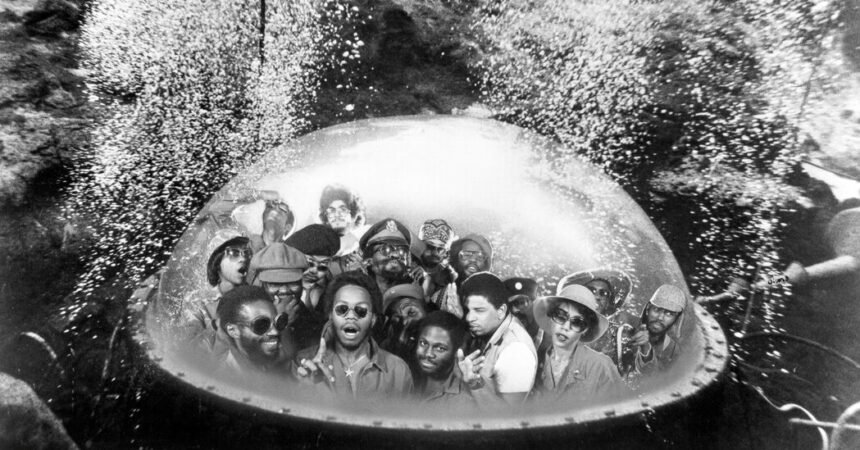
Fifty years ago, a spacecraft landed in New Orleans. “The Mothership,” a silver pyramid conceived as an intergalactic Cadillac by way of ancient Egypt, delivered Parliament-Funkadelic frontman George Clinton onstage during a concert at the Municipal Auditorium in October 1976. With “Mothership Connection,” the platinum-selling album released the previous year, Clinton had created a sci-fi universe complete with funky heroes (Starchild), outlandish villains (Sir Nose D’Voidoffunk) and mad scientists (Dr. Funkenstein). Clinton, who grew up during the space race watching “Star Trek,” presented the intergalactic as a realm of freedom and self-determination for Black Americans. “You have overcome, for I am here,” he sings in “Mothership Connection (Star Child),” the second track on the album. Clinton’s musical universe remains one of the most striking examples of Afrofuturism, as the decades-long tradition of speculative art, music and literature proposing alternative pasts and futures for African and diasporic cultures was termed in the ’90s. Although the original Mothership, which cost $500,000 to create, was sold in the early ’80s, a new model was built and later acquired by the National Museum of African American History and Culture, where it inspired the 2023 exhibition “Afrofuturism: A History of Black Futures.” Clinton, indefatigable at 84, will take a new Mothership with him onstage in New Orleans this summer.
9. L.G.B.T.Q. Rights
Two men in waist-high water kiss, their bodies cut from a single map of the world, at the center of a 1984 collage by David Wojnarowicz. The work’s title — “Fuck You Faggot Fucker” — came from a scrap of paper with a crude cartoon the artist found (the original is pasted below the couple). Elsewhere in the collage are black-and-white photographs showing Wojnarowicz and a friend, nude, inside an abandoned building in downtown New York; another depicts a former lover posing as St. Sebastian on one of the derelict piers in Lower Manhattan where gay men once cruised. At a time when sex was becoming a source of terror for people helpless to save their dying lovers and friends, Wojnarowicz created a fearless vision of intimacy. He’d rail against bigotry in many other artworks and essays until his death at 37 from AIDS-related illness in 1992. In this work, however, he deftly renders homophobia ridiculous — a flimsy bit of trash in an otherwise vivid and expansive world.
10. Climate Activism
In the 2013 book, “Hyperobjects: Philosophy and Ecology After the End of the World,” the philosopher Timothy Morton came up with the term “hyperobject” to describe phenomena so “massively distributed in time and space relative to humans” they defy comprehension. Climate change is a hyperobject, according to Morton, which is what makes it so difficult to combat. Rather than despair at the scope of our current environmental crisis, though, the artist Mary Mattingly creates works of art that double as pilot programs in how societies might rethink broken systems. In 2016, she docked “Swale,” a barge supporting a garden of edible plants, in the South Bronx for locals with otherwise limited access to fresh produce. Anyone could come and pick as many herbs, fruits and vegetables as they wanted. Foraging in city parks is illegal, but the monumental sculpture helped local advocates and Parks Department officials establish the Bronx River Foodway, the first parkland where foraging is permitted. A new incarnation of “Swale” called “Floating Garden” is slated to return to New York City later this year.