Published on 6/13/2026
The fighting in southern Lebanon is escalating at a rapid pace with the concentration of Israeli military operations in the vicinity of Nabatieh, where the occupation forces are trying to advance towards the strategic Ali al-Taher hill, in a move that observers see as a key to fiery control of the city and its surroundings, amid continued resistance from Hezbollah and evacuation warnings that included dozens of towns.
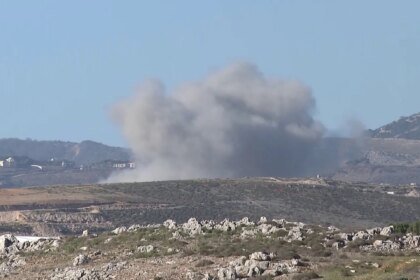
These developments come at a time when the Israeli army announced the interception of a drone that infiltrated from Lebanon into northern Israel, while Hezbollah spoke of targeting Israeli forces and military vehicles in more than one axis, coinciding with the continuation of raids on the areas of Nabatieh, Jezzine and Tyre.
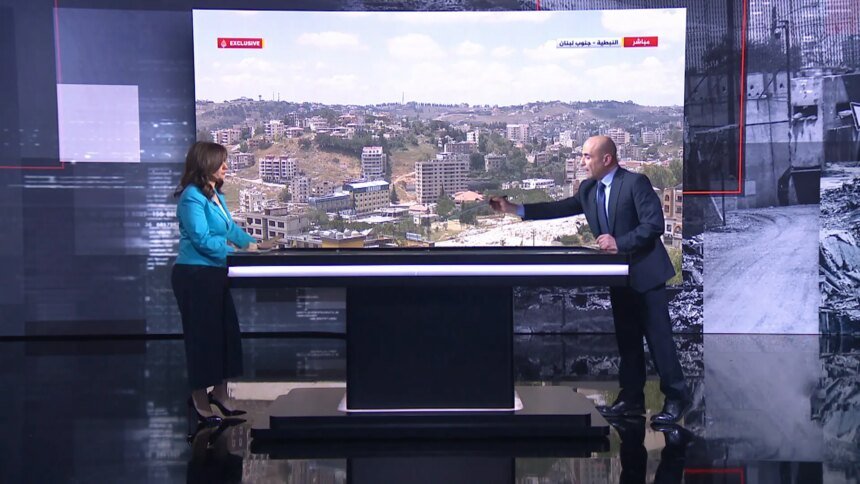
Colleague Mahmoud Al-Zebaq explained, via the interactive screen, that the current escalation is mainly centered in the Al-Tuffah region, which extends between the Nabatieh and Jezzine districts, where Israeli forces are seeking to expand the scope of their ground operations under heavy fire cover.
He pointed out that the occupation forces had previously tightened their control over the Beaufort Castle height, and are currently seeking to reach the Ali Al-Taher height, which rises about 700 meters and overlooks the city of Nabatieh and its surrounding villages, giving it exceptional strategic importance.
According to Al-Zaybak, controlling this height may allow Israel to expand its field supervision towards the eastern villages, all the way to the vicinity of Marjayoun, which makes the current battle directly linked to the future of Nabatieh and its geographical surroundings.
He also pointed out that the intense Israeli raids that targeted the towns of Kafr Rumman, Mahmoudiyah, Al-Rayhan, Kafarhouna, and Armati come within the framework of an attempt to impose fire superiority that precedes any ground movement towards the heights overlooking the city.
In parallel, the Israeli army issued warnings to evacuate 20 towns and villages between Nabatieh and Jezzine, while air strikes and artillery shelling continued in the region, an indication of preparations for a new field phase.
On the other hand, Hezbollah announced that it would confront Israeli attempts to advance in the vicinity of Majdal Zoun in southern Lebanon. It also confirmed that it had targeted Israeli military vehicles with attack drones, at a time when Israeli media reported about drones penetrating the northern airspace.
Key to the Battle of Nabatieh
In a military interpretation of the scene, the military and strategic expert, retired Brigadier General Khalil Gemayel, said that the occupation forces are currently stationed in the vicinity of Kafr Tibnit and are trying to advance gradually towards the Ali Al-Taher hill, which is the most prominent hill range overlooking Nabatieh.
Al-Jamil explained that the villages included in the evacuation warnings are all located within the scope of this axis, considering that this clearly reveals Israel’s intention to open the road towards the highland, which represents an essential field node in the Battle of Nabatieh.
The military expert believes that reaching Ali Al-Taher is not impossible, but it will be very costly, given the exposure of the advancing forces to being targeted by multiple sides, whether from Iqlim al-Tuffah or from the vicinity of Nabatieh and the neighboring highlands.
He added that the importance of the height does not lie only in its geographical location, but in its ability to give the occupation an advanced fire position that allows it to monitor large areas of southern Lebanon and support any subsequent operations towards the city.
In his estimation, Nabatieh represents more than just a city for Hezbollah, as it is an important moral and geographical center within the party’s environment, which makes the possibilities of confrontation within it more complex and fierce if the battles reach its outskirts.
Gemayel pointed out that the party does not leave its areas easily, and that the resistance facing the Israeli forces in the vicinity of Kafr Tibnit during the past days reflects an awareness of the importance of preventing the occupation from reaching the ruling heights overlooking the city.
He also linked the field escalation in Nabatieh to the increase in launching marches towards northern Israel, explaining that any additional Israeli approach to the city may push the party to expand the targeting circle to include deeper areas inside Galilee.
The military expert concludes that the battle of Nabatieh is not related to controlling a specific hill or town, but rather constitutes a decisive test for the balance of power in southern Lebanon, as the fall of Ali Al-Taher may open the way to a more dangerous phase of the confrontation, while the price of Israeli progress remains high in field calculations.