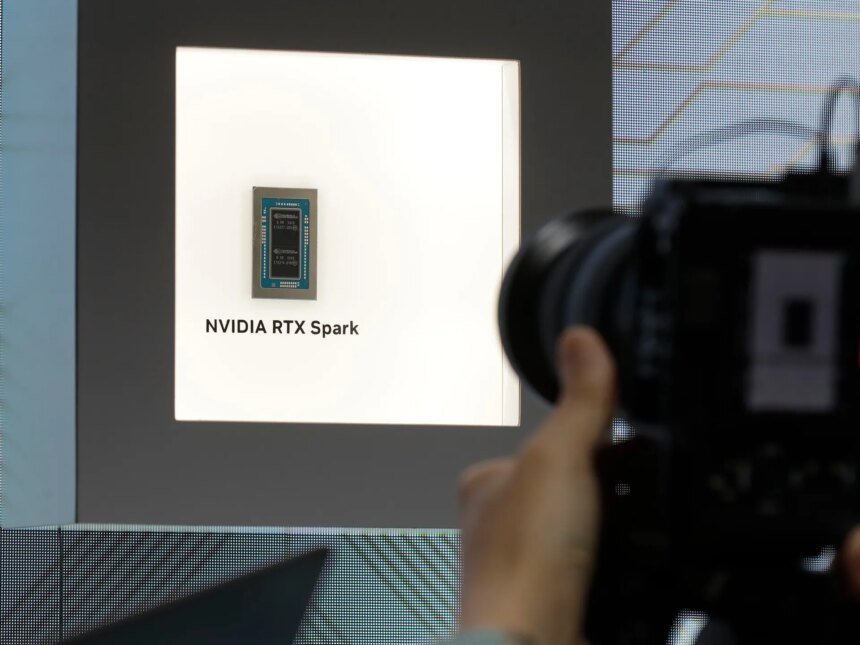
At the recent Computex exhibition in Taipei, NVIDIA announced its official entry into the personal computer market with the RTX Spark chip — a computer that performs tasks with commands and runs artificial intelligence models locally without the need for the cloud. But this same promise was made by HP, Dell, and Qualcomm three years ago and was met with consumer apathy and Wall Street skepticism. What makes Nvidia’s bet different this time, and will analysts accept it?
The American chip company Nvidia stole the spotlight at the recent Computex conference in Taiwan when it announced its official entry into the personal computer market with the integrated “RTX Spark” chip, which is built on the “ARM” architecture, which integrates the central processor chip, random memory, and graphics chip into one unit.
NVIDIA is betting on the capabilities of its new chip in the artificial intelligence sector, starting from running models locally without the need to pay expensive monthly subscriptions for companies to completing various tasks with commands and relying on artificial intelligence agent technologies.
However, this same promise was made by HP, Dell, and Qualcomm almost 3 years ago, and was faced with skepticism from both Wall Street and consumers, according to a Reuters report. These are the same skepticism that Nvidia faces now, so what makes its bet different this time?
Different technical strength
Nvidia has recently become the most valuable company in the world thanks to artificial intelligence technologies and the chips it manufactures and uses in various data centers, according to a report published by the New York Times. Therefore, what the company is trying to do through the RTX Spark chips is not fundamentally different from what it has done over the past years.
The main difference between Nvidia’s previous chips for artificial intelligence technologies and the “RTX Spark” chip lies in the target audience of each chip. While it previously sold its chips to data centers and the companies responsible for them, it is now trying to sell them to users in their homes.
The technical similarity between both types of chips provided by Nvidia is that the RTX Spark chip is a reduced version of another chip with the same name that was issued to data centers in recent years.
Nvidia’s experience in the artificial intelligence chipset sector constitutes the main factor that the company is betting on to succeed where others have failed over the past years. The idea of a computer dedicated to artificial intelligence is not the product of Nvidia’s conferences, and Microsoft has previously tried to do it with several chips from Intel to Qualcomm.
At its core, the RTX Spark chip has a pivotal difference from the rest of the processor chips, as it belongs to the category of integrated chips that carry a central processor, a graphics processor, and a unified memory of up to 128 GB in the highest category of chips. These are technical specifications that make it suitable for running artificial intelligence models locally, as well as the ability to operate and manufacture artificial intelligence agents, according to a report by the American technology company “Spaceworks.”
What makes Nvidia’s bet different?
In announcing the new chips, NVIDIA resorted to relying on an ambitious marketing speech from its CEO, Jensen Huang, who said that NVIDIA chips change the way we deal with computers, adding: “This is the new personal computer; the personal artificial intelligence computer.”
But the real difference between Nvidia’s bet and other companies on artificial intelligence computers lies in one main point, which is the possibility of running artificial intelligence models locally and providing a computer with excessive power suitable for a specific category of users and not for all users.
The Reuters report confirms that Nvidia is targeting content makers, developers, and programmers. It can be said that Nvidia is targeting everyone who previously turned to Apple’s MacBook Pro computers, which were considered the most powerful in the category of lightweight laptops with great battery performance.
The mechanism for using artificial intelligence in NVIDIA computers, due to the power of the chip, differs from any previous artificial intelligence computer. Previously, companies relied on installing the artificial intelligence model within the system, as was the case with Copilot Plus, but this time, the computer itself will be able to run large artificial intelligence models locally.
Therefore, the user will not need to subscribe to additional or cloud services to operate artificial intelligence technologies, and will be satisfied with the model that works for him locally.
Although computers based on the new chip have not yet appeared, what Nvidia promises represents a real qualitative leap in the use of artificial intelligence computers and providing them to the regular user, which is confirmed by Huang’s statements: Every home will have its own artificial intelligence computer in the future, adding: “I can completely imagine having an artificial intelligence supercomputer in your home one day, where all your agents and assistants will be occupied, and they will do all kinds of things for you all the time.”
Why do analysts doubt?
“Nvidia” made resonant promises during its announcement of the new chip, and while these promises were sufficient to make the company’s shares jump by about 6%, according to an independent report from the American newspaper “The Wall Street Journal”, in addition to increasing the price of the shares of all the companies cooperating with it, as “Microsoft” shares jumped by about 2%, “Dell” and “HP” shares by about 8%, and even the company “Arm”, which sells the rights to use the architecture, jumped by about 15%.

But this was not enough to reassure analysts about the continued performance of the company’s shares and the demand for the new computers that the company is trying to create, as the “Spaceworks” report reveals analysts’ skepticism about the demand for new computers and their respective chipsets, respectively.
It can be said that there are three obstacles that support analysts’ doubts and stand in the way of the new “RTX Spark”:
- the price
- Low demand for personal computers in general
- Programmatic compatibility with already existing software
Morgan Stanley estimates that the cheapest class of computers based on RTX Spark processors may come in at around $1,800, compared to $2,900 according to a Reuters report.
While these prices do not differ much from the prices of MacBook Pro computers in its higher categories, they remain relatively far from the ability of the usual user to purchase a laptop, in addition to the possibility of an increase in the price due to the ongoing random memory crisis.
A separate report from the IDC Center for Consumer Products confirms that shipments of personal computers have declined in recent years by 11.3%, which is confirmed by Dell itself, which stopped labeling its products as personal computers for artificial intelligence because it found users unaffected by this matter.

However, software constitutes the biggest obstacle to the spread of new NVIDIA processors and the computers that depend on them, as it was previously the reason for undermining the spread of ARM processors until Apple adopted them and began using them and forcing developers and users to use them.
The reason for this is because the majority of applications and software are developed mainly for the traditional “X86” architecture, which was very prevalent in recent years.
Companies also develop games exclusively on the x86 architecture for personal computers, which represents a challenge for NVIDIA if it wants to sell its new processors to gamers.
Autumn holds the answer
Nvidia processors caused all this hype after their unveiling, without announcing their final release date or even the final prices and specifications and the appearance of various testing and performance experiments on computers.
Many factors play a pivotal role in the success and spread of new processors, starting from the battery’s ability to withstand and keep up with new operating requirements to cooling performance and the performance of the actual computer.
Therefore, the main question remains unanswered: Can NVIDIA fulfill its promises to provide truly working artificial intelligence computers? Do users accept it?