


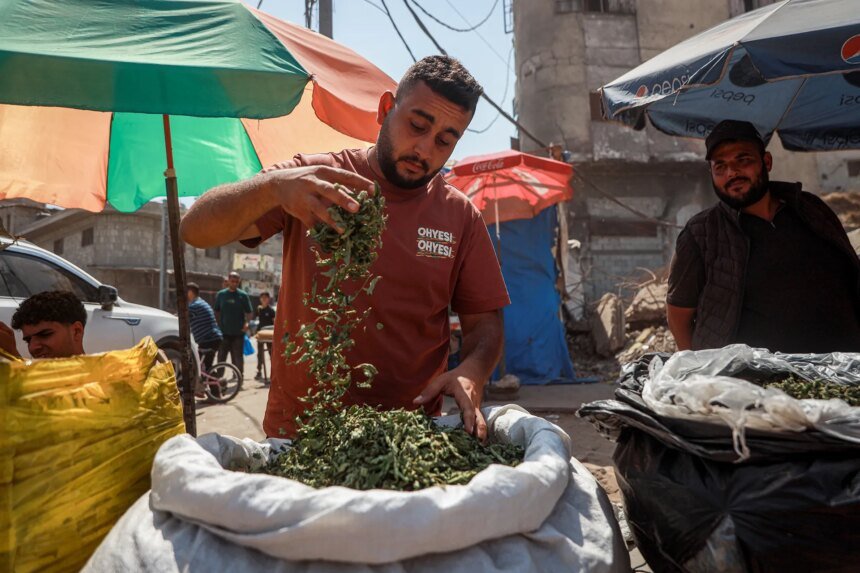
Next to a garbage dump, a small informal market runs along a dirt road in downtown Gaza City. Makeshift stalls line the sides, where vendors display large plastic bags of dried molokhiya leaves alongside a few packets of tobacco.
Al Jazeera’s English correspondent, Maram Hameed, met Alaa in front of a vendor as he was about to order a “molokhiya cigarette.”
The seller takes a handful of dried leaves, rubs them between his fingers, then adds a small drop of liquid nicotine, and wraps the mixture in thin paper before handing it to Alaa.
The 27-year-old, who has been smoking for six years, describes how war and rising prices forcibly changed his habits.
Alaa points out that what was previously a routine personal habit has now become another example of the high cost of living that has come to define the details of daily life in Gaza, in light of severe inflation that was exacerbated by the Israeli war of annihilation.
He says: “A cigarette now costs 100 shekels (about 34 dollars)… This is crazy,” exhaling smoke that smells like molokhiya before continuing the conversation, “It no longer resembles tobacco at all… but it is something we use because there are no other options.”

More dangerous than tobacco
As a father of two children, and unemployed since he lost his job as a carpenter at the beginning of the war, every pack of cigarettes has become an unbearable burden. He says: “Before the war, we tried everything… different types of tobacco, and imported brands… but now we smoke anything we can dry and roll. This is not a real alternative, but merely a necessity.”
Although there is no official confirmation from the Ministry of Health in Gaza, a number of doctors in the respiratory and cardiology departments reported cases of suffocation, breathing difficulties, and changes in facial color associated with smoking Molokhiya cigarettes.
Dr. Ahmed Saeed Al-Jadba, an ear, nose and throat consultant, warns that burning molokhiya may be even more dangerous than traditional tobacco, and may increase the risk of cancer.
He explains that the substances added to dried molokhiya include liquid nicotine, a substance known to be carcinogenic, and in some cases even synthetic substances such as pesticides or battery oil, which makes the mixture highly toxic.
He says: “When these materials are burned, they release toxic gases such as carbon monoxide and tar. These are the same harmful compounds found in traditional tobacco, and they are among the main causes of cancer and cell damage over time.”
He points out that many patients who arrive at clinics suffer from a severe cough, hoarseness, and dark or yellow phlegm, and in some cases they have been diagnosed with pre-cancerous lesions on the vocal cords.

“Aren’t all our lives harmful?”
Alaa has had bad experiences with nicotine, and recalls a disturbing incident when liquid nicotine came into contact with his skin, causing severe irritation and a loss of consciousness that lasted four hours.
He says: “I was carrying a nicotine syringe in my pocket. It suddenly broke and leaked into my skin. It caused severe burns and penetrated the tissues. I would have died had it not been for God’s mercy.”
He added that he had heard of several similar incidents in the local market, where improper handling of nicotine led to serious injuries and even deaths.
Although he is fully aware of the risks, addiction and economic pressure overcome his attempts to quit. He says bitterly: “In difficult circumstances like ours in Gaza, we only need to smoke to relieve the pressure… something with which to relieve all this tension.”
He adds: “Aren’t all our lives harmful anyway?”
The use of molokhiya mixed with nicotine has become popular as street vendors try to make ends meet. What was previously a modest source of income before the war has become more volatile due to Israeli restrictions on imports into Gaza.
Israel has not allowed tobacco products to enter Gaza since the beginning of its war on the Strip, in addition to other restrictions on the entry of food and humanitarian aid into the Strip.
The restrictions were supposed to be lifted under the current ceasefire, which began in October, but Israel has continued to restrict what can enter Gaza.

Unconventional alternatives
Abdul Karim Helles (36 years old), from Shujaiya, is now displaced in the west of Gaza City, and has been selling tobacco for years. He says: “We have been working in tobacco since before the war… and we continued working during the war. I have no other profession.”
But the real transformation, as he explains, is not limited to trade conditions only, but also includes customer behavior. With the skyrocketing price of cigarettes, people began to resort to unconventional alternatives, including herbs mixed with nicotine, most notably molokhiya.
He says that the idea spread as an emergency solution, within a broader pattern of improvisation imposed by scarcity. But he realizes that this “solution” entails serious health risks.
He added, warning: “Using raw nicotine with herbs is dangerous. It is a toxic substance and may cause death,” recalling incidents that occurred in the market. “I know two people who recently died immediately after consuming nicotine.”
He explains that the danger lies not only in the nicotine itself, but in the way it interacts with dried herbs, especially molokhia, which has become the most widely used base because it “holds the substance” better than other plants.
He continues: “Nicotine does not stick to all herbs. Molokhiya does. That’s why it spread in this way, despite all the warnings.”
Abdul Karim lists the preparation method, which he describes as primitive, saying: “The leaves are dried, ground, and mixed with nicotine to produce a substance used for smoking, far from any safety standards,” stressing that it cannot be considered a real alternative.
But he says that the economic reality and the high prices of cigarettes leave him little margin for choice.
He explains: “A pack of cigarettes used to cost 15 shekels ($5.15)… but now it costs 500 or 600 shekels ($171 or 205). It has become almost impossible for many.”
He adds that even single cigarettes are sold at exaggerated prices, which reflects a sharp collapse in purchasing power.

Psychological stress
This sharp rise, coupled with shortages and restrictions on imports, has led to a significant decline in demand, not because of health awareness, but simply because people can no longer afford it.
In turn, Hassan Hajan (40 years old), who has been smoking since 2017, resorted to Molokhiya cigarettes, and says: “Frankly, I fear for my health…but what is available is not a real alternative.”
He describes waking up every day with shortness of breath and a chest full of dark phlegm, which prompted him to try to quit several times, but he would relapse under the pressure of addiction.
He confirms that constant psychological pressure and the lack of cigarettes make him more angry and irritable.
Like hundreds of thousands of others in Gaza, Hassan is just trying to make ends meet, without knowing when life will return to any form of normal.
He says: “I can barely feed my four children. My situation is stifling. I lost my home in Shujaiya and now live in a tent in very harsh conditions.”


