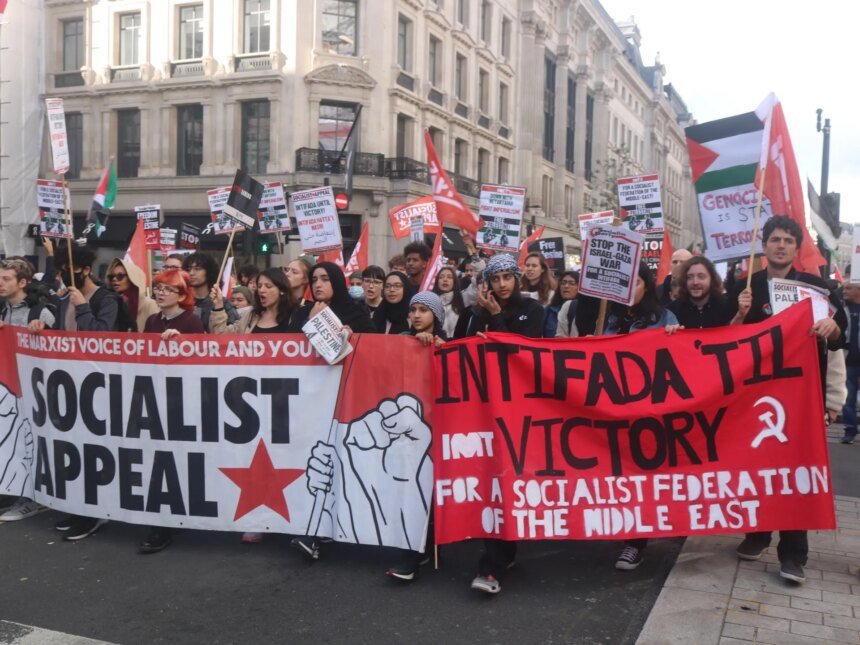
LONDON – “Sara” – a pseudonym for a British woman who works in the field of youth and refugee care – recalls the details of her arrest after participating in a pro-Palestine demonstration in Leeds in December 2025.
Sarah was charged with incitement to racial hatred after participating in the “Intifada” chant.
and A number of pro-Palestine activists and demonstrators in Britain are facing investigations and arrests based, in part, on Arabic slogans and terms chanted during public protests. while The British Public Prosecution Office confirms that the use of the words “uprising” or “resistance” alone does not legally require criminal prosecution.
Al Jazeera Net reveals, based on documents, correspondence, and exclusive testimonies from defendants, lawyers, and human rights defenders, a gradual process that began in late 2025 to tighten dealing with some slogans related to the Palestinian issue, amid a growing legal debate about the limits of freedom of expression and the role of context in interpreting political slogans.

Detention and warning
Sarah told Al Jazeera Net that members of the West Yorkshire Police raided her home the day after the demonstration, before taking her to a detention center where she remained for about 15 hours under investigation and was offered only one meal, according to her testimonies.
The demonstration was broadcast live over the Internet, before video clips of it spread on social media platforms, followed by reports and complaints to the police via the X website.
Sarah is still subject to bail conditions that prevent her from participating in activities related to the Palestinian issue, and she later received a job warning that may affect her continued work.
Documents seen by Al Jazeera Net show that pro-Israel organizations addressed the British police in December 2025, demanding that they take a tougher stance toward a number of slogans used in pro-Palestine protests, most notably the slogan “globalization of the intifada” and “resistance.”
The documents also show that some of this correspondence was based on assessments and reports issued by the “Community Security Association,” a British organization concerned with issues of Jewish community security and monitoring incidents of anti-Semitism, as it was based on what the organization described as the impact of some slogans and chants on the sense of security of members of the Jewish community.

An issue that outlines a method
In London, lawyers and human rights activists are awaiting the course of a case that many view as an important legal test. Maher, founder of the “Palestine Pulse” initiative, was accused of participating in activities that included slogans including “Intifada Revolution” and “There is only one state, Palestine 48.”
The defendants denied all charges against them, while the case was scheduled to be heard before the court in April 2028.
Defense lawyers say that the case may affect how British courts will deal with cases related to political slogans linked to Palestine in the future.
The persecutions did not stop at slogans associated with the word “uprising.” During activities commemorating the Nakba last May, an activist was arrested and arrested again after chants that included the word “resistance” and other slogans related to the war in Gaza.
Full context
Documents and legal memorandums reviewed by Al Jazeera Net indicate that the evaluation of any political chant under the British Public Order Law does not depend on the words alone, but rather on a set of elements that include the meaning, context, intent of the speaker, his role in the event, the extent of the message’s spread, and its potential impact.
The British Public Prosecution also confirms that the interpretation of political slogans must be done in light of the circumstances surrounding each incident, and not by reading the words in isolation from their context.
However, human rights organizations and lawyers defending defendants in these cases believe that field practice does not always reflect this approach.
In this context, Ola Rowe, Public Affairs and Communications Officer at the International Center for Justice and Palestinian Rights, said: For Al Jazeera Net British law requires words to be evaluated within their full context, considering that some recent arrests raise concerns about the breadth of the security interpretation of the Public Order Act.
For her part, she added: Charlene Pink, Director of Campaigns at the Good Law Project, told Al Jazeera Net that the controversy surrounding some slogans related to Palestine reflects a broader debate about freedom of expression and the limits of state intervention in organizing political protests.

What do the police say?
Al Jazeera Net contacted the London Police regarding the standards used in dealing with slogans and Arabic terms during the protests, but they referred us to previous statements by the Police Commissioner, in which he stressed that dealing with controversial slogans and chants depends on an assessment of the context, relevant legislation, and the practical circumstances of police work, indicating that some phrases may be considered legal or illegal depending on the circumstances of their use.
The police also relied on previous positions announced by its officials stating that some political slogans are subject to varying interpretations among different groups of society, and that officers are directed to deal with them in light of the context, legal considerations, and circumstances specific to each case.

Linguistic and academic controversy
On the other hand, political sociology researcher David Miller, in an interview with Al Jazeera Net, considered that the controversy surrounding the term “uprising” goes beyond the security dimension to questions related to language and racial discrimination in dealing with political discourse.
Miller said that the word “uprising” is usually translated as “uprising” in the English language, and it is a word used in multiple political and historical contexts without being considered an illicit expression in itself.
He added that allowing the use of equivalent terms in English while raising controversy over their Arabic counterparts raises, from his point of view, questions related to linguistic equality and freedom of expression in the public sphere. Miller doubted that this approach might extend to the Persian language later.

An open legal battle
On the other hand, lawyers representing a number of defendants confirm that the ongoing prosecutions lack an adequate legal basis and affect rights protected under the European Convention on Human Rights, most notably freedom of expression and freedom of peaceful assembly.
The defense team of the law firm “Imran Khan & Partners” is preparing to wage a legal battle to drop some cases. Lawyers submitted official requests to the court to end the procedures in a number of files, relying on legal and procedural defenses related to the circumstances of the arrest and investigation, in addition to arguing that the criminal element was not present in the use of terms that they believe fall within legally protected political speech.
While defenders of the accused raise questions about the legal basis for criminalizing the use of terms such as “uprising” and “resistance,” and whether prosecuting their use is consistent with British legal obligations related to freedom of expression and peaceful assembly.