With the start of the 2026 World Cup in the United States, Canada and Mexico, the absence of the Chinese national team from the competitions is renewed, but this time it was in exchange for an increasing presence of Chinese companies in various aspects of the tournament.
The Chinese presence is no longer limited to traditional sponsorship, but has expanded to technology, infrastructure, culture and consumer products, in a rapid development of the Chinese economic role in global sports competitions.

A presence that goes beyond care
The Chinese news agency Xinhua indicates that Chinese companies have become a pivotal part of the World Cup system, with 4 Chinese companies occupying important positions on the list of 16 global sponsors. These companies include Hisense, Lenovo, and Mongeo, in addition to other companies providing technical and production support for the tournament.
Read also
list of 4 itemsend of list
The Chinese presence is no longer limited to placing advertisements, but has become more integrated and with multiple dimensions. Lenovo, as an official technology partner, has introduced artificial intelligence-based solutions, including arbitration support systems and 3D imaging technologies.
Hisense also provides advanced display technologies to support the Video Assistant Referee (VAR) system, which enhances the accuracy of arbitration decisions and broadcast quality.
Xinhua explains that this expansion reflects the transition of Chinese companies from traditional sports marketing to actual participation in building the tournament experience, whether through technology, services or content.

Infrastructure serving millions
In other aspects of their presence, Chinese companies play a prominent role in supporting transportation infrastructure. According to the Xinhua report, 115 light trains manufactured by the Chinese company CRRC will enter service in the Mexican host cities, with a daily transport capacity exceeding 1.25 million passengers.
These trains were specially designed to suit local operating conditions, including high altitudes and humid climates, and were equipped with energy-saving systems and technologies to reduce noise and improve comfort. Some train lines connect directly to the stadiums, which contributes to facilitating the movement of fans during the tournament.
The company also deployed technical support teams working around the clock to ensure stable operation, in a move that reflects China’s previous experience in supporting major global events such as the Olympics and World Cup.
Industry and creativity
In a broader context, the Global Times notes that China’s participation in the World Cup reflects a deeper shift in its industrial model, from relying on low-cost production to focusing on design, creativity and branding.
The Chinese city of Ewu stands out as an example, where local companies display spherical products specially designed in the colors of the host countries. The director of one of the companies confirms that the competitive advantage is no longer in the price, but in the design and identity.
Chinese companies have also obtained official licensing rights for products related to the national teams, with a focus on integrating mass culture into everyday products such as clothing and accessories. “Fans are expressing their affiliation outside the stadiums as well, which opens the way for lifestyle products,” says Jin Yi, a company official.
“Labobo”
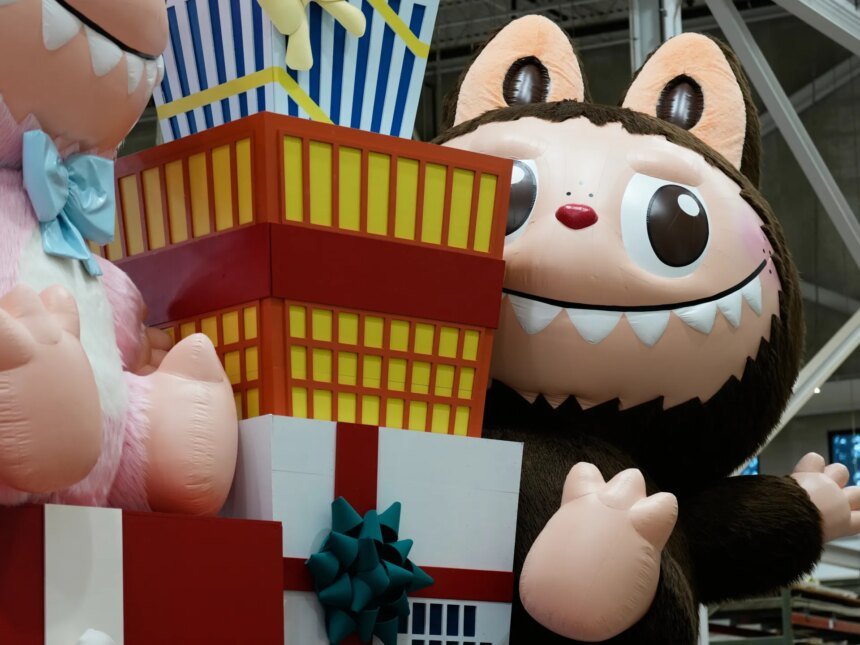
In a remarkable scene, Chinese popular culture recorded its presence through the character “Labobo” who appeared at the opening ceremony of the tournament, according to the Global Times. Some reports described this moment as one of the most prominent moments of the opening, especially since it represents the first official appearance of a Chinese gaming brand in this global event.
The character’s appearance spread widely on social media, and some considered it evidence of the growing Chinese cultural influence globally. The character also previously appeared in an official music video for the tournament, as part of a cooperation between Pop Mart and the International Federation of Association Football (FIFA).
Despite the absence of the Chinese team, the report pointed to a historical precedent through the participation of the Chinese “Ma Ning” as the main referee in the tournament, which prompted some observers to describe the Chinese presence as an “alternative lineup” that combines culture and arbitration.
The 2026 World Cup reveals that China’s competitive sporting absence inside the green rectangle is offset by an increasing presence outside the lines.
A shift in the global role
Experts believe, according to the Global Times, that the role of Chinese companies is no longer just a supply or sponsorship, but rather has become part of the infrastructure of major tournaments, whether through technology, services or products. The report quoted officials as saying that these companies are now contributing to improving the organization of sporting events and developing the fans’ experience.
International reports also pointed to this transformation, describing the role of Chinese companies as a leap from the edges of the stadium – a metaphor for advertising venues – to the position of the main player in the infrastructure and technology of global sports.
The 2026 World Cup reveals that China’s competitive sporting absence inside the green rectangle was matched by an increasing presence outside the lines, in a way that reflects a broader ambition to redefine China’s position in the international sports economy.