Published On 10/6/2026
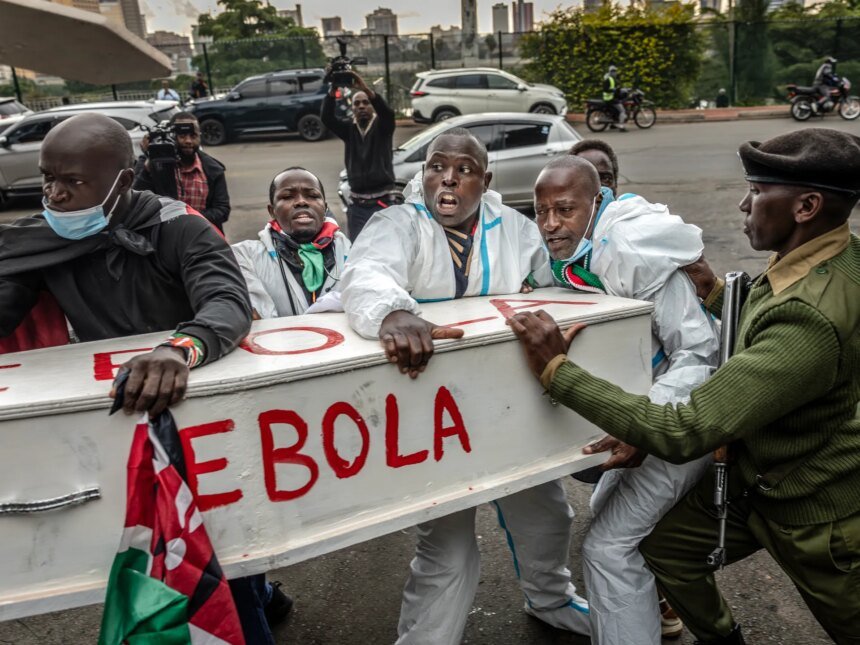
Yesterday, Kenyan police fired tear gas to disperse protesters in the town of Nanyuki in central Kenya, who opposed a quarantine center designated for Americans exposed to the Ebola virus, which the United States is rushing to build inside an air base despite Kenyan judicial decisions preventing the continuation of work.
The planned 50-bed facility at Kenya’s Laikipia Air Base has angered many Kenyans, who accuse Washington of burdening them with the health risks of caring for those exposed to the Ebola outbreak in eastern Democratic Congo and Uganda.
Hundreds took to the streets of Nanyuki last week as frustration mounted among residents, while the Kenyan and American authorities publicly renewed their commitment to the project despite the decisions. One of the demonstrations resulted in the death of at least two people and the injury of a third.
The Kenyan Doctors, Pharmacists and Dentists Union said in a statement that it “will not stand idly by and watch Kenya treated as a containment colony,” adding, “If the matter is extremely dangerous for America, it is extremely dangerous for Kenya.”

Construction continues despite the ban
The Nairobi High Court had earlier suspended construction work and the arrival of patients. However, American military planes continued to transport crews and equipment after the decisions were issued, according to American and diplomatic sources and flight tracking data, with several planes expected to land this week. According to Reuters, satellite images showed an increase in the erection of white tents on a plot of land of about 46,000 square meters that had been prepared inside the Laikipia base since May 27.
The United States said it was aware of the legal challenge and was “working with the Kenyan government to resolve any objections.” Kenyan officials stated that the facility would also be used for the benefit of Kenyans and foreigners in addition to American citizens, which was not confirmed by American officials.
The Katiba Institute – a body concerned with protecting the constitution in Kenya – and the Kenya Bar Association filed two separate appeals before the High Court in Nairobi, citing the risks of exposure to infection and the lack of consultation with Kenyan citizens, and pointing to the limited capacity of the fragile Kenyan health system to manage Ebola.
President William Ruto defended the project, telling reporters, “When President Trump asked the government of Kenya to support them by establishing a center at Laikipia Air Base, I agreed, because it is an agreement and a partnership with friends who have walked with Kenya for 30 and 40 years.” He called on Kenyans to ignore fears of the country’s inability to deal with Ebola, without referring to the issue or confirming that construction would proceed.
For his part, US Secretary of State Marco Rubio announced that Washington “cannot and will not allow” any Ebola case to enter American territory. His spokesman, Tommy Piggott, confirmed the existence of talks between Rubio and Ruto, and Washington’s commitment to provide $13.5 million for Kenya’s preparedness efforts, and an additional $112 million for the regional response. As for Kenyan Minister of Health, Aden Duale, he confirmed that the facility will be open to both Americans and Kenyans, and that it is among 23 facilities that will be established in high-risk counties.
The World Health Organization declared an international public health emergency on May 17 after detecting the rare “Bundebugyo” strain, which was found to have been spreading for weeks in the Democratic Republic of the Congo before arriving in Uganda, and there are no approved vaccines or treatments available for it, unlike the more common “Zaire” strain. There are no confirmed cases so far in Kenya, which has not recorded an outbreak of this disease before.