Published On 11/6/2026
Northern Ireland is witnessing one of the most severe waves of social and security tension in recent years, following a serious stabbing incident that occurred in the Kennard Avenue area north of Belfast, resulting in the serious injury of a man named Stephen Ogilvie.
Quickly – as the New York Times reported – the stabbing incident turned into a spark that ignited widespread unrest and violence targeting immigrants and their property in Northern Ireland, amid the escalation of anti-immigration rhetoric and the intervention of figures affiliated with the extreme right in fueling popular anger through social media.
Read also
list of 2 itemsend of list
The beginning of the events – as reported by the newspaper – dates back to Monday evening, when Stephen Ogilvie, a man in his forties, was subjected to a violent attack that left him blind in his left eye and hospitalized in serious condition.
Video clips that spread very quickly on the Internet showed bloody scenes of the attack, as the attacker appeared to be crouching over the victim, who was soaked in blood, before a passerby intervened and attacked the assailant with a wooden stick used in the Irish sport of hurling, according to the newspaper.
No terrorist motives
The authorities arrested the suspect, Hadi Al-Awadid, a 30-year-old Sudanese refugee, who has resided legally in the United Kingdom since 2023 after obtaining refugee status and a residence permit extending until 2028. Official information indicates that he arrived in Northern Ireland via the neighboring Republic of Ireland before settling in the area that witnessed the attack.
Al-Awadid was brought before the court on charges of attempted murder, and during a session held via video communication technology before the Belfast Court – according to Newsweek magazine – Al-Awadid refused to seek the assistance of a lawyer or provide any defenses regarding the charges against him.
For its part, the police confirmed that they do not yet have any indications linking the attack to terrorist motives, and that investigations are still continuing to determine the circumstances and causes of the incident. They also clarified that they are not looking for other suspects in the case, considering that the investigation is focusing on the accused who was arrested.
But the case quickly went beyond its criminal framework, and turned into a material for political and media incitement on social media platforms – as the New York Times says – after far-right figures and groups exploited the incident to publish unconfirmed accounts and information about the background of the suspect, and to call for tightening policies towards immigrants and refugees.
Calls also spread to take to the streets and organize widespread protests, which contributed to raising the level of tension within the local community, and riots actually broke out in Belfast and other regions of Northern Ireland.

The right calls for protest
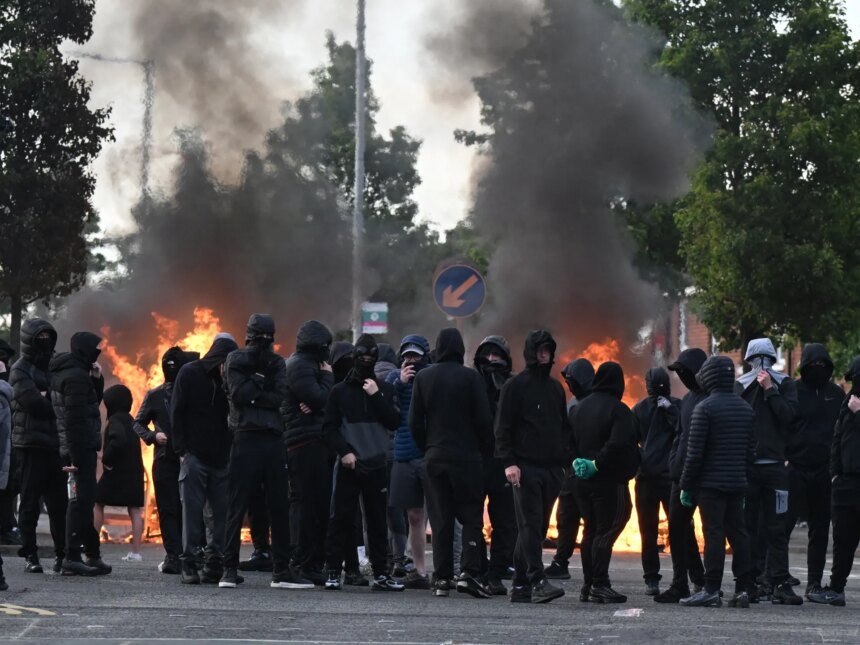
According to Newsweek, the city witnessed groups of masked people burning a number of homes, cars, and waste containers, and a public bus was set on fire, while police forces were pelted with projectiles while trying to control the situation.
Immigrant communities have become at the heart of the crisis – according to the New York Times – and community leaders spoke of a state of fear and anxiety prevailing among foreign families residing in Northern Ireland, and in some cases emergency teams were forced to evacuate entire families from their homes after they were exposed to burning or threats.
In the midst of these developments, the role of social media emerged as a major factor in accelerating the spread of popular anger – according to the newspaper – as video clips of the attack were widely circulated, coinciding with the publication of inflammatory publications and misleading information about the incident and the identity of its perpetrator.
Well-known figures from the extreme right in Britain also shared content calling for protest and escalation, while the re-publishing of some of these materials by figures with great public influence contributed to expanding the scope of interaction with them, as the New York Times says.
These events come in a broader context of escalating controversy over immigration and asylum issues within the United Kingdom in recent years, as the country witnessed several prominent criminal incidents that were used to fuel anti-immigrant rhetoric, some of which were followed by waves of protest and acts of violence.

Bullying and racism
Observers believe that the Belfast incident represents the latest episode in a series of crises that reveal the extent of the increasing polarization around the immigration issue, especially in light of the economic and social pressures witnessed in some British regions.
On the other hand, political figures from various directions sought to contain the tension. British Prime Minister Keir Starmer condemned the stabbing incident and described it as horrific and shocking, but at the same time he stressed that targeting people because of their origins or ethnic backgrounds is unacceptable and will not be tolerated by the authorities. He also pledged to pursue all those involved in the riots and violence and bring them to justice.
Condemnations were also issued by various political forces in Northern Ireland, and local government leader Michelle O’Neill described the attacks on immigrants’ homes as acts of “thuggery and racism,” stressing that the original crime cannot justify assaulting innocent people or displacing families from their homes.
As for Deputy Prime Minister Emma Little Pengelly, she considered that violence does not serve any political or social cause, but rather exacerbates divisions and harms society as a whole, noting that the police are collecting photographic evidence and the necessary information in preparation for judicial prosecutions expected in the coming days.

The victim’s family calms down
The family of the victim, Stephen Ogilvie, sought to calm the tense atmosphere and called for the tragedy not to be exploited to incite hatred or divisions. They issued a statement in which they stressed that their only priority is their son’s recovery from the serious injuries he suffered.
The family expressed its gratitude to the people who intervened during the attack and contributed to saving his life, as well as to the emergency teams and medical teams who continue to care for him, stressing that many immigrants contribute positively to British society and in vital sectors such as health care and services.
While the police continue their investigations into the stabbing incident and pursue those involved in the riots, Northern Ireland remains facing a new test regarding its ability to contain social tensions and prevent a single criminal incident from turning into a broader crisis affecting societal coexistence and relations between local residents and immigrant communities.
Political and security circles fear that continued incitement and the spread of misleading information will fuel more unrest in the coming days, at a time when calls for calm and the preservation of civil peace are increasing.