Published On 11/6/2026
Russian writer Valery Verbinin said that France increased its nuclear arsenal by 80 weapons within one year, and wondered why Russia should not ignore Paris’s nuclear ambitions?
In his article in the Vzglad newspaper, the writer relied on the periodic report issued by the Stockholm International Peace Research Institute, which indicated – compared to the year 2025 – that China increased the number of its nuclear warheads by 20 warheads (from 600 to 620), and India by 10 warheads (from 180 to 190), while Russia slightly reduced the number of warheads (from 5459 to 5420).
Read also
list of 2 itemsend of list
But what is most interesting – according to his opinion – is that France possessed 290 nuclear warheads last year, and this number has risen to 370 this year, an increase of 80 nuclear warheads.
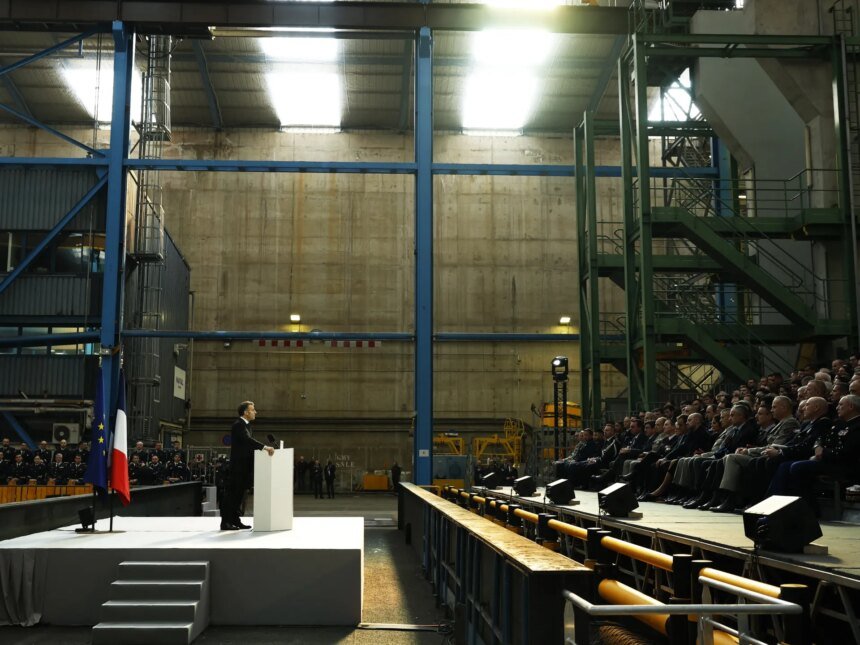
If France was able to increase its nuclear arsenal by about a quarter at once – as the writer says – what other surprises can be expected from it, especially after French President Emmanuel Macron announced in early March that he considered increasing the country’s nuclear arsenal to be extremely important due to the complex geopolitical situation.
Verbinen pointed out that Macron acknowledged that he had ordered an increase in the number of nuclear warheads in his country’s arsenal, yet he did not reveal the exact number of nuclear warheads, unlike what Paris had previously done.

Ambiguous accounts
The writer expressed his astonishment that France was able to increase its nuclear arsenal to this extent in just a few months, and that the exact number of new warheads was known to independent researchers.
The writer pointed out that the French newspaper “L’Opinion” tried to reassure public opinion by saying that the problem lies in the methodology used, which led to the inclusion of old data in the calculation.
According to the newspaper, an additional 80 warheads are considered out of military service, awaiting dismantling, but the Stockholm Institute usually relies on the basic estimates of an independent non-governmental organization, the Federation of American Scientists.
According to the Union, these warheads are “old TN75 warheads”, likely recently removed from the submarine “Le Viguilain”, which is no longer part of the current French arsenal. However, they have been included within the current French nuclear arsenal.
The writer provided an explanation from the expert at the Russian Council for International Affairs, Alexander Yermakov, that researchers in last year’s report listed 80 warheads as dismantled and ready for renewal, but they included them in this year’s report as active.

Yermakov believes that this measure aims to highlight the efforts of Emmanuel Macron, who had previously announced the expansion of the French nuclear arsenal, noting that Paris may have increased the number of warheads, but it is unlikely to be by 80, and it is estimated that the number may reach a few dozen.
Moreover, the researcher emphasized that although it is impossible to determine the exact number of warheads, because the Fifth Republic did not acquire any submarines carrying intercontinental ballistic missiles.
In other words, even with the increase in the number of warheads, the number of missiles available for launch has not changed, according to Yermakov, who also explained that France has 4 ballistic missile submarines, 3 of which are ready to operate, the fourth is undergoing maintenance, and it only has enough ammunition for three submarines.
The writer believes that, in practice, there is no place to add a large number of additional warheads, but he emphasizes that the problem is not limited only to the number of warheads, but also includes the ability to produce them.
The writer points out that in 1997, France abandoned the production of highly enriched uranium and plutonium, because it believed it had sufficient reserves to meet its needs.

The writer mentions that the newspaper “L’Opinion” also addressed the issue of the fate of these warheads that appeared unexpectedly in the study, and said that France has not produced fissile material for military use since the late 1990s, and that it manufactures warheads from a fixed stock of plutonium, but at the same time it uses plutonium extracted from the reprocessing of nuclear warheads to replenish this stock.
Verbinen believes that this is one of the indicators of the expansion of nuclear arsenals globally, because approximately $119 billion will be spent by 2025 on maintaining and expanding the nuclear arsenals of the nine countries that possess these weapons, which are the United States, Russia, China, the United Kingdom, France, India, Israel, Pakistan, and North Korea.
This number represents a 19% increase compared to 2024, indicating the start of a new nuclear arms race.
Moreover, while discussing the staggering rise in costs, the writer also pointed to concerns that artificial intelligence may increase the risk of making decisions involving the use of nuclear weapons, and said that France has a leading role in this, because it announced its desire to expand the scope of the French nuclear umbrella to include its European allies in the North Atlantic Treaty Organization (NATO).
According to the writer’s opinion, manipulating French nuclear calculations does not send a positive signal to Russia, because Moscow considers France’s policy of expanding the scope of nuclear deterrence to include Eastern European countries and Scandinavian countries an uncomfortable matter.