Published On 11/6/2026
|
Last update: 12:30 (Mecca time)
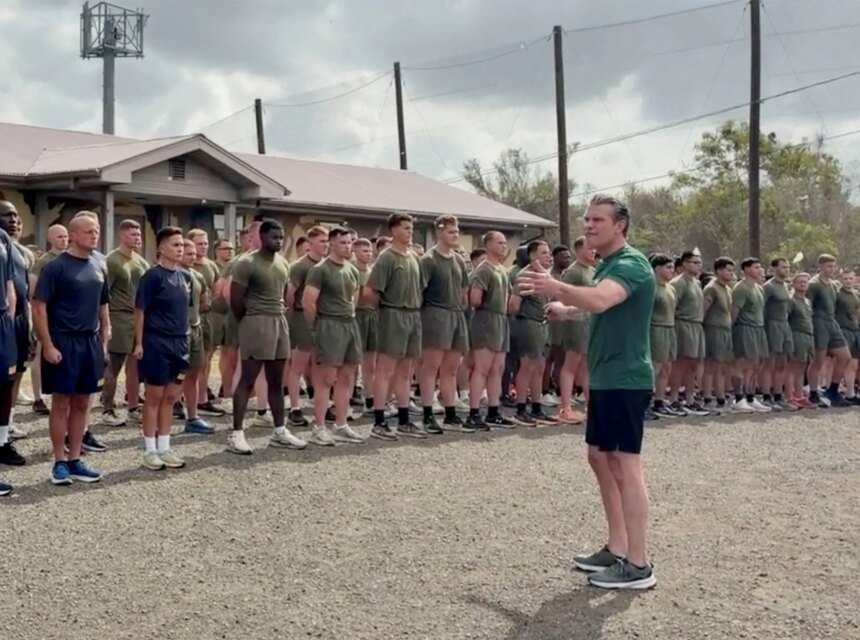
While the dispute between Washington and Havana is escalating, and with Cuban President Miguel Diaz-Canel talking about the United States seeking to bring about political changes in his country, US Secretary of War Pete Hegseth visited the Guantanamo military base and warned of the possibility of a confrontation that he said the Cubans do not want and will not be able to bear.
Days before Hegseth’s visit to the base located southeast of Cuba, the Cuban president said that the United States was studying three scenarios against Cuba, including creating conditions for a social explosion through economic pressure, or controlling the economy and perhaps launching military aggression.
Read also
list of 2 itemsend of list
According to a report prepared by Karim Al-Asyouti for Al-Jazeera, the visit was not an inspection visit as much as it was a confirmation of the United States’ adherence to its presence in this part of Cuban territory, and to strengthen its monitoring of its surroundings in light of fears of possible security developments.
During his conversation with American soldiers stationed at the base, Hegseth said that the future of Cuba is in the hands of the President of the United States and the Cuban leadership, and that his ministry – regardless of anything – will remain prepared for any possible emergency.

A confrontation that Havana will not tolerate
The US Secretary of War did not fail to point out that “it would not be wise for the Cuban government to seek weapons that could reach the Guantanamo base or American territory, because this would mean entering into a confrontation that Havana does not want and cannot bear.”
Pete Hegseth’s visit coincided with the US Southern Command’s unveiling of a rare meeting that brought together military and security leaders from the two countries at the fence separating the Guantanamo base to contain tension and prevent direct friction between the two sides.
This meeting – according to Al-Assiouti’s report – reflects the sensitivity of the situation on the ground despite the intensity of the political discourse between the two parties, with the increasing American pressure on Havana through the stifling economic blockade and tightening restrictions on fuel and energy imports, which created a stifling electricity crisis and directly affected the daily lives of the population.

With the deterioration of the living situation in Cuba, Havana’s two main allies, Russia and China, entered the line, as Russian State Duma Speaker Vyacheslav Volodin said that interference in the affairs of sovereign countries is “unacceptable,” stressing the necessity of working to abolish all sanctions imposed on Cuba, North Korea, and Iran.
These sanctions “aim to curb the development of other countries,” Volodin said, adding, “This is a wrong policy and is usually carried out by the weak and insecure, and we must make every effort to keep these methods away from international relations.”
Thus, Cuban-American relations appear to be heading towards further complexity in light of the economic pressures exerted by Washington to deepen the internal crisis in Cuba, in conjunction with military movements that carry clear messages of deterrence.
Siege and threat
The administration of President Donald Trump considers the communist island located 150 kilometers off the coast of Florida an “exceptional threat” to American national security. Despite these tensions, the two governments confirm the continuation of diplomatic communication between them.
The United States imposes an effective blockade on Cuba by threatening to impose sanctions on countries that supply it with fuel, which has exacerbated the worst electricity crisis the country has witnessed in decades.
The United States also announced a package of sanctions targeting Cuban entities and officials, while foreign companies – including international hotel groups – announced partial or complete withdrawal from Cuba, for fear of possible US sanctions.
As things became more likely to go towards a direct clash, the Cuban president stressed the need for the country to prepare to defend itself in order to avoid any “surprise” or “defeat.”