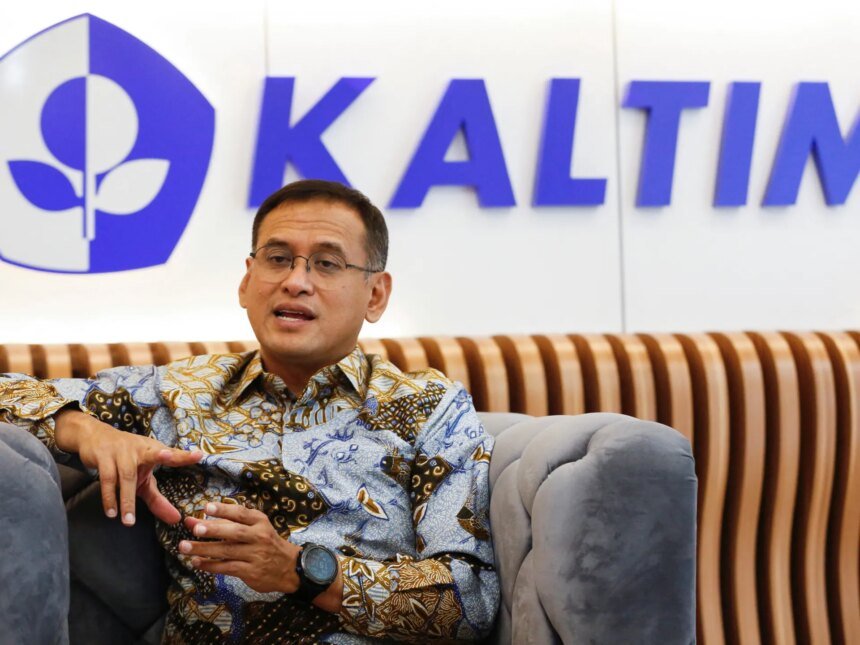
The CEO of the Indonesian Fertilizer Company, Rahmat Pribadi, described the crisis that the global fertilizer industry has been going through since the outbreak of the war on Iran as “extremely serious” and had “tremendous” effects, given the difficulty of fertilisers’ exit from the Strait of Hormuz. Pribadi added that his company has achieved a structural surplus in fertilizer production as a result of decades of work and is now able to export it.
In an interview with Al Jazeera Net, Pribadi pointed out that Qatar Chemical Fertilizer Company (QAFCO) was affected by the conditions caused by the war, as it is a huge producer of urea, and even the largest producer in one place in the world, as it has the QAFCO-6 factory with a production capacity of 3,850 tons per day, adding that there are other countries around the Strait of Hormuz whose facilities were disturbed or were affected logistically as a result of the war.
Read also
list of 4 itemsend of list
Pribadi explained that the effects of the fertilizer industry crisis are long-term, adding, “For example, 5 out of 6 urea factories in Bangladesh, 3 urea factories in India, and 2 urea factories in Pakistan have closed.”
He continued, “The issue is not limited to nitrogen only, but the phosphate production capacity in Morocco has been reduced by up to 30%.”
The president of the Indonesian company added, “We in Indonesia have many friends in the Gulf countries, and we pray to God to give our brothers there who are affected by this war the strength, patience and fortitude to overcome this crisis. I am confident, God willing, that QAFCO will return to work.”
“Patient work” to build capacity
Pribadi stressed that Indonesia is currently able to export fertilizer, not to benefit from the crisis, but this is “the result of hard work, silent and patient work, to build Indonesia’s food security over nearly 70 years.”
As a result, he says, Indonesia now has a surplus of urea that we can share with countries that need it, a “structural surplus,” as he describes it, that has been built through hard work.
Structural surplus is an economic term that means companies achieving an increase or abundance in production that is stable, sustainable, and built on strong organizational foundations, and not just a temporary boom or a stroke of luck.
The Indonesian company official explained that there are at least three things that Indonesia has done to be able to reach the current situation. The first is the gas policy, as the gas used in the fertilizer industry in Indonesia receives special treatment from the government, and its volume is guaranteed at a special price as well.
Hence, if other countries, such as those in Europe, are subject to disruptions due to high gas prices, Indonesia does not face such a problem thanks to the government’s consistent policy over 70 years that prioritized the construction of fertilizer plants.
The second reason, according to Pribadi, is that the Indonesian government is working hard to build a strong institutional and regulatory framework for the fertilizer industry and distribution.
For example, two presidential decisions were recently issued. The first is Presidential Decree No. 6 of 2025 to lift regulatory restrictions on managing the distribution of subsidized fertilizers, making it easier for farmers to obtain them. As for Presidential Decree No. 113 of 2025, it allows the Indonesian Fertilizer Company to reactivate its operations and work with maximum efficiency.
The result was that fertilizer distribution until the third week of last May reached 3.8 million tons, which represents an increase of 36% over last year.
Pribadi explains the rise in this number by saying that distribution has become easier, because in October 2025 the government reduced the local retail price of subsidized fertilizers by 20%.
The third thing is the clear guidance from Indonesian President Prabowo Subianto, as he places food security at the core of his policies.
“Lines of defence”
Rahmat Pribadi explained to Al Jazeera Net that when talking about fertilizers and exports, we rely on 3 lines of defense, “The first for us is Indonesian farmers, who are the main mission of the Indonesian Fertilizer Company, by working to put the needs of the local market at the forefront by reducing fertilizer prices and facilitating the distribution of subsidies.”
The second is the regional level, “as we build the Southeast Asia Fertilizer Association, an open platform where we can discuss, have a unified voice on fertilizers,” and where ASEAN countries can exchange information and take a joint response to crises, including when a global shock occurs.
The third line is the world, adds the same speaker. For example, Australia and India need urea fertilizer, and there are many other countries that are holding discussions with the Indonesian company in this regard.
Culture of togetherness and cooperation
He added, “For us, fertilizer is not just a commodity. Fertilizer is a choice. Will we ensure that there is food on the table of every family in the world, or will we leave our children to sleep at night with empty stomachs and hungry?”
He stressed that fertilizers are “a very strategic commodity,” so “our commitment, starting from the first line, which is Indonesian farmers, then at the regional level, all the way to the world, is that we will treat fertilizers not as a purely commodity, as this is not just a commercial decision,” explaining that “this is our national approach, and this is Indonesia’s ethics, where our culture of togetherness and cooperation is.”
He stressed, “The matter is clear from President Prabowo: As for the countries that are in need, we help as much as we can, and therefore we continue to discuss with the countries that are in need, as each of them has a different growing season.”
He pointed out that 47 thousand tons of urea were shipped to Australia within the framework of cooperation between governments, and this will continue, and perhaps in the following season there will be shipments to India, Bangladesh and others.

Tripartite cooperation with neighboring countries
In response to a question about cooperation between Indonesia, Malaysia and Brunei in the field of fertilizers, he said that the Indonesian Fertilizer Company met with the Petronas Chemicals Group from Malaysia, and the Brunei Fertilizer Industries Company from Brunei to discuss this matter, explaining that these are three companies from three countries with a Muslim majority population that unite to achieve their interests.
He added, “This was announced on April 1 of this year in Bali. We consciously chose the headquarters of the General Secretariat in Brunei, and the presidency will be on a rotating basis.”
He stressed that this is a structure that sends a message that “this is a solidarity initiative, not a bloc, nor a competitive structure, but rather a solidarity structure,” as he described it.
He continued, “We are opening the doors of this Southeast Asian Fertilizer Association to accept other ASEAN countries that wish to join. In addition, we are also opening our doors to cooperation with producers in the Middle East and North Africa and other associations in the world.”
He described this association as an “open dialogue platform”, where we can exchange knowledge and resources, and together map out how to respond when there is a shock to global supplies and how ASEAN has a unified voice on matters like this.
Meet global needs
In response to a question about the ability of Indonesia, and perhaps other Asian countries, to become a new leader in meeting global fertilizer needs, he replied that “this is a shared collective responsibility, and all of us around the world must cooperate to ensure this.”
He went on to say, “With this crisis, we realized how concentrated fertilizer supplies are in this world. We know that 44% of the global fertilizer trade comes from the Middle East, and Indonesia has proven to be a reliable diversification option.”
He stressed that President Prabowo’s directives are “not to politicize fertilizers. Behind fertilizers there are farmers, behind farmers there are families, and behind families there is the stability of the country.”
Therefore, he said, we should not use fertilizers to disrupt stability anywhere. The Indonesian President stressed the need to help those in need as much as we can, and we will continue to do so.