Published on 6/8/2026
There are versions of World Cup tournaments that are linked to specific memories, such as a legendary or decisive goal, or a refereeing controversy over a shot that changed the course of a match or tournament. As for the 1966 World Cup, before its start, it was associated with a hybrid dog that turned overnight into a national and world champion.
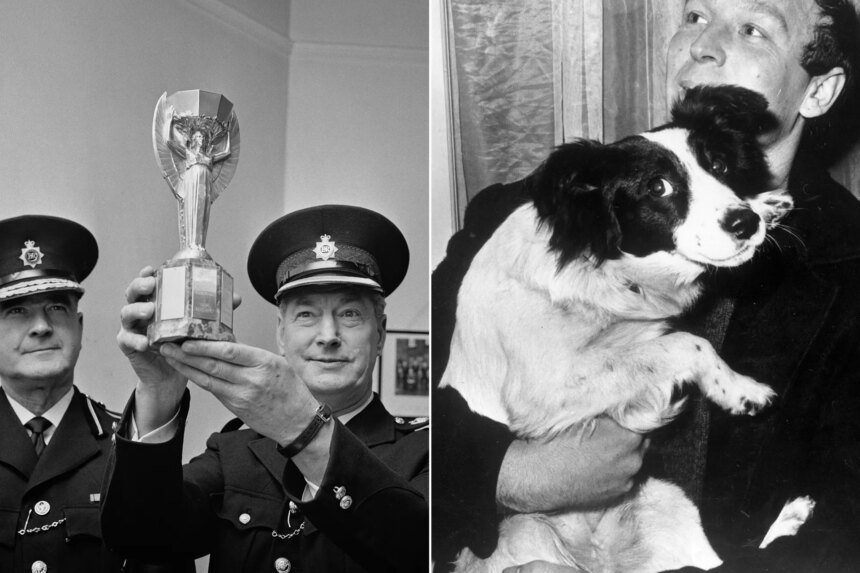
Some people may be surprised by this information or refuse to comprehend it, but in reality it represents the truth itself. The dog “Pickles” suddenly became the biggest star of the 1966 World Cup, as described by the Spanish newspaper “Sport” after he thwarted the theft of the cup.
Pickles the dog saves the 1966 World Cup
That dog prevented a global scandal from occurring. On March 20, 1966, that is, three months before the start of the World Cup, the Jules Rimet Trophy was stolen the next day after it was displayed inside a glass safe in Westminster Central Hall, located in the center of the British capital, London.
Britain, the organizing country for that edition, which is historically known as the cradle of world football, is in a very embarrassing position, due to the theft of the cup, which is considered the most important symbol of the tournament in the world since 1930.

Over the course of several days, the British police turned the streets of London upside down without being able to find the cup, and even received blackmail messages and false signals that coincided with enormous media pressure.
The newspaper said, “The matter had become a national issue. England was about to open the World Cup with the greatest embarrassment imaginable.”
A coincidence that saved the pride of the English
A week after the incident, the black-and-white hybrid dog Pickles, who was walking with his owner on a street in southwest London, appeared. He stopped next to a car on the side of the road and began sniffing a package wrapped in newspaper.
Faced with the dog’s insistence, his owner, David Corbett, decided to open the package, only to be shocked by the presence of the trophy that the British police and the whole world were searching for.
Corbett immediately returned the cup to the police, who suspected him of stealing the cup before releasing him later after numerous investigations. His dog turned into a national hero and a real star and won many awards. He also appeared on television as a champion in commercials.
Its owner, Corbett, benefited from this, as he was invited to the official dinner after the final match at Wembley between England and Germany, which the hosts won 4-2, and he also received a financial reward of 5,000 pounds sterling (about 6,350 dollars), according to what was confirmed by the British Broadcasting Corporation (BBC).
The British police were later able to arrest the thief, Edward Beachley, and he ended up in prison.
The dog “Pickles” did not enjoy this fame for long, as he died the following year (1967) and was buried in Corbett Park in Lingfield.
Ghost target
That World Cup edition (1966) was later engraved in memory for another reason, which was the “ghost goal” in the final match, scored by English striker Geoff Hurst against Germany in the first extra period, specifically in the 101st minute.
The referee awarded that goal after consulting with his assistant, even though the ball that hit the crossbar and hit the ground did not cross the goal line, giving the English a 3-2 lead, before they scored a fourth goal that settled matters completely.
Other thefts
This incident opened the door to other attempts to steal the cup, but this time there was no other Pickles to save the day.
The new incident dates back to 1983, when the Jules Rimet Trophy, which Brazil kept after winning the World Cup for the third time in 1970, was stolen in Rio de Janeiro.
Brazilian police arrested several men who gave conflicting accounts about the incident, most notably that they melted the cup and turned it into bullion.
The Brazilian Football Confederation now keeps a replica of the Jules Rimet Trophy, but the real trophy remains one of the biggest mysteries in World Cup history.