Published on 6/7/2026
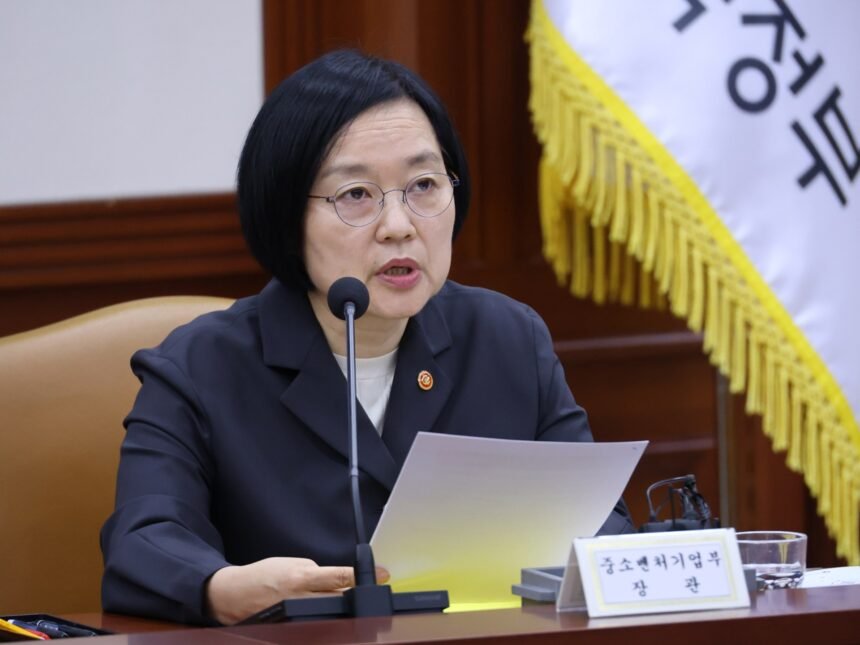
The South Korean presidency announced on Sunday that President Lee Jae-myung has chosen Minister of Small, Medium and Emerging Enterprises Han Seung-suk to assume the position of Prime Minister, becoming the first woman to hold this position in the country in 20 years, if she obtains the approval of Parliament.
Presidential Secretary Kang Hoon-sik said during a press conference that Han, who previously served as CEO of the South Korean internet giant Never, is expected to lead national transformation efforts in the field of artificial intelligence.
He added that Han has extensive experience that qualifies her to transform economic growth led by the boom in the semiconductor sector and increased exports into “comprehensive growth that benefits everyone, including small and medium-sized companies.”
The position of Prime Minister in South Korea is largely administrative and ceremonial in nature under the country’s presidential system, while basic executive powers are concentrated in the hands of the president.

Demands for re-election
Protesters gathered in front of a vote-counting center in South Korea, on Saturday, for the second day in a row, demanding that the local elections that took place last week be re-conducted.
Yonhap News Agency reported – citing unofficial police estimates – that an estimated 10,000 people gathered at an Olympic handball stadium, where votes were being counted for last Wednesday’s elections to choose mayors and local government officials.
These protests come in the wake of a shortage of ballot papers that prevented some eligible voters from casting their ballots across the country, leading to the resignation of the head of the National Elections Commission.
The Election Commission says that ballot papers ran out in 50 centers out of 14,300, and voting was temporarily suspended in 22 electoral centers due to delays in receiving supplies.

The ruling party is sweeping
South Korea’s ruling Democratic Party, to which President Lee Jae-myung belongs, swept most of the local election races held on Wednesday, but suffered a symbolic setback due to the victory of opposition conservative politician Oh Se-hoon for another term as mayor of Seoul.
The Democratic Party won 12 of the country’s 16 major municipal and regional contests, and the conservative People’s Power Party won four of them, a result that gives Lee’s party broad control over local governments a year after assuming the presidency.
However, the loss of the position of mayor of Seoul, which is the most politically important, diminished the value of the ruling party’s victory and gave the conservatives a key foothold in their quest to rebuild after a scandal related to former President Yoon Suk-yeol’s attempt to impose martial law in 2024 and the subsequent impeachment that led to his impeachment.