Muhammad Rayyan’s joy was not complete when he graduated from the Engineering Department at the Islamic University of Gaza. After years of study, diligence, and waiting, he was looking forward to the moment when he obtained his university degree as the fruit of his effort and the gateway to the labor market, but the difficult financial reality prevented that.
Due to the accumulation of tuition fees owed to him, he was unable to obtain a graduation certificate or official transcript, which prevented him from applying for many job opportunities and scholarships that require presenting official university documents.
Read also
list of 2 itemsend of list
Suspended certificates prevent graduation
Rayyan told Al Jazeera Net: “The economic conditions that my family is going through, and the loss of sources of income resulting from the war and the deterioration of living conditions, have made paying tuition fees beyond our financial capacity, despite our repeated attempts to arrange the required amount.” He adds: “The feeling of helplessness becomes even more severe when you have already graduated, but you cannot prove it officially because of fees that you can no longer pay.”
Zaher Hamad’s story is not much different from Rayyan’s story. For months, he has been searching for a job that would help him start his career, but he finds many doors closed in front of him due to his inability to obtain his university degree as a result of accumulated fees.
Hamad told Al Jazeera Net: “The joy of graduation was not complete as I had dreamed. Instead of the certificate being my gateway to a better future, I became locked in my drawers at the university waiting to pay the fees that my family was unable to afford in light of the stifling economic conditions in the Gaza Strip.” He adds: “Every job opportunity I see reminds me of my need for that paper that documents my years of effort and effort, but it is still out of reach, leaving my professional dreams suspended between graduation and unemployment.”
Between the dream of graduation that has been achieved academically, and the degree that is still hostage to financial burdens, Rayan and Hamad, like thousands of other graduates in the Gaza Strip, live in a state of anxiety and anticipation, waiting for a solution that will open for them the doors to the future that they sought throughout their years of study.
Suffering after graduation
The suffering of Gaza students does not stop at the borders of war, unemployment, and economic collapse, but rather extends to haunt them even after they finish their university studies. While thousands of graduates are waiting to receive their certificates as a passport to work, complete higher studies, or travel, many of them find themselves unable to obtain them due to the accumulation of tuition fees in light of an unprecedented inability to pay.
Kholoud Al-Othmani recounts the details of her family’s suffering, which worsened with the outbreak of war, after her husband lost his only source of livelihood that he relied on to support his family, as he worked as a tailor in a profession that provided them, over the years, with the minimum requirements of life.
Al-Othmani told Al-Jazeera Net: “The cessation of work and the complete deterioration of economic conditions in the Gaza Strip deprived our family of any stable income, and we began to struggle to secure the basic needs of life before thinking about any other obligations.”
She added: “These circumstances directly affected the future of my son Firas, who completed his graduation requirements in the field of information technology after years of study and diligence. The moment of graduation was supposed to be the beginning of his path towards professional life, but it turned into a long waiting station due to our inability to pay the accumulated university fees and obtain his university degree.”

A difficult human reality
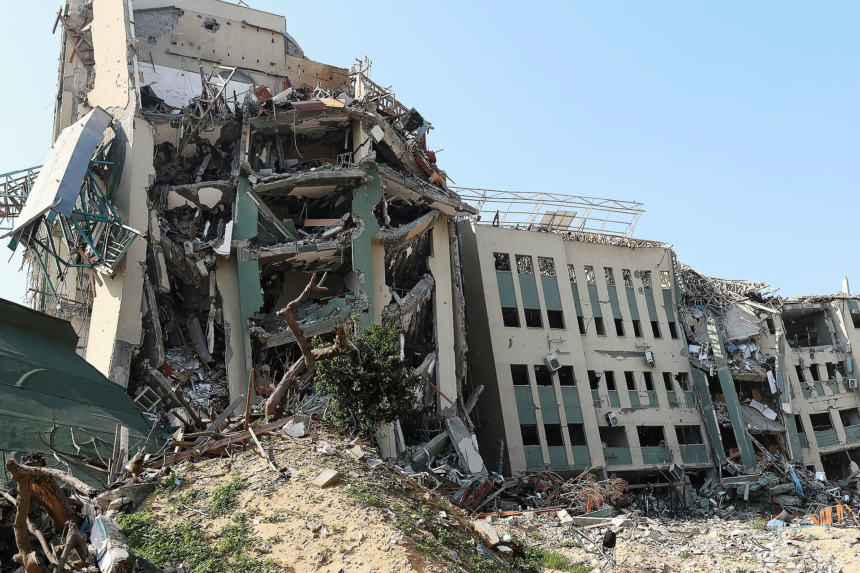
On the other hand, Palestinian universities in the Gaza Strip are suffering from serious repercussions caused by the war, which included the destruction of university buildings and facilities, the interruption of studies, in addition to their heavy reliance on tuition fees as the main source of covering operational expenses and the salaries of their workers. The war has directly affected these financial resources, reducing the ability of universities to provide facilities and scholarships, and exacerbating the economic burdens faced by students and their families in light of extremely difficult living and humanitarian conditions.
In this context, Mahmoud Atallah, Director of Student Affairs at Al-Aqsa University, explains that the university includes about 30,000 male and female students enrolled in its academic programs, and provides various forms of support and scholarships to approximately 7,000 male and female students.
He told Al Jazeera Net: “About 2,000 male and female students benefit from a complete 100% exemption from tuition fees, while 1,500 male and female students receive a 50% exemption, and 1,200 male and female students benefit from social affairs exemptions, in addition to 770 male and female students who are children of employees at the university and the Ministry of Education.”

He added: “The university also provides various exemptions to about 3,000 male and female students, including exemptions for brothers, memorizers of the Holy Qur’an, children of martyrs, people with disabilities, and students who suffer from chronic diseases.”
Atallah confirms that the university took a series of exceptional measures to alleviate the financial burdens on students, as at the beginning of the crisis it allowed registration for the maximum number of study hours while postponing the payment of fees for three consecutive semesters. He continues: “Later, the university decided to allow students to register for 12 credit hours without paying fees, provided that the fees for the additional hours are paid immediately. About 22,000 male and female students benefited from this procedure.”
Efforts to edit certificates
For his part, Dr. Mohamed Hamdan, Director of Cultural Affairs and Public Relations at the University, confirms that the University continues to make great efforts to support graduates and enable them to obtain their university degrees.
He told Al Jazeera Net: “The university offers a 50% discount on the fees owed to graduates, in addition to continuing work to attract financing projects in cooperation with supporting institutions to contribute to paying part of those fees as part of certificate issuance initiatives.”
He points out that these projects, despite their importance, are often subject to conditions and standards set by funding agencies, such as targeting specific specializations or requiring specific academic grades, in addition to the limited numbers of beneficiaries, which prevents the inclusion of all students in need of support.

He added: “The war exacerbated the students’ financial crisis in an unprecedented way as a result of the restrictions on the work of international institutions and supporting bodies, and the decline in the volume of donations and aid reaching the Gaza Strip, at a time when the number of students unable to pay tuition fees increased due to the economic collapse and thousands of families losing their sources of income.”
He continues: “Universities find themselves facing a difficult equation, which is ensuring that students and graduates are not deprived of their right to education and obtaining their degrees, in exchange for the increasing financial challenges faced by the educational institutions themselves.”
Dr. Rashid Odeh, Head of the Student Affairs Department and the Graduate Unit at the University College of Applied Sciences, believes that the war has led to a noticeable increase in the number of financially distressed students compared to previous years. He told Al Jazeera Net: “There is a real crisis facing graduates in applying for jobs and scholarships, and pending certificates are one of the most prominent obstacles preventing them from obtaining available opportunities.”
He added: “The college and universities, through the Student Welfare and Social Research Fund, are seeking to communicate with many local and international bodies to provide grants that help students obtain their certificates. There are responses, but they are not commensurate with the scale of the crisis, the numbers of graduates, and the financial obligations.”

Numbers reveal the scale of the crisis
Al Jazeera Net obtained statements from a number of major universities in the Gaza Strip about the number of graduates who have met the graduation requirements, but their certificates are still suspended due to accumulated tuition fees.
At the Islamic University, the number of graduates who had accumulated financial dues and were unable to receive their diplomas reached 5,808 graduates, with a total dues amounting to 4,029,968 Jordanian dinars (about 5.7 million dollars).
At Al-Azhar University, the number of graduates who were unable to obtain their degrees reached 5,588 graduates, with a total fees owed amounting to 7,669,592 Jordanian dinars (about 10.8 million dollars).
At Al-Aqsa University, the number of graduates who did not obtain their degrees due to university fees reached about 12,000 male and female graduates, with a total accumulated fees estimated at approximately 7,000,000 Jordanian dinars (about 9.9 million dollars).
As for the University College of Applied Sciences, the number of graduates who did not complete graduation procedures due to accumulated fees reached 4,127 male and female graduates, with a total value of 1,213,929 Jordanian dinars (about 1.7 million dollars). A number of them also face additional obligations associated with higher education loans, which increases the amount of money required to obtain their degrees.
Tuition fees are one of the most important financial resources that universities in the Gaza Strip depend on. However, the recent years of the war witnessed a sharp decline in students’ ability to pay, while some universities did not receive tuition fees from large numbers of students for long periods, which exacerbated their financial crisis.
Between universities struggling to continue, and graduates waiting for their degrees, thousands of academic and professional dreams remain suspended behind accumulated numbers of tuition fees, at a time when the humanitarian and economic scene is becoming more complex day after day.