Published on 6/6/2026
|
Last update: 22:04 (Mecca time)
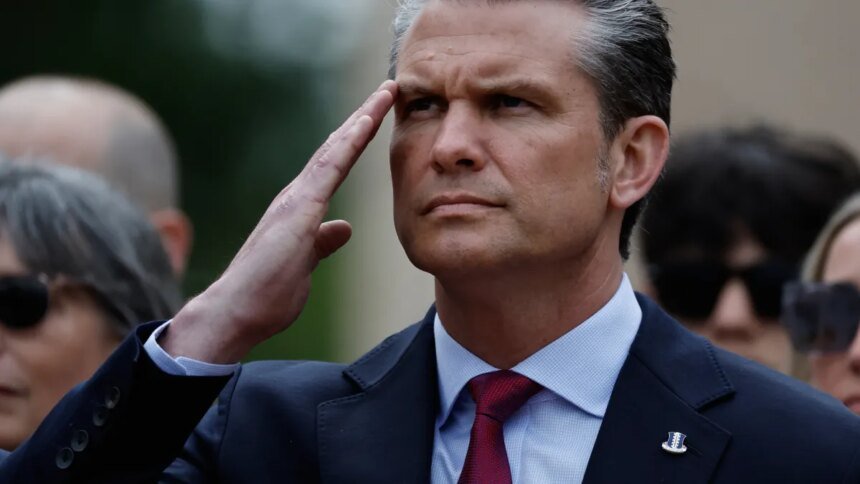
US Secretary of War Pete Hegseth on Saturday attacked Europe over what he described as an invasion coming from the sea, in criticism of immigration policies on the continent, during a ceremony commemorating the Allied landing in Normandy in northern France in World War II.
Hegseth said during a speech at the Normandy American Cemetery in Colleville-sur-Mer: “Unfortunately, today various European shores are witnessing an intrusion of a different kind, represented by dangerous ideologies. On the shores of Spain, Italy, Greece and Bulgaria, boats are arriving and men are coming.”
He added: “When will European capitals move to confront this invasion, or is it too late? I hope it is not so, and I believe it is not so.”
His statements reflect criticism that the administration of President Donald Trump has directed at Europe, considering that the continent suffers from weak defenses, an inability to deal with the immigration file, bureaucratic complications, and “censorship” of the voices of the far right and nationalist movements to prevent them from reaching power.
Hegseth’s comments came during the commemoration of the 82nd anniversary of the Allied landings in Normandy, when American and allied forces crossed the English Channel to begin the liberation of Western Europe from Nazi occupation.

Vance denounces “civilizational decline”
American officials, led by President Trump and Vice President J.D. Vance, have repeatedly criticized European countries for allegedly failing to control immigration.
The US Vice President also resorted to using the word “invasion” when he criticized Britain’s handling of the case of the killing of a white student by a Sikh man on Friday, describing the incident as a “civilizational decline” resulting from the “invasion” of immigrants.
He said on the
“His killing is as tragic as it is infuriating,” added Vance, who is known for criticizing European immigration policies.
The US Vice President continued: “He would still be alive today if the past few generations of European elites had stood up to the mass invasion of immigrants, many of whom despise the West and the people who love it.”
He added: “Henry was not the first to lose his life needlessly, and I fear he will not be the last.”
Before that, the US State Department commented on the same issue, with a statement on Thursday, in which it said: “Ideological guidance and dual application of the law represent blatant indicators of civilizational deterioration,” adding that “this must be rejected throughout the West.”
The American judiciary wins for immigrants
Despite these statements, the Trump administration suffered a defeat before the judiciary in the US state of Rhode Island, as a federal judge issued a ruling on Friday that policies adopted by the US administration were illegal, preventing citizens of 39 countries from receiving decisions regarding asylum requests, work permits, permanent residency, and citizenship.
US District Judge John McConnell in Providence, Rhode Island, overturned a set of policies adopted by the US Citizenship and Immigration Services Agency, saying they left people from dozens of countries in Africa, Asia, Latin America and the Middle East in a “pending and indeterminate legal situation.”
He said the migrants had complied with the legal procedures enacted by Congress and the agency had adopted regulations, yet they were “stranded for months on end waiting for benefits applications that the agency refuses to process.”
The ruling represents a victory for a coalition of immigrant service organizations and labor unions that filed a lawsuit in March challenging policies adopted by the agency, which is part of the US Department of Homeland Security.

“Civilizational obliteration”
A US National Security Strategy document issued last year warned that Europe was facing a “civilizational obliteration,” calling on it to correct its course if it wanted to remain a reliable ally of the United States.
This document, along with other statements by senior officials in the Trump administration, influenced the assumptions that prevailed after World War II regarding the strength of the relationship between Europe and its strongest allies, and also prompted European capitals to focus on the urgent need to diversify dependence away from American technology and defense.