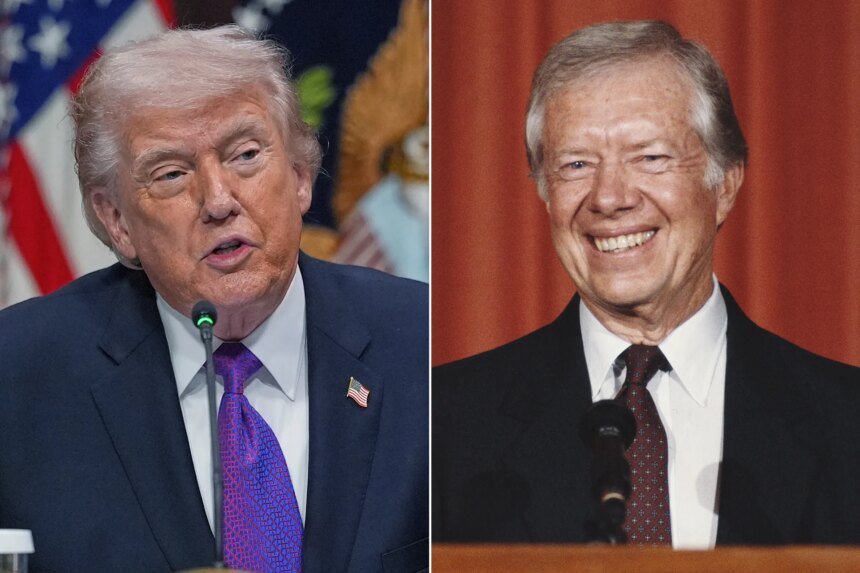
More than four decades later, the name of former US President Jimmy Carter is still strongly present in discussions related to Iran within the United States.
As the intensity of the confrontation between Washington and Tehran escalates, the specter of the hostage crisis that politically toppled Carter in 1980 returns to the fore, remaining one of the most painful and controversial moments in modern American history.
Iranian officials recalled that incident and its political repercussions for Carter, anticipating that the current confrontation would have similar repercussions for Donald Trump.
On the other hand, Trump himself repeatedly invokes Carter’s experience when talking about Iran, which raises the question: Did he actually succeed in avoiding the political fate that ended the term of the former Democratic president?
The story began in the wake of the Islamic Revolution in 1979, when Iranian students stormed the American embassy in Tehran and detained 52 American diplomats and employees for 444 days. The apparent reason at the time was to punish the United States for granting asylum to the deposed Shah, Mohammad Reza Pahlavi.
Over time, the crisis turned into a severe test for the Carter administration, especially after the failure of the military rescue operation known as “Eagle Claw” in April 1980, which resulted in the deaths of 8 American soldiers.
As the hostage-taking continued and the United States’ global image declined, Carter’s popularity gradually eroded, and he lost the presidential election to Ronald Reagan in November 1980. Since then, the hostage crisis has become a symbol of the failure to manage foreign crises that haunts the American leadership.
Why does Trump invoke Carter’s name?
For Trump, Carter represents a model that he does not want to resemble. The current Republican president built a large part of his political speech on showing firmness and strength in the face of opponents, while the image of Carter became entrenched in the American consciousness as a hesitant president unable to impose his country’s will.
Therefore, over the past years, Trump has continued to use Carter as a negative standard for comparison, repeatedly stressing that the United States will not show the same weakness that it showed during the hostage crisis.
According to American media, Trump realizes that the Iranian file was one of the main reasons that brought down Carter electorally, which explains his sensitivity to any comparison between the two stages.
But the irony is that the circumstances that prompted Carter’s invocation have reappeared in a different way. Tensions with Iran, rising energy prices, economic fears, and internal political division are all elements that bring to mind the atmosphere of the late 1970s.
The documents – which were declassified in recent years – also showed a more complex picture of US President Jimmy Carter’s relationship with the hostage crisis in Iran.
The documents revealed that Carter studied multiple military options from the first days of the crisis, which included imposing a naval blockade and carrying out strikes against strategic targets inside Iran, but the Soviet invasion of Afghanistan in December 1979 turned American calculations upside down and prompted the American administration to reconsider its approach to the crisis.
According to Time magazine, Washington feared that any large-scale attack on Iran would open the door to direct Soviet intervention or even the occupation of parts of the country, which would have threatened the strategic balance in the Gulf during the height of the Cold War. Thus, Carter’s hesitation was not only the result of moral or electoral considerations, but also of broad strategic concerns.

Did Trump avoid Carter’s fate?
Electorally, it seems that Trump is right when he asserts that he did not face Carter’s fate, as the Democratic president then lost his re-election battle, while Trump was able to return to the White House and win a second term.
But the comparison becomes more complex when looking at the broader picture, as Trump does not face the risk of losing new presidential elections due to constitutional restrictions that prevent him from running for a third term, while Carter was waging a direct political battle to remain in power.
However, Trump’s success in avoiding Carter’s fate does not necessarily mean that he has overcome the same challenges, as the results of any long confrontation with Iran could be reflected in the popularity of the Republican Party in the midterm elections, and may also affect Trump’s political legacy after he leaves the White House.
A member of the Expediency Discernment Council and former commander of the Iranian Revolutionary Guard, Mohsen Rezaei, linked the consequences of the American-Israeli war on Iran to the future of the political scene in the United States, indicating that its results will reshape the balance of power in the region and the international system in Tehran’s favor.
In a blog post published on the X platform, Rezaei threatened US President Trump to repeat the political fate that former President Jimmy Carter faced following the Iranian hostage crisis in 1979.
Time magazine noted that, remarkably, Carter was later able – despite his political loss – to rebuild his image on the international scene through his diplomatic and humanitarian activity, which culminated in him receiving the Nobel Peace Prize in 2002.
As for Trump, who is constantly keen to present himself as the opposite of Carter, he is still fighting the battle to prove that his more confrontational approach towards Iran is capable of achieving better results than those achieved by his Democratic predecessor.