Published On 4/6/2026
|
Last update: 6/5/2026 00:16 (Mecca time)
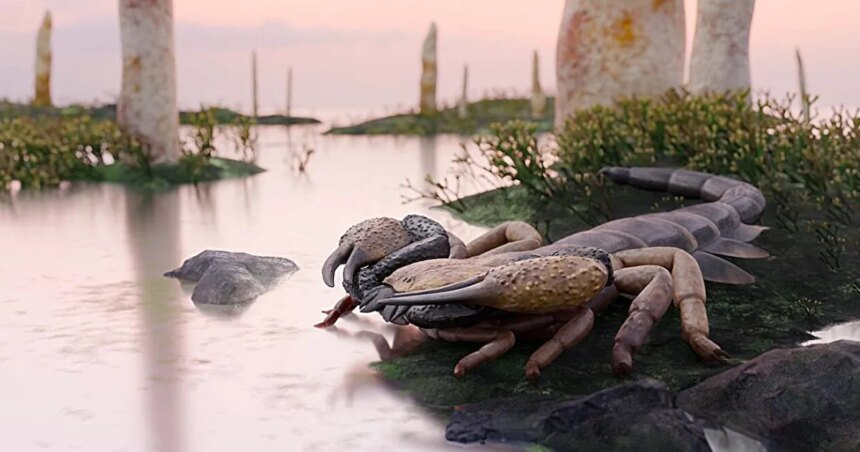
A recent study in the journal Palaeontology revealed that British fossils dating back about 415 million years likely belong to the largest scorpion known to date, the extinct species Prairectorus gigas, which may have exceeded one meter in length, and possessed pincers that reached about 16 centimeters in length.
What is noteworthy is that these fossils are not a completely new field discovery, but rather specimens preserved in museum collections since the nineteenth century, now re-examined with modern techniques and new anatomical comparisons.
This scorpion was a long-standing scientific mystery. When it was first described in 1871, scientists thought it was close to woodlice-like crustaceans, not scorpions. Later, the hypothesis was put forward that it was a giant scorpion, but the remains of fossils in the form of incomplete fragments, and the absence of crucial parts such as the tail, made the classification controversial.
However, the new study re-described the fossil material using fine drawings, optical imaging, and cross-sectional data, and found anatomical characteristics that support its belonging to scorpions, including large pincers with a fixed and a moving finger, and a long, semi-triangular thoracic structure similar to what is seen in ancient scorpions, the existence of which scientists have previously confirmed.

A very special world
The study indicates that some of the characteristics of this scorpion, in addition to the riverine environment that preserved its fossils in ancient red sandstone formations in England and Wales, may mean that it was aquatic or amphibious, moving between water and land.
It had lateral structures on parts of its body that resembled appendages seen in some modern crustaceans, which suggests that it was not a desert scorpion in the sense we imagine it today, but rather a being from a different world, in which the boundaries between land and water were not yet decisive.
The importance of the discovery lies in its timing. This scorpion lived in the Early Devonian Period, at a stage when life on land was still in its infancy, represented by small plants, fungi, and primitive arthropods, before the emergence of complex forests, and before reptiles, mammals, and birds began to invade the land.
So the presence of a predator of this size at such an early time changes the traditional picture of when and why ancient arthropods reached giant sizes.
Scientists often link the huge size of ancient arthropods to the Carboniferous era, when giant insects and arthropods appeared in oxygen-rich environments, but Prairectorus appears to have preceded that stage by tens of millions of years, which means that the enormous size here may not have been the result of oxygen alone, but perhaps because the prey-rich environment allowed the organism to do so.