
Published on 6/6/2026
|
Last update: 13:21 (Mecca time)
“He sells the one who stands alone, buys the one who stands against him, and leaves the one who supports him and follows the one who stifles him.”
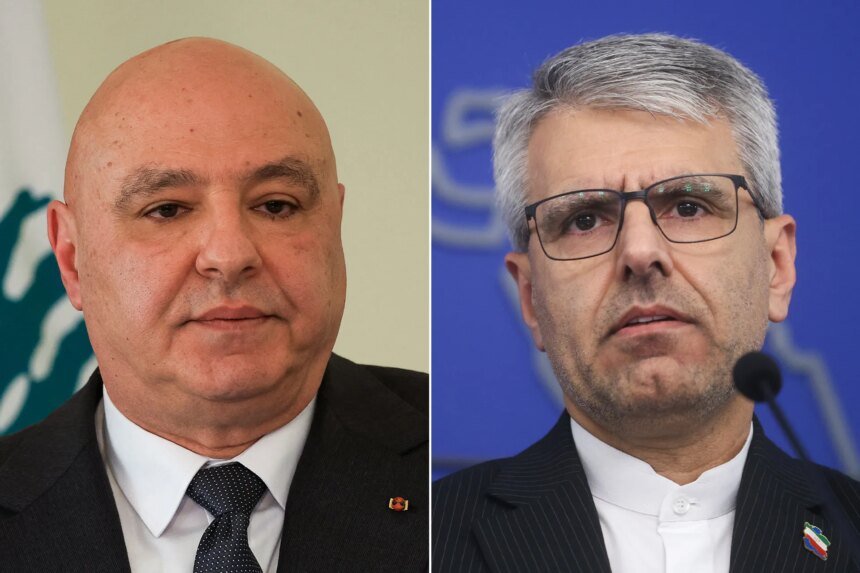
With this sharp statement in the Lebanese dialect, Iranian Foreign Ministry spokesman Ismail Baghaei commented, through his account on the “X” platform, on the statements of Lebanese President Joseph Aoun, in the context of an escalating political debate that reflects the intensity of tension in the mutual discourse between Beirut and Tehran, especially with regard to positions on highly sensitive regional files.
Baqai’s comment came after an interview conducted by the Lebanese President with CNN, during which he directed direct criticism at Tehran, accusing it of using Lebanon as a bargaining chip in its conflict with the United States and Israel, at the expense of the Lebanese people.
Aoun stressed that the Lebanese are “tired of wars and want to live in peace,” stressing the need to end the recurring cycle of destruction that strikes the country.
Read also
list of 2 itemsend of list
He said: “This is our country, not your country,” in a direct message to the Iranian Revolutionary Guard, adding that the Lebanese people are the ones paying the price for Iran’s interests.
Aoun announced his commitment to advance the negotiation process with Israel with the aim of reaching agreements to stop the ongoing war, considering that there is a historic opportunity to end decades of hostility since 1948.
The Lebanese President said that his country is fully prepared to engage in negotiations to end the war, sending a message to Israel that peace and security will not be achieved by military force alone.
These statements sparked widespread controversy across social media platforms, as reactions varied regarding their content and language, in light of the escalation of the political debate related to the statements exchanged between Beirut and Tehran.
While activists considered that these statements reflect an unprecedented intensity in the diplomatic discourse between the two sides, they pointed out that the use of this type of language reflects the escalation of political tension and the shift of the debate from the traditional official framework to a more direct and unified discourse.
Activists added that this verbal escalation may open the door to further divergence in positions between Beirut and Tehran, in light of the sensitivity of regional files in which the interests of both parties overlap, which makes any exchange of accusations or sharp expressions an additional factor in the complexity of the current political scene.
On the other hand, others saw that these statements come in the context of the usual political responses to recent media statements, and fall within a recurring pattern of diplomatic debate witnessed in the discourse between the two sides, without necessarily reflecting a fundamental shift in official positions.
Observers pointed out that this discrepancy in readings reflects the state of division in evaluating the nature of the exchanged political discourse, between those who see it as an actual escalation in tone, and those who see it as an extension of a familiar pattern of mutual responses.
Observers added that the continuation of this type of verbal debate may contribute to maintaining the level of political tension, without necessarily reflecting fundamental changes in the official positions of the two parties, but it remains an indicator of the fragility of the existing political climate between Beirut and Tehran.