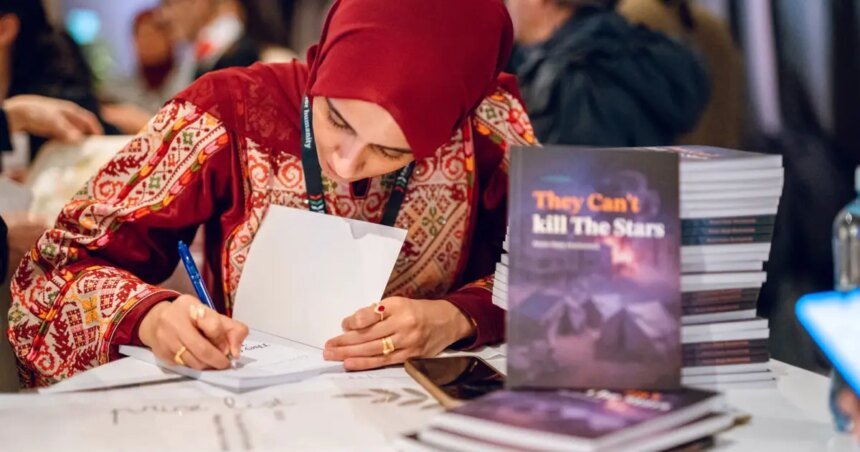
Palestinian writer Wijdan Abu Shamala, after receiving the Follow Women 2026 International Award for her book “They Can’t Kill the Stars,” said that the award represents international recognition of the genocide committed by Israel in the Gaza Strip, stressing that the book directs a moral call to correct the Western outlook toward the Palestinians and Gazans in particular.
The Palestinian writer added to Al Jazeera Net that the award, which came in recognition of her efforts in documenting the suffering of the Palestinians and highlighting the humanitarian effects of the genocide, is a testimony that the truth, no matter how besieged, is able to find its way, stressing that the Gaza Strip is not only a place for death but also for life, love, culture, art and creativity.
Read also
list of 2 itemsend of list
Wijdan Wajdi Abu Shamala explained that the award given to her by the Danish branch of the Follow the Women International organization is not only a tribute to her person, but rather it is a tribute to Gaza itself, its steadfast people, the testimonies that the pages of the book carried, and the voices that she tried to convey to the world as they were.
She emphasized that the greatest injustice of the genocidal war on Gaza was that it turned people into numbers, and that the book presents the faces, names, dreams, and lives that hide behind those numbers, pointing out that writing was not just a process of documentation for her, but rather it was a form of mourning, and an attempt to understand this huge amount of loss.
She explained that she lost nearly 400 members of her extended family during this war, and she left Gaza carrying with her names, faces, and memories that would never leave her, saying, “Sometimes, during interviews, we would cry together; me and those I was interviewing.”
She added that she faced difficulties in collecting testimonies in almost impossible conditions of power outages, collapse of communication networks, and repeated displacement. She wrote part of the book inside Gaza and completed it after leaving the Strip, 6 months after the outbreak of the Israeli genocide.
The Israeli genocide in Gaza, which broke out on October 7, 2023, during which about 73,000 martyrs and 173,000 were wounded, most of them children, women, and the elderly, in addition to widespread destruction of civilian infrastructure, the damage of which the United Nations estimated at 70 billion dollars.
The book “They Can’t Kill The Stars” dealt with some of these damages, as Wijdan says, in a humanitarian documentation that includes 17 living testimonies from Gaza to the effects of genocide, containing stories of children who were permanently disabled and lost limbs or parts of their bodies, mothers who lost their children, fathers who lost their families, and survivors who emerged from under the rubble.
Under the rubble, there are still many stories that have not been told, and human experiences that are threatened by absence, as Wijdan says, hoping to continue writing not from the angle of the tragedy alone, but from the angle of the Palestinian human being in all its aspects.
From the perspective of the Palestinian human being, Wijdan Wajdi Abu Shamala answered some questions to Al Jazeera Net about the importance of the award and the printed paper book despite the digital age, and her opinion on the cultural reality and the role of writing in reformulating the Arab mind…
-
What does winning an award for the Israeli genocide in Gaza mean to you?
I receive this honor with mixed feelings that are difficult to summarize in a few words. On the one hand, I feel grateful that this book found someone to listen to its message and give it this appreciation. On the other hand, it is difficult to celebrate any achievement while Gaza is still bleeding, and there are still thousands of untold stories waiting for someone to carry them to the world.
Therefore, I do not treat this award as a personal honor, but rather I see it as a tribute to the Palestinian human narrative, and to the voices that the book carried within its pages. It is a testimony that the truth, no matter how besieged, is able to find its way, and that human pain does not lose its moral value even if the world tries to get used to seeing it.
Therefore, this honor is not just a tribute to my person, as much as it is a tribute to Gaza itself, to its people who withstood the unbearable, to the testimonies carried by the pages of the book, and to the voices that I tried to convey to the world as they are, with their honesty, pain, and human dignity.
I dedicate this honor to beloved Gaza, to the martyrs who passed away and whose stories and memories remain, to the wounded, survivors and displaced people, to the mothers who patiently wrote chapters of heroism that words cannot do justice to, and to the children who were deprived of their most basic rights and still cling to life.
-
What obstacles did you face in writing this book?
The process of writing this book was one of the most difficult experiences I have ever gone through, both on the human and professional levels.
On a practical level, I was trying to collect testimonies in almost impossible circumstances. Power outages, the collapse of communication networks, repeated displacement, difficulty reaching people, and the constant fear of losing the people I talk to.
I also wrote part of the book while I was inside Gaza and the other part after I left.
On the humanitarian level, the biggest obstacle was the psychological and moral weight of this mission. I was sitting in front of mothers who lost their children, children who lost limbs, survivors who lost entire families, and people who emerged from the rubble to find that their previous lives no longer existed.
I often cried during interviews, and sometimes I ended the interviews crying. I was not just dealing with journalistic material or stories for publication, but with real human pain. My greatest responsibility was to convey these testimonies honestly, without exaggeration, without exploiting the tragedy, and without making those who bear them lose their human dignity.

-
Was it easy for you to talk about the tragedies of Gaza and the martyrs, despite the loss of 400 members of your family?
No, it was never easy.
In fact, there were moments when I felt unable to continue writing or even giving interviews. I was listening to a mother talking about her lost son, and I found myself thinking about the relatives I had lost. I listen to a child talking about his home that was destroyed, and I think back to my home, my city, and what we left behind.
I did not write this book from the position of a journalist who came to document the tragedy of others and then returned to her normal life. I was living the tragedy itself. I lost nearly 400 members of my extended family during this war, and I left Gaza carrying with me names, faces, and memories that will never leave me.
Sometimes, during interviews, we would cry together; Me and those I am talking to. That is why writing for me was not just a process of documentation, but rather a form of mourning, and an attempt to understand this enormous amount of loss.
But as difficult as it was, I felt that those who passed deserved to have their stories told. I was more afraid of forgetting them than I was afraid of pain for myself, so I continued.
-
If you could tell us a quick summary of the book?
The book “They Can’t Kill The Stars” is a humanitarian documentary book that includes 17 living testimonies from Gaza, through which it documents an aspect of the human experience of genocide.
The book contains stories of children who were permanently disabled and lost limbs or parts of their bodies, mothers who lost their children, fathers who lost their families, and survivors who came out from under the rubble to find themselves facing a new life full of loss and pain. It also includes stories of people who were killed and left behind unfinished dreams and stories, and of others who were lost.
The book does not document death alone, but also documents what death leaves behind, including physical scars, psychological traumas, heavy memories, and deferred dreams.
Through it, I tried to convey the Palestinian person as he is: with his weakness and strength, with his pain and hope, and with his complete humanity. Because I saw that the greatest injustice of this war was that it turned people into numbers, while their lives were much greater than any number.
-
What does the book hold for the world and the West in particular, and is there any duality?
It carries a moral call to reconsider the way in which the Palestinian in general and the Gazan in particular are viewed. In the book, I tried to present to the Western reader a child who dreams of school, a mother who fears for her children, a young man who aspires to build his future, and a family who wants to live a normal life like the rest of humanity.
I believe that the power of documentation lies in its ability to bring people back to the center of the scene. When the reader reads the story of one person in depth, he may understand what thousands of statistics cannot explain.
It reminds the reader that suffering does not need translation, and that a human being remains a human being, regardless of his language, nationality, or religion. This book attempts to present the faces, names, dreams, and lives that hide behind those numbers.
I do not believe that the West is a single bloc. There are peoples, writers, activists and institutions in the West who sincerely stood by the Palestinians and rejected genocide.
-
What are the most important findings in your book, and is there a defect in the Arab cultural scene currently?
The war of extermination does not only target a person in his life, but also targets his memory.
I also realized that survival is not the end of suffering. There are wounds that do not appear in pictures and are not measured in medical reports. Many of the survivors I met carry permanent injuries that will accompany them for life. Some of them lost their limbs, sight, or ability to lead a normal life, while others carry psychological wounds that may be more severe than physical wounds.
On the other hand, I found an amazing ability in people to cling to life despite everything, and this was perhaps what influenced me most during writing.
I believe that we have great creative potential and real talent, but the problem lies more in the cultural structure than in the individuals. We still suffer from weak cultural institutions, limited investment in knowledge, and the dominance of rapid consumption at the expense of deep intellectual projects.
Also, many major issues sometimes turn into seasonal waves, while culture needs long-term accumulation, sustainable intellectual and cultural projects that go beyond immediate reactions, and institutions that protect knowledge from political and media fluctuations.
-
Do you think that writing is still necessary in light of the digital age and artificial intelligence, and does it contribute to changing awareness towards Israel?
More necessary than ever.
Digital media are fast and fleeting by nature, but writing is what gives the experience its depth, memory, and permanence. Humanity has experienced wars, famines, and disasters that we know nothing about except because someone wrote them down. Human memory is essentially an ongoing writing project.
The tools may change from paper to screen, but the need for the word will not disappear, because man does not live by news only, but he also lives by meaning, and meaning is created by writing.
I do not believe in the idea that one book is capable of changing the world at once, but I believe in the power of accumulation. Every honest testimony, every honest book, and every honest work of art adds a new brick to building awareness.
This book presents part of the truth through the voices of its authors, and if it is able to make one reader reconsider the stereotypical image he holds of the Palestinians, or push him to think morally about what is happening, then he has achieved an important part of his message.
-
What are your future projects in writing about Gaza and Palestine?
There are still many stories that have not been told, many voices that have not yet reached the world, and entire human experiences that are still threatened with disappearance if they are not documented and preserved.
In the next phase, I aspire to continue writing and documenting about Gaza and Palestine, not from the perspective of the tragedy alone, but from the perspective of the Palestinian human being with all its complexity and human richness. Gaza is not a place of death, but it is also a place of life, full of love, memory, dreams, culture, art and creativity.
I also seek to develop documentary and literary projects that address the effects of genocide on individuals, families, and future generations, because what happened does not end with the end of the bombing, but rather extends to the memory, identity, and daily life of the survivors. I believe that it is our duty to document not only how people were killed or martyred, but also how the survivors lived, how they resisted attempts to erase them, and how they held on to their humanity in the most cruel moments.
In essence, I see that my mission as a writer is not to speak on behalf of people, but rather to make room for their voices to be heard. Therefore, I will continue to work on projects that give human testimony its rightful place in the Palestinian narrative, and contribute to preserving memory from oblivion, and preserving the truth from distortion.
As long as there is a story that has not been told, and as long as there is a person who fears being forgotten, there is still something worth writing.