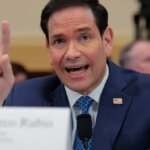
A lengthy interrogation session of US Secretary of State Marco Rubio before the Foreign Affairs Committee in the House of Representatives, today, Wednesday, witnessed debate about the recent war with Iran, the future of nuclear negotiations, and developments in Lebanon, Ukraine, and Sudan.
Rubio faced sharp criticism from Democratic members who accused the administration of President Donald Trump of involving the United States in an economically and militarily costly war, while Republicans defended the administration’s policies and considered them necessary to prevent Iran from possessing a nuclear weapon.
During the session, the US Secretary of State said that Operation “Epic Rage” against Iran ended after achieving its military goals, considering that the destruction of the bulk of Iran’s conventional military capabilities represents a “victory” for the United States.
He added that the operation succeeded in destroying what he described as the “conventional shield” that Iran was building through missiles, drones, and naval forces, which, in his words, prompted it to return to the negotiating table.
Rubio stressed that Washington will not accept any agreement with Iran that does not include ending high enrichment activities, stressing that the ongoing negotiations focus on the principle of “zero enrichment” and getting rid of the stock of highly enriched uranium.
He added that Iran will not obtain any relief from sanctions unless it agrees to American demands related to its nuclear program, noting that the United States does not offer “rewards” to Tehran in exchange for signing an agreement, but rather that any discussion about lifting sanctions will be conditional on the implementation of clear commitments.
He also expressed his hope that Iran would abandon its nuclear ambitions, hand over its stock of enriched uranium, and stop supporting armed groups that Washington classifies as terrorist organizations.
Rubio stressed that the entire international community, including China, agrees on the need to prevent Iran from possessing a nuclear weapon, explaining that he had not received any information indicating that Tehran threatened to conduct a nuclear test if the current negotiations failed.
Iranian Navy “at the bottom of the sea”
Speaking about the results of the military operations, the US Secretary of State said that Iran had suffered heavy losses among the leaders of the Revolutionary Guard, and that its military capabilities had suffered a sharp decline.
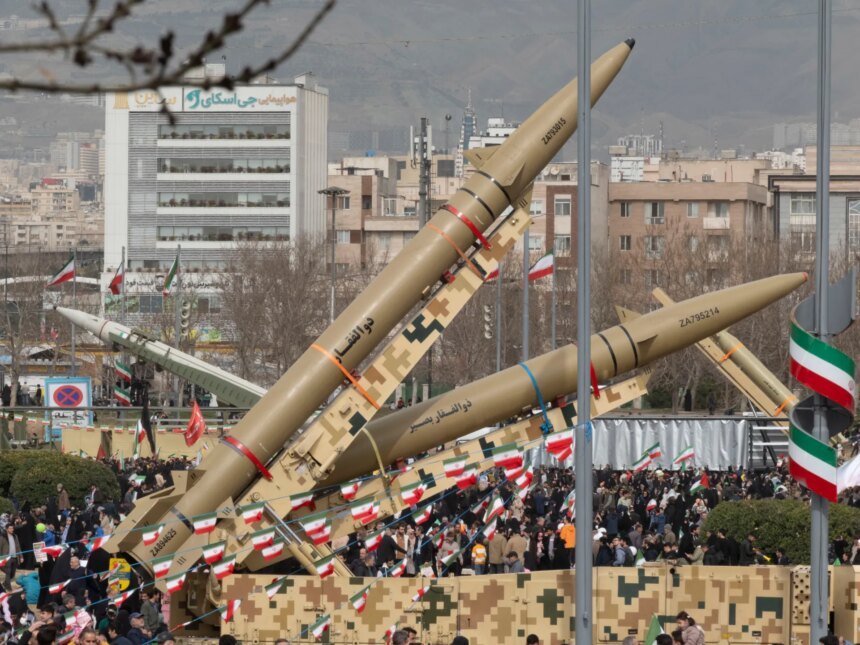
He added that the Iranian Navy “is at the bottom of the sea”, that Tehran no longer possesses an effective air force, and that missile launchers and defense industries have been subjected to severe damage.
Despite this, the American minister acknowledged that Iran still possesses some military capabilities, but it is no longer able to launch large numbers of drones as it used to do in the past.
He pointed out that the current Iranian attacks in the Strait of Hormuz rely on low-cost drones targeting commercial ships, and that American forces respond by shooting them down and targeting their launch sites to protect international navigation.
He accused Iran of waging a “war against the United States” since the establishment of the Islamic regime there in 1979, stressing that it continues to threaten commercial ships and regional stability.
On the other hand, Democratic members confronted the American minister with a barrage of questions about the cost of the war and its actual results.
The session chairman accused the Trump administration of igniting a costly conflict that led to rising energy and shipping prices and inflation, considering that Iran still maintains an important part of its military and missile capabilities despite the war.
He also questioned the feasibility of the military operation, noting that the Strait of Hormuz had become more dangerous after the outbreak of the confrontation, and that the United States had suffered great human and material losses.
Representatives tried to extract direct answers from Rubio about whether he had warned President Trump in advance of the economic and military repercussions of the war, but the minister refused to answer in the form of “yes or no,” contenting himself with asserting that the US administration was aware of the risks but saw that allowing Iran to possess a nuclear weapon constituted a much greater danger.
During the session, questions were also raised about the US President’s financial investments in energy and defense companies during the war, but Rubio denied knowledge of these allegations, stressing that he had not seen the President’s financial disclosures.
Lebanese-Israeli negotiations
Regarding the Lebanese file, the American minister revealed that officials from the Lebanese and Israeli governments were meeting inside the headquarters of the US State Department in conjunction with the interrogation session.
Rubio said that Washington hopes that these meetings will result in a statement and an action plan that lays the foundations for a new security path in Lebanon away from Hezbollah’s influence.
He revealed contacts that took place about two weeks ago with Hezbollah, and said that the party informed Washington of its readiness to stop firing missiles at Israel if it stopped attacking Beirut, but he accused the party of violating the understanding a few hours later and launching missiles toward Israeli territory.
Rubio said that his country believes that Hezbollah does not only represent a challenge to Israel, but also a threat to Lebanon and the Lebanese state, considering that there should be “only one army” in the country, and that Washington is working with the Lebanese army and government to achieve this goal.
He also considered that Israel has the “right to defend itself,” and that its military operations in southern Lebanon come in response to the launching of rockets from Lebanese territory.
Sudan and Ukraine
On the other hand, the American minister described the war in Sudan as turning into a “proxy war” between several regional and international parties.
Rubio said that negotiations are still ongoing, and that the United States is strongly engaged in mediation efforts in coordination with international partners.
Regarding the Ukrainian file, Rubio stressed that the war between Russia and Ukraine cannot be resolved militarily, stressing that the United States is ready to return to mediation efforts if the two parties show a real willingness to negotiate.
He added that Washington continues to supply Ukraine with weapons, but believes that the final solution must be political and diplomatic.
The US Secretary of State touched on other issues, saying that his country wants the Cuban people to live in a normal state in which they can choose their leaders.
Regarding Venezuela, Rubio considered that it no longer poses a threat to American national security as it did before.