Published On 3/6/2026
|
Last update: 15:42 (Mecca time)
The Freedom and Change Alliance – one of the alliances of the Sudanese Democratic Bloc – confirmed its categorical refusal to sit with the “Taases” coalition affiliated with Mohamed Hamdan Dagalo (Hemedti), in its capacity as a political arm of the Rapid Support Militia, with all Sudanese blocs agreeing on the necessity of adhering to a pure Sudanese dialogue within the country.
During a press conference held in the Ethiopian capital, Addis Ababa, on Wednesday, the leaders of the Democratic Bloc explained that their refusal to sit with the “Establishment” coalition stems from its being a political partner of the Rapid Support Forces.
The delegation stressed that any comprehensive dialogue must exclude “those proven to be involved in crimes against the Sudanese people,” stressing that the people’s capabilities and national gains cannot be compromised or compromised.
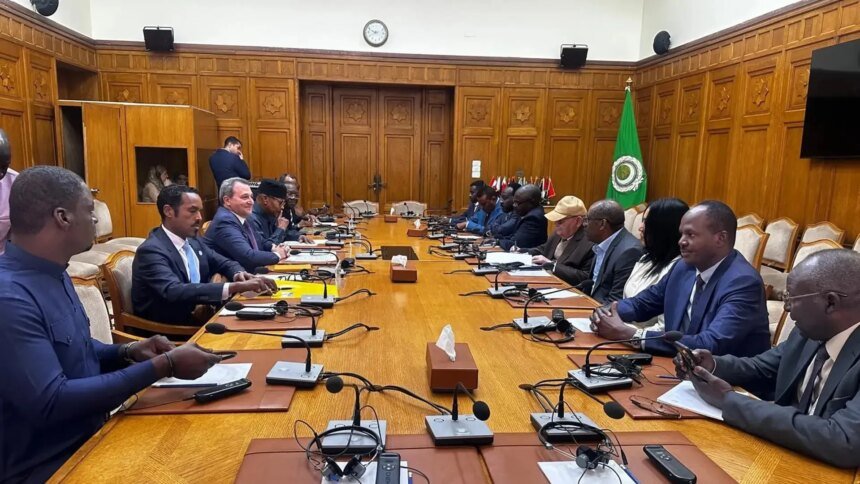
The expanded meeting between the Sudanese political components and the five-party mechanism – which includes the United Nations, the African Union, the Arab League, the European Union, and the Intergovernmental Authority on Development (IGAD) – aims to lay the first building blocks for a political transition process that will end the war that has been raging since April 2023.
The Freedom and Change Alliance, which is affiliated with the Sudanese Democratic Bloc, renewed its support for democratic civilian rule and dialogue that leads to a political solution, and also affirmed its categorical rejection of any political settlement that gives the Rapid Support Forces or their political fronts new legitimacy.
Nidal Hisham Yassin, spokeswoman for the Democratic Bloc, said that the participating delegation includes prominent leaders headed by Mubarak Ardoul and Sally Zaki (assistants to the head of the bloc), and representatives of armed movements, including the Sudan Liberation Movement led by Minni Arko Minawi, and the Sudanese Alliance.
She explained that this delegation, consisting of 13 people, was formed after extensive consultations led by Jaafar Al-Mirghani, Vice President of the Democratic Unionist Party, and the Governor of the Darfur region, Minni Arko Minawi.
Stormy disagreements between Sudanese alliances, political parties, and civil forces threaten to suspend a conference organized by the five-member mechanism concerned with the Sudanese crisis from June 3 to 5 in the Ethiopian capital, Addis Ababa, following a dispute over the inclusion of new forces and the exclusion of others.
Minawi’s conditions and steadfastness
The governor of the Darfur region and head of the Sudan Liberation Army Movement, Minni Arko Minawi, announced – yesterday, Tuesday – that the role of the five-party mechanism and the international community should be limited to providing support and facilitating dialogue between the Sudanese, without replacing or overriding the national will.
He also confirmed, through his official Facebook account, his refusal to grant the Rapid Support Forces or the “Establishment” coalition any political privileges that go beyond the requirements of justice and accountability, considering that such steps represent a political and moral mistake that may have serious repercussions on the future of the political process in Sudan.
As for the “Samoud” coalition, its official spokesman, Jaafar Hassan, announced the completion of consultations with the five-party mechanism and reaching understandings on all points that were a matter of disagreement between the parties.
He explained in a blog post published on his Facebook page that the coalition delegation went to Addis Ababa to participate in the consultative meeting after agreeing on all controversial issues.
Dialogue inside Sudan
Although the bloc welcomed the international role as a “facilitator” of the political process, its leaders stressed the need for the dialogue to be “purely Sudanese-Sudanese” and held within Sudanese territory.
The bloc considered that the multiplicity of external initiatives contributed to complicating the crisis rather than solving it, noting that the absence of national will had previously led to unimplementable outcomes.
The speakers stressed that Sudanese sovereignty and respect for the Sudanese decision are a red line, rejecting any external interference that controls the course of the political process.
Support the army and condemn violations
The political position of the Democratic Bloc was consistent with developments on the ground. The coalition renewed its alignment behind the Sudanese Armed Forces in the “Battle of Dignity.” The bloc’s leaders pointed out that it is the army’s victories that now open a “real opportunity” to establish the post-independence state on the right foundations.
In the same context, Mubarak Ardoul, assistant head of the Democratic Bloc, held the Rapid Support Forces responsible for the horrific violations in Kordofan and Darfur, and specifically mentioned the recent violations against civilians in North Kordofan in the Dar Hamid areas, considering that these crimes increase the gap of division and make sitting with their political facades impossible.
This comes after dozens of people were killed in two separate attacks in North and West Kordofan states in Sudan within 48 hours during Eid al-Adha, according to a statement by a human rights group concerned with documenting war violations and local sources. Last Sunday, the International Organization for Migration announced the displacement of 2,245 people from South Kordofan State, due to deteriorating security conditions.
Over the past three years, international and regional efforts to bring together Sudanese parties have faltered in an effort to agree on steps to accelerate the cessation of the war and hold a Sudanese-Sudanese dialogue to answer questions in the post-conflict period.