Published On 4/6/2026
|
Last update: 00:43 (Mecca time)
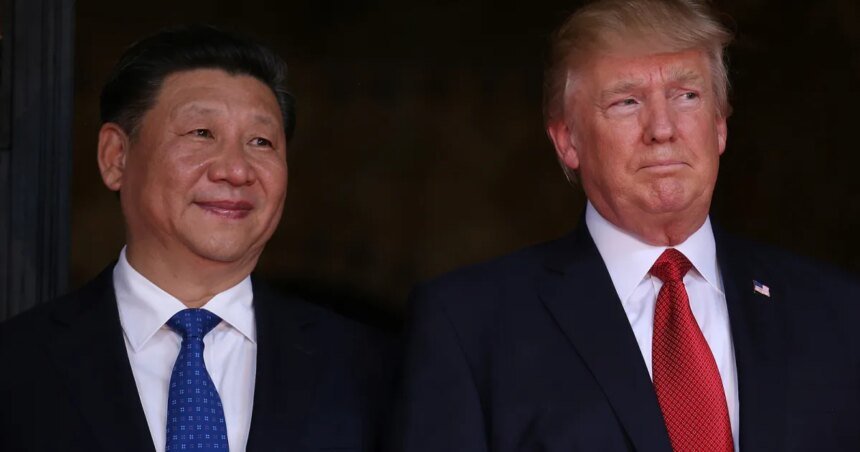
The American-Chinese relationship goes beyond the borders of the trade dispute to reach the level of comprehensive geopolitical competition, in light of a continuous escalation that combines economic, technological, and military competition, amid fundamental questions about whether the “rising” power will inevitably collide with the “hegemonic” power, or whether the two parties will find a way to coexist in a world of intertwined interests.
Dr. Osama Abu Irsheid, an expert on American affairs, believes that American fear of China is not limited to President Donald Trump, but rather is a well-established institutional position, which he describes as “the most prominent geopolitical adversary,” which has the intention and ability to replace American hegemony globally, according to the American National Security Document for 2022.
Abu Irsheid explains during an episode (6/3/2026) of the “Trying to Understand” program that these fears are based on concrete economic data, as Chinese purchasing power is now equivalent to about 41 trillion dollars, compared to 19 trillion for Washington, which means that every project that costs America $20 costs China one dollar, according to former US Secretary of Defense Lloyd Austin, who described the phenomenon as “the erosion of America’s competitive advantage.”
In addition to this, China is superior in the number of naval vessels – despite its qualitative backwardness – and its monopoly on rare minerals necessary for industries and high technologies.
On the other hand, political analyst Rong Huan, known as “Nader,” confirmed his disagreement with Abu Irsheid’s opinion, and pointed out that China has no intention of replacing America in world leadership, and that its primary goal is to improve the standard of living of its people and achieve sustainable development.
He pointed out that China has become the largest contributor to funding for the United Nations, and the largest sender of forces in peacekeeping operations, an indication of its commitment to the multilateral international system.
A deeper ambition
Chinese foreign policy expert Dr. Khair Dhiabat partly agrees with Nader in denying China’s intention of confrontation, but he disagrees with him on the details, as he believes that its ambitions during the era of President Xi Jinping are deeper than what is announced.
He pointed out that this ambition recalls the legacy of the historical “Kingdom of the Middle” and seeks to restore China’s position as a global civilizational center. Thiabat points out that Beijing has mastered “walking the ropes” and is focusing on latent economic and technological power rather than sliding into the swamps of external military involvement that has sapped American power for decades.
Regarding the strategic aspects, the experts discussed what Abu Irsheid called “Trump’s trap,” as Trump implements policies that contradict what is agreed upon in existing international norms, creating a strategic vacuum that China fills, starting with the comprehensive regional trade agreement that includes 15 Asian countries outside the American umbrella, passing through the Indo-Chinese rapprochement imposed by the strict American tariffs, and ending with Europe’s trend towards diversifying its partnerships away from Washington.
The experts concluded that direct military confrontation remains an unlikely scenario, not because of a lack of motives, but because of intertwined commercial interests amounting to $650 billion annually, and a nuclear balance that paralyzes any offensive force. They are likely to continue the relationship between the two parties in an ebb and flow pattern, until such time as China charts its long-term strategic horizon.