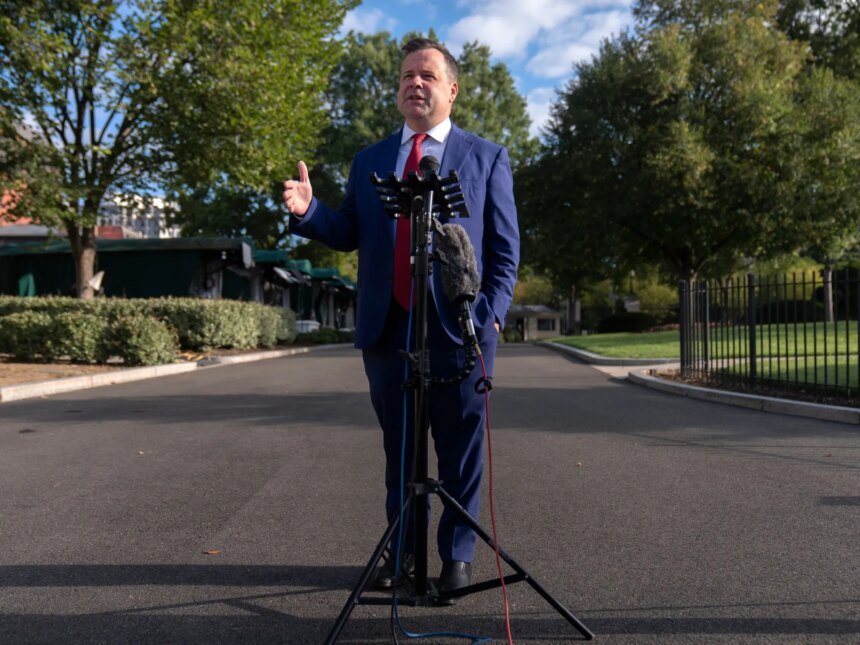
The appointment of William (Bill) Bolt as Acting Director of National Intelligence was not just a sudden administrative decision within the administration of US President Donald Trump. It seemed to many observers to be a revealing moment about the nature of the new phase that the United States is entering.
The man coming from the world of finance and housing, with no prior intelligence or security experience, has reached one of the most sensitive positions in the country thanks to what his supporters describe as absolute loyalty to the president, and what his critics see as a model of prioritizing political affiliation over professional competence.
Read also
list of 2 itemsend of list
While the media coverage focused on the character of Bolt himself, the broader picture drawn by several American newspapers and magazines goes beyond the man to a larger question: How does Trump reshape the institutions of government in his image?

Loyalty comes before experience and competence
In a lengthy report prepared by three of its correspondents, the Wall Street Journal revealed that Bolt, who served as director of the Federal Housing Finance Agency – which supervises the mortgage market in the United States – saw Tulsi Gabbard’s sudden resignation as an opportunity, so he presented the president with a bold proposal to succeed her as acting director of National Intelligence.
Although Bolt does not have any experience in the field of national security, he has a quality that Trump values above all else: absolute loyalty. The newspaper quoted people “familiar with the matter” that Bolt presented himself, during his conversations with the president, as a staunch opponent of Trump’s foreign policy, and also expressed his support for the war on Iran.
The newspaper reported that this proposal was accepted and convinced by Trump, who in recent days showed increasing tolerance towards his critics in the Republican Party before surprising his advisors on Tuesday by announcing through his platform (Truth Social) the appointment of Bolt as his chief advisor for intelligence affairs.
According to the report, Trump found in Bolt a model of an official who does not hesitate to fight political battles in his defense, which helped him win the position despite the surprise the decision caused even among a number of the president’s senior aides.
But reactions within Congress showed the extent of the doubts surrounding the appointment. Republican Senator John Cornyn said that he did not see any evidence that Bolt possessed the necessary qualifications for the job, while Republican Senate Majority Leader John Thune warned of the danger of turning the position into a political tool, saying: “We do not need a politicized intelligence director.”
Treasury officials only learned of the decision to appoint Bolt to the senior intelligence post through social media while the secretary was preparing for a congressional hearing.
Little Trump
Most American media coverage agrees that the decisive factor in Bolt’s rise was not experience, but rather the special relationship he has built with Trump since assuming the presidency of the Federal Housing Finance Agency.
The man who oversees giant mortgage companies – such as Fannie Mae and Freddie Mac – has succeeded in turning his technical position into a remarkable political platform, using the investigations and accusations against Trump’s opponents as a means of proving his loyalty to the president.
Treasury officials only learned of the decision to appoint Bolt to the senior intelligence position through social media while the secretary was preparing for a congressional hearing.
Bolt, whom some call “Little Trump,” has succeeded in gaining the president’s trust thanks to his decisive, aggressive approach in performing his role as head of the housing sector in the US administration.
For its part, Time magazine explained in a news report by journalist Connor Greene that Bolt claimed that a number of those believed to be Trump’s opponents had committed mortgage fraud, including Senator Adam Schiff, New York State Attorney General Letitia James, Federal Reserve Board member Lisa Cook, and former Representative Eric Swalwell, in addition to Fulton County Prosecutor Fanny Willis.
Although all of them denied the accusations, and most of the files did not result in convictions or court rulings, Bolt gained a reputation within conservative circles as one of the officials most willing to engage in political confrontations in defense of the president.

Naughty Bolt
In turn, the Politico news website revealed that Bolt became, in a short period of time, one of the most visible officials alongside Trump, to the point that he sometimes accompanied the president on Air Force One and participated in political discussions that went far beyond his original specializations in the housing sector.
However, Bolt was not a consensual figure even within the White House itself. According to the Wall Street Journal, his aggressive style sparked sharp disagreements with a number of senior officials, including Treasury Secretary Scott Besent, who at one point went so far as to threaten to physically assault him after he learned that Bolt was attacking him in front of Trump.
He also aroused the dissatisfaction of other officials because he bypassed the traditional administrative hierarchy and resorted directly to the president, whether through private meetings at the Mar-a-Lago resort in Florida or during weekends at the golf courses owned by Trump.
But the Politico website indicates that Bolt is also known, in the corridors of the White House, as an official who lacks discipline and tends to stir up chaos within institutions. He has previously entered into disputes with other officials, including the controversy sparked by his short-lived proposal to extend the mortgage term to 50 years, a proposal that was met with widespread ridicule and criticism in public and official circles.
Actual heir
But the most in-depth analysis came from an editorial published by Newsweek magazine entitled “‘Young Trump is the Actual Targeted Successor.’” The magazine believes that the importance of Bolt’s appointment lies not in the position itself, but in the political message that the decision sends.
According to the editorial, Bolt should not be seen as just an official who moved from the housing sector to intelligence, but rather as a model of what the magazine calls “the reproduction of Trumpism within state institutions.” In her view, the man does not represent a political heir to Trump in the traditional sense, but rather embodies the style of governance that the president seeks to spread across the various government agencies.
The magazine says that Trumpism – a term that refers to the populist ideology and policies of the American president – is no longer waiting for a single heir to emerge to succeed Trump in the upcoming elections, but rather is producing “miniature versions” of him within various government institutions.
These versions share a set of characteristics that include heavy reliance on social media, targeting political opponents, bypassing traditional bureaucratic channels, and displaying personal loyalty to the president as a supreme political virtue.
It is precisely for this reason that Bolt has earned the nickname “Little Trump” within the administration.
Newsweek believes that this title is no longer just a joke circulating in Washington circles, but rather has turned into an accurate description of the mechanism of work within the administration. Technical qualifications or specialized experience have become less important than the ability to perform the political role preferred by the president.
Other reports support this conclusion. Time magazine indicated that Trump justified his choice of Bolt by talking about his experience in managing huge financial files worth more than $10 trillion through his supervision of Fannie Mae and Freddie Mac, and not based on any security or intelligence experience.

Serving Trump’s political agenda
But critics of the decision believe that this justification raises more fears rather than dispelling them. Time magazine reported a statement by Democratic Senator Mark Warner, Vice Chairman of the Senate Intelligence Committee, in which he warned that selecting an official who lacks the required experience could lead to “politicization of intelligence information.”
He added that the danger lies not only in lack of competence, but in the possibility that the intelligence services will be asked to present the narrative that the White House wants to hear instead of the abstract facts.
A fundamental question arises here, raised by most of this media coverage: Does the man’s appointment represent an exceptional case imposed by circumstances after Tulsi Gabbard’s resignation, or is it part of a broader pattern?
In this context, Newsweek acknowledges that the president has the right to appoint an interim administrator to fill the void, and that Bolt is not a marginal or unknown figure, as he has previously been confirmed by the Senate to take over the presidency of the Housing Finance Agency.
However, the magazine emphasizes that the political significance of the decision goes beyond the procedural aspects. When a sensitive position suddenly appears, the person the president chooses to fill it reveals a lot about his priorities and standards.
This point also appears present in the Politico report, which believes that Bolt succeeded in transforming the housing agency from an independent regulatory body into a political tool that serves Trump’s economic and electoral agenda. Some experts who spoke to the news site even considered that the agency has become closer to a propaganda platform for the president than a regulatory body specialized in the mortgage and housing market.
The controversy raised by Bolt’s appointment revealed a deeper transformation taking place within the institutions of government in the United States, which represents the transition of Trumpism from being a political movement led by one man to an administrative and political model that is being replicated within the state apparatus itself.
Reproduction of Trumpism
While observers disagree about the ability of the new Director of National Intelligence to actually manage the US intelligence community, most analyzes agree that the impact of his appointment is not only related to what he will do in the coming months, but rather to the message he sends to the rest of the officials within the administration.
The lesson for those aspiring to the rise, according to Newsweek, is very clear: loyalty, political confrontation, and targeting opponents may be more effective than specialized experience in opening the doors to senior positions.
Ultimately, Bolt may leave his temporary position within months, and Trump may choose another, more traditional candidate to fill the position permanently.
From this particular angle, the story of Bill Bolt seems less connected to the future of the American intelligence apparatus, and more connected to the future of Trumpism itself, and whether it will turn into a phenomenon linked to the person of Trump only, or to a style of governance capable of reproducing itself through dozens of officials who adopt his style and rise thanks to him? This is the question that made the appointment of “Little Trump” an event that goes far beyond the limits of the position he obtained.
Source: POLITICO + Time + Newsweek + Wall Street Journal