Published 17.57

28-year-old Lina Bryant was found dead in the snow in western Sweden and a murder investigation was launched.
The truth that was revealed was like a punch in the gut for the family.
– What happened to my Lina must never happen again, says mother Camilla, 55.
In Norway, the case surrounding Camilla Muukki’s daughter has sparked intense debate – but in Sweden it has been quiet, she says. Camilla is Swedish, as was her daughter, but has lived in Norway for 25 years.
– In Norway, there are many who reacted to the inhumanity that befell Lina.
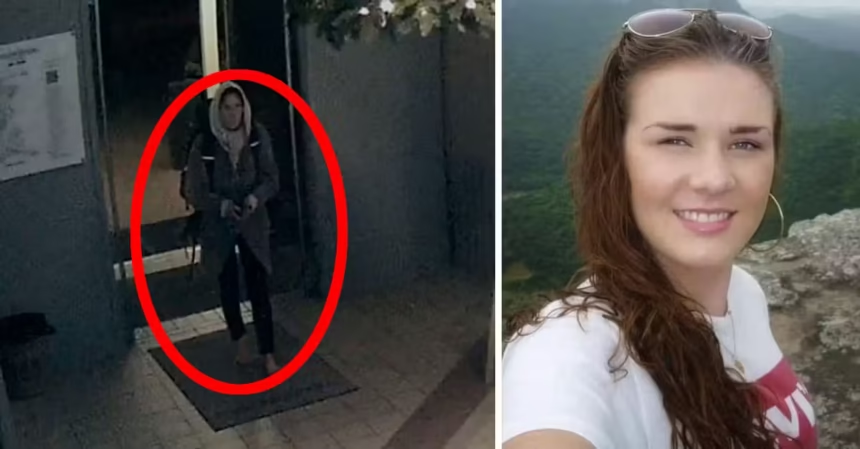
On a November evening in 2022, 28-year-old Lina Bryant was found dead in the snow at a holiday home in Tanum municipality, and a preliminary investigation into murder was launched. She was wearing only underwear and had cuts on her body.
But the investigation revealed something completely different – Lina had been rejected by psychiatry, and sent out into the cold night. Despite the fact that she suffered from psychosis, despite the fact that those around her tried to sound the alarm. The events – and the family’s struggle – are depicted in the NRK documentary “The Lina case: Death in the snow”which is available on SVT Play.
The documentary follows Camilla’s search for answers – which prompted her to contact Norwegian NRK.
– I didn’t get any answers from the care, it was difficult to get the records out – the lid was put on. When I contacted the journalist Helene Sandvig, it was to get advice. But it was not an easy decision to participate in the documentary. I was afraid, and it was about Lina’s integrity, about her image. Because Lina was so much more than what she suffered at the end.
Committed to society’s vulnerable
Camilla describes a strong-willed, lively girl, with great integrity and a strong sense of right and wrong.
– As a child, she was beaten when she alone had to defend a girl who was being bullied because she stuttered. Lina couldn’t stand bullying, she spoke up, says Camilla.
– She made many friends and was popular at school. The children thought she was interesting and brave.

Lina was creative, interested in drawing, music and photography – and got her pictures sold. With warmth and empathy, she committed herself to society’s vulnerable. The family’s elder sister was also physically active, a skilled boxer who won medals.
But Lina had challenges to contend with. She had needed more support at school – where she was lagging behind. It became difficult to reach the dream profession of police. During the pandemic, she isolated herself and signs of psychosis began to appear.
Lost the home
Decisive mistakes were also made in Norway. In February 2022, she was forced into hospital, but managed to escape. She ended up in care again – but after a while she was discharged, and would manage on her own. A care team would help with medication. Camilla felt great concern, raised the alarm to health care – but to no avail.

Lina lost her home, lived in tents and in boarding houses for the homeless. She is said to have had delusions.
“Someone wants to kill me,” the daughter is said to have said over the phone, and was hiding under a car.
In the fateful last winter, Lina sought her way back to Sweden and Kämpersvik, where the family had a country estate.
She was seen at several locations in the area, and several in the public reacted to her condition. She gave a confused impression.
Was released from care
In November 2022, staff at a sports shop outside Grebbestad raised the alarm about a woman walking barefoot in the cold. A day later, 28-year-old Lina was found dead in the snow. In between there is a chain of care that has broken.
Lina was picked up by ambulance, and showed clear signs of delusions. She was able to see a general practitioner at the emergency centre, a doctor at the psychiatric emergency department and nursing staff at the somatic emergency room at Norra Älvsborg County Hospital (NÄL). The ambulance staff informed the doctor about what Lina had said, how she had acted. The warning lights should have been red, Camilla thinks.
– Her feet were sore, she had frostbite.

Despite that, no decision was made on compulsory care. The ambulance staff was instructed by the doctor to release her, in the middle of the night, says Camilla. They drove Lina to the emergency department and wrote a deviation report. Lina was free to go. She went out again – and died of hypothermia.
Fell through the ice
For Camilla, it was traumatic to hear about her daughter’s last moments in life, which were largely caught on surveillance footage.
– Lina was not suicidal. She had gone out on a frozen lake, fallen through and cut her whole body open in the ice. She got up and realized she was dangerously chilled. She stood at a locked villa with a pot in her hand, and considered breaking a window to get in. Allow to warm up. She hesitated. She was so righteous, she doesn’t want to spoil for others. She let it go, says Camilla and now the tears start to flow.

The grief and loss in the family is enormous. Camilla, who describes herself as spiritual, feels a strong closeness to her daughter. But there have been so many tough realizations to deal with. Part of grief is the struggle for recovery.
Event analyzes determined serious shortcomings at Närhälsan, which includes the emergency center, and NU healthcare, which includes NÄL. Lex Maria notifications were made to the Inspectorate for Care and Care.
– But I wish there had been an independent investigation, says Camilla, who has been on sick leave for long periods.
“Can never happen again”
The drive to change is great, and with the combined expertise of the board, she has founded Lina Bryant Memorial Fund.
– We want to work for better support, both for people in crisis and for their relatives. Increase knowledge about psychoses, mental health and system deficiencies. Fight for safer and more respectful, professional treatment in healthcare. We do this through opinion formation, seminars, lectures and spreading knowledge, says Camilla.
– It’s about making something meaningful out of the meaningless. A way for us in the family to be able to move on.
Being open about what happened to her daughter is a big step, she emphasizes. But she sees the silence in Sweden about Lina Bryant’s fate as worrying.
– My biggest fear is that the debate will not take place. Because what happened to my Lina must never happen again.

Camilla Muukki’s advice to relatives:
1. Be aware of changes in the affected person, signs of deterioration, and be prepared to sound the alarm.
2. Being a relative is heavy, difficult and demanding, and it’s important that you take care of yourself – don’t be afraid to ask for help.
3. There is a duty of confidentiality regarding adult patients, but care must become better at listening to relatives in order to get an overall picture. If the caregivers do not contact you, continue to contact them yourself.
The chief doctor: “Really want to regret this terrible”
Kristofer Wennerström, specialist in general medicine and chief physician for Närhälsan, answers Aftonbladet’s questions.
How could Lina Bryant be let go, in the condition she was in?
“First of all, as a representative of healthcare, I really want to regret this terrible thing that happened. What our lex Maria investigation concluded is that lack of competence regarding coercive legislation and the application of this legislation was the single most important explanation for why it turned out the way it did.”
How have the incident and consequences been handled afterwards, in your organization?
“Education efforts have been carried out in primary care, in addition to training opportunities for AT and ST doctors. Partly about the basics of compulsory care, partly to spread information about the case itself and what lessons are important to learn. Lessons that we point to in our investigation.”
How do you ensure that something like this does not happen again?
“In our geographical area, we have done our best to spread knowledge about the event and the reasons why it could happen. In addition, we are actively working to support our staff to work patient-safely in clinical everyday life.”
Jesper Swärd, chief physician for NU healthcare, also answers Aftonbladet’s questions.
How could Lina Bryant be let go, in the condition she was in?
“This deeply regrettable event is what we call a diagnostic error. A misjudgment. It was wrongly judged that she did not meet the criteria for issuing a certificate of care under the Compulsory Psychiatric Treatment (LPT) Act. Thus, there was no basis for issuing such a certificate of care. When we analyze what happened in retrospect, we believe that there were clear symptoms that should have led to such a certificate. A certificate of care would have given us the opportunity to detain her for up to 24 hours, which in all probability would have led to the psychotic symptoms being secured.”
How have the incident and consequences been handled afterwards, and how do you ensure that something similar does not happen again?
“We have worked on learning from what happened. Diagnostic errors are difficult to prevent with changes to routines and working methods. The doctors who treated Lina are competent and have our full trust, yet this happened which in retrospect appears to be unreasonable. There is an important learning in it. We have worked on learning, based on what happened to Lina, primarily for all staff groups in psychiatry. We have also had training based on what happened aimed at the somatic emergency department and I have gone through the incident at a meeting aimed at all of the hospital’s doctors. We cannot undo what has been done, but we have an obligation to learn from it as much as we can.”