In one of the most European biographies linked to the intersection of colonialism, science and religion with Hajj as an Islamic obligation, the story of the Dutch physician Dr. B. H. Van der Hoog (1888-1957), later known after his conversion to Islam as Muhammad Abdul Ali, is described as a multi-layered journey that combines colonial policy towards Mecca and the Hajj, colonial medicine, scientific research in bacteriology, and the spiritual experience associated with the Hajj and Mecca.
It is not just the biography of a European doctor in the Hijaz, but rather the story of the transformation of the identity of a man who lived between two worlds: Europe, and Mecca as a global spiritual center in which the Islamic religious experience is intensified.
Van der Hoog falls within a limited wave of Europeans who converted to Islam in the period between the two world wars, a wave that was not widespread in the Netherlands compared to other European countries such as Britain, France, or Germany. This phenomenon was linked to intellectual and spiritual contexts among some European elites who were searching for religious and moral alternatives outside the traditional Christian framework, and at the same time they were interacting with the Islamic world as an intertwined cognitive, colonial, and cultural field.
From Leiden to the colonies… forming a doctor outside the traditional path
Van der Hoog was born in 1888 into a Dutch military family, and his father was an army general. He received his education at the famous Leiden University, where he studied medical sciences at its ancient university, which had formed an important center for Orientalism and Islamic studies in the Netherlands since its inception at the end of the sixteenth century. Despite his early scientific interests, his father pushed him towards a strict path that combined medicine and military service, so he chose to engage in colonial medicine instead of a purely military life, following in his father’s footsteps.
In the early twentieth century, Van der Hoog moved to the Dutch East Indies, where he worked as a doctor on teams fighting tropical diseases and microbes. There, he was not just an employee in the medical profession, but rather he was a witness to a complex colonial system, which made him develop a critical stance towards the military bureaucracy at the time. He was known for his scathing writings in Dutch newspapers against his military superiors, which led to his being transferred more than once to remote areas as a form of administrative punishment.
This stage in the colonies was not only functional, but rather constituted a cultural laboratory in which he became acquainted with the Islamic societies in Southeast Asia, which cultivated within him an early interest in Islam as a religious and civilizational system, not just a subject of study.
Between medicine and Orientalism
Van der Hoog later returned to the Netherlands, and in 1922 he obtained a doctorate from Leiden University on the subject of sexual diseases. But his career was not stable within the academic framework, as he was experiencing an internal tension between medicine as a modern material science, and existential questions related to religion and its deeper spiritual meaning.
At that time, Europe was witnessing a wide intellectual debate about Islam and the East, in light of the legacy of orientalists such as Christian Snoeck-Hergerone, who was famous for his studies of Mecca in the nineteenth century. There were also cases of Europeans converting to Islam, which made the idea less strange within some academic circles.
In this intellectual climate, Van der Hoog received an offer to work as a doctor in Hijaz, an offer that would radically change the course of his life and open a door for him towards an experience that was not only medical, but also spiritual.
Arrival to Jeddah
When he arrived in Jeddah in 1928, he found himself facing a very complex health reality. The city was suffering from an outbreak of disease with the influx of thousands of pilgrims from various parts of the Islamic world, making it an extremely difficult medical environment.
In his writings, he described Jeddah’s streets as crowded and unsanitary, while hospitals lacked basic tools and some medical procedures were performed in dangerous conditions.
But Jeddah was not just a medical site for him; His stay coincided with the Hajj season, which made him encounter for the first time a global religious experience that brought together tens of thousands of people in one spiritual moment. Here an internal transformation began to take shape: the doctor who treated bodies also began to reflect on the meaning of faith and Muslim unity.
Bacteria and health concerns of Hajj project
On April 20, 1927, Youssef Yassin, an advisor to the Saudi government, submitted an official request to the Dutch Consulate to recruit a bacteriologist with recognized scientific experience to work within the Public Health Department in Hijaz for one year according to precise conditions. The candidate was entrusted with basic tasks that included preparing serums and vaccines, most notably the smallpox vaccine, in addition to examining water and vital materials while strictly adhering to public health regulations.
The request was not limited to the executive side, but also stipulated that the scientist train local medical assistants to ensure continuity of work and localize expertise. In exchange for these responsibilities, the position was assigned a monthly salary of £60.
In the context of this stage, and with the increase in the number of pilgrims from the Dutch East Indies to about 50,000 pilgrims annually, and with the expansion of the Javanese community in Mecca, Van der Molen called on the Dutch consul in Jeddah to send a specialized bacteriologist to strengthen health control during the Hajj season.
He urged the Ministry of Foreign Affairs in The Hague to quickly send a health expert, and considered that this step would strengthen the Netherlands’ position within the Islamic world. He also recommended that the project be financially supported by the Dutch government or the East Indies government if funding faltered. Providing quarterly reports on the health situation from a bacteriological perspective.
Van der Hoog was chosen due to his medical and cognitive experience in bacteriology honed by his work in the tropics under Dutch colonial rule.
Van der Hoog’s conversion to Islam
In Jeddah, Van der Hooch declared his conversion to Islam, and took the name Muhammad Abdul Ali. But this decision sparked widespread controversy within European circles. Consul Van der Molen questioned his motives, considering that the conversion might be a way to access scientific sources such as studying Zamzam water directly.
Some colonial newspapers also believed that his conversion to Islam might be an opportunistic step rather than a sincere spiritual conversion. However, Van der Hoog insisted that he was not a devout Christian before, and that he was seeking to become a sincere Muslim, although this claim was not met with complete belief in European circles.
Returning to the Netherlands… Islam as an idea
After spending several months in Jeddah, Van der Hoog returned to the Netherlands to continue his medical career, and opened a medical clinic in Leiden, but an inner voice kept pushing him to return to Mecca. As a Muslim then, he could perform the Hajj, and his thoughts often returned to the thousands of pilgrims he had helped before: those who had suffered or died in Jeddah or in the desert after having sold their possessions in order to save their souls.
In Leiden, he began studying Arabic with the help of Indonesian Muslim students, and learned to pray and memorize parts of the Qur’an. He later wrote to the Saudi authorities asking to be allowed to perform Hajj, but he received a welcome response. After a period of preparation, he began his Hajj journey in 1935, after obtaining official permission from the Saudi government at the time.
Hajj 1935… journey completed
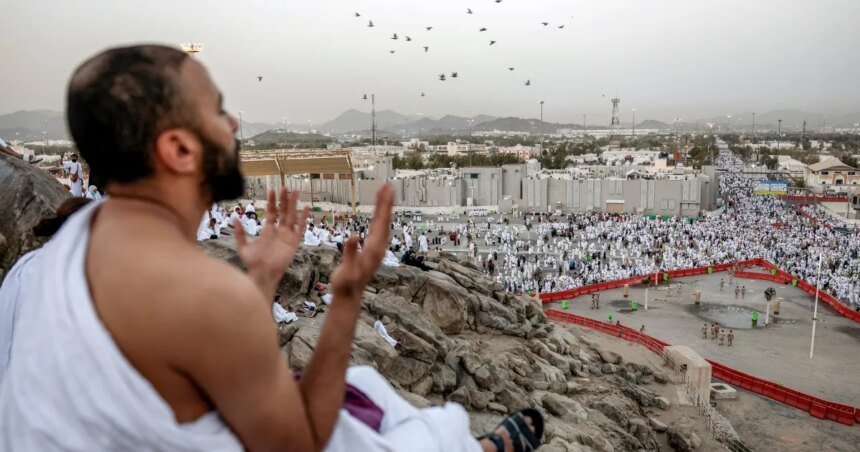
In 1935, Van der Hooch arrived in Mecca as a pilgrim and Muslim. There, the European doctor was no longer just an observer, but became a participant in the religious rituals themselves. He circumambulated the Kaaba, stood at Arafat, and witnessed the moment of transformation he had been searching for for years.
But even this moment did not end the internal tension between his scientific identity and his religious identity, but rather made him more complex: a man living between Europe and Mecca, between the laboratory and the weather, between criticism and faith.
Van der Hooch’s pilgrimage is one of the most important chapters of his life. He entered Mecca after years of waiting and hesitation, traveling across the sea with caravans of pilgrims from Bukhara, Palestine, and Egypt. There, he faced a very intense religious experience, starting from circumambulating the Kaaba and ending with standing on Mount Arafat.
In Arafat, he wrote about his sense of human unity, and about the disappearance of the differences between rich and poor, European and Asian, in one religious moment. He considered that moment the peak of his spiritual experience, as he felt closer to the “truth of faith” than ever before.
On the other hand, his experience was not entirely ideal or romantic, as he also noted the difficult health conditions, criticized pollution and poor services, and considered this to be a major challenge for pilgrims.
Mecca as a scientific and spiritual field
During his research in Mecca, he noticed the pilgrims’ insistence on performing their rituals despite the harsh conditions, which he interpreted as an expression of the strength of faith. Here the central contradiction in his vision emerged: a scientific mind that sees the health risk, and a spirit that tries to understand the religious meaning of this collective insistence.
Transformation inside Mecca
During his stay in Mecca, Van der Hooch began to notice the contradiction between the spiritual structure of the Hajj and the harsh health reality. He saw that crowding of pilgrims and the lack of clean water were all factors that led to the spread of diseases.
However, his experiment was not only scientific. Between circumambulating the Grand Mosque and standing in Arafat, he lived moments that he described as the pinnacle of the human experience, where differences between people disappear, and everyone becomes equal before rituals.
A man between two worlds
Van der Hoog’s biography represents a unique example of a personality who lived on the borders of the European and Islamic worlds. He was not just a colonial doctor, nor just a new Muslim, but rather a complex human condition in which medical knowledge intersects with spiritual experience.
What distinguishes Van der Hoog’s experience is that he did not completely abandon his European identity, nor did he fully integrate into the traditional Islamic identity. Rather, he continued to live in a state of tension between the two worlds.
In his writings, he was critical of modern European civilization, especially with regard to industrialization and excessive modernity, but at the same time he did not fully embrace a traditional religious vision. He also tended to interpret some Islamic rituals, such as the Hajj and circumcision, from a medical and historical perspective.
In the end, his story with the Hajj trip and performing rituals in Mecca remains an open question: Can a person live more than one identity at the same time without losing his balance? Or is diversity itself a form of human truth?
The opinions expressed in the article do not necessarily reflect the editorial position of Al Jazeera Network.