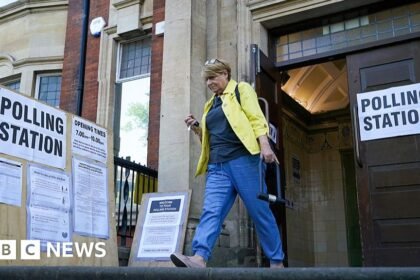
Bogota- Today, Sunday, more than 40 million citizens of Colombia go to the polls to participate in the first round of presidential elections and choose their next president.
This round of elections is considered crucial for Colombia, because it may determine whether the experience of the first left-wing government in the country’s modern history, led by outgoing President Gustavo Petro, will turn into a continuous political path, or will remain an exception in a country ruled by the right for many decades.
The repercussions of the results will not be limited to the Colombian interior only, but will also affect the political map of the region and Colombia’s international relations, especially with the United States, and with the right-wing governments that dominate the region, as well as towards the Middle East.

Sharp polarization
In this context, Colombian society is divided into two parts:
- A large segment supports the leftist candidate Ivan Cepeda, the political heir to Gustavo Petro and representative of his political coalition, the Historic Pact. After Petro, Cepeda became the most prominent representative of the left in Colombia, and he is the candidate who topped all opinion polls since the beginning of the election campaign.
- On the other hand, the other half is lined up behind a divided right, represented by two figures who are similar in visions and in the content of the policies they propose to address the core issues, but they differ in style.
The first right-wing movement is led by far-right candidate Abelardo de la Esprilla, who ranks second in most opinion polls. He is a lawyer who has no political experience or experience in the public sector, and is considered a new face on the Colombian political scene. He proposes a strict economic and security model for the country, modeled on Salvadoran President Nayib Bukele and Argentine President Javier Mele.
The other movement is the traditional right-wing movement, led by candidate Paloma Valencia, who ranks third in the polls. It follows the political approach of former President Alvaro Uribe, a prominent right-wing figure in Colombia, known for his firm security policies during the internal war, and his links with paramilitary groups accused of committing massacres against leftist groups, both armed and unarmed.

Pietro…successes and criticisms
Leftist candidate Ivan Cepeda benefited from the support of a large portion of voters supporting Petro’s mandate. But this support does not seem sufficient to resolve the elections in the first round, as the candidate needs at least 51% of the votes to win.
The leftist candidate Cepeda’s topping of all opinion measurements indicates that a large portion of Colombians have benefited from Petro’s social policies and support them.
Even if the leftist president was not able to implement all his promises, he was nevertheless able to achieve important reform policies in the economic and social fields, such as raising the minimum wage, which contributed to reducing poverty levels and reducing the social gap in a country that is classified among the most unequal countries among different groups.
But with regard to the security file, Petro adopted what is known as the “comprehensive peace” policy. This approach is based on dialogue and negotiation between the government and armed groups to reach agreements that may end the internal war that has been ongoing for more than half a century in Colombia, and which did not stop after the conclusion of the historic agreement between the state and the FARC group in 2016.
However, betting on “comprehensive peace” did not achieve the promised security, and the right accuses President Petro of causing a worsening of the security situation and strengthening the armed groups.
The Middle East in the vision of the Colombian left
At the level of international relations, President Petro has emerged as one of the most important voices of the left in Latin America, alongside his Brazilian counterpart Lula da Silva and Mexican President Claudia Sheinbaum, in the face of what the left sees as the hegemonic ambitions of the administration of US President Donald Trump in the region.
With regard to the Middle East, Petro was one of the most prominent leaders who condemned Israel and the genocide it is carrying out in the Gaza Strip and its actions in the West Bank. Candidate Cepeda seeks to continue the same approach if he wins the presidency.
Cepeda, as his campaign emphasizes on his website, proposes an independent and pro-peace foreign policy. He defends independence and integration in Latin America, and his position on international conflicts, especially the genocide in Gaza, is clear and in the footsteps of President Petro. He supports Palestine, which he made a main focus in his international speeches during his election campaign.
Among his most prominent positions during the war on Gaza, Cepeda filed a criminal case against former right-wing president Ivan Duque, accusing him of promoting terrorism, after the latter visited Israel and met with Prime Minister Benjamin Netanyahu. He then publicly defended the Israeli war on the Gaza Strip, saying that it was “a necessary answer against terrorism.”

The relationship with the United States and the region
In parallel, during his election campaign, Ivan Cepeda hinted at the nature of the relationship that his potential government might have with the United States, the ideological opponent, but also Colombia’s first economic ally.
The leftist candidate stressed that he would not sever relations with Washington, but he set clear conditions for this relationship, stressing that “Colombia is not a dependent, subjugated, or colonial state,” and is not subject to the hegemony of any foreign power.
Speaking to Al Jazeera Net, a prominent employee in the current government, who preferred to remain anonymous, said, “The relationship will likely continue, according to a pragmatic approach based on emphasizing the principle of joint responsibility with regard to combating drug smuggling.”
As for the region, and especially for Venezuela, it is also expected that a pragmatic approach will prevail, although much will depend on what may happen during the possible transitional phase after the ousted President Nicolas Maduro, according to the same employee.
Regarding Cuba, the government is likely to take more active positions in denouncing the US blockade. The source added to Al Jazeera.net: “The Cuban issue is considered very sensitive for Cepeda, and therefore it is likely that we will witness greater diplomatic and political activity in this file.”
A vision contrary to the left
In MaqabIn complete contrast, the right-wing candidates promote completely opposite ideas and positions regarding domestic politics and international relations.
Abelardo de la Esprilla and Paloma Valencia defend a conservative vision for managing the country’s affairs, based on an economically liberal approach, and a strict and strict approach to the security file. They both consider that there is no room for dialogue with the armed groups they describe as terrorist, and that the only way to end the internal war in Colombia may be a military solution against these groups.
Regarding international relations, they both adopt an unconditionally supportive position for the United States, especially the current Republican administration, and they also strongly defend Israel, which they consider to be Colombia’s main ally in the Middle East.
The far-right candidate, Abelardo de la Esprilla, promised, if elected, to move the Colombian embassy to Jerusalem. He also pledged to strengthen relations and the strategic alliance with Israel, placing this among the priorities of his foreign policy agenda.

A critical turning point
Colombians will choose between two widely divergent political projects, and the results of these crucial elections will have internal, regional and international repercussions, especially in a region dominated by the right and the extreme right, as the left governs only 3 countries out of 12 in South America.
The victory of the left means that Colombia will remain among the few countries led by this intellectual current in the region, which will not facilitate its already tense relations with right-wing governments such as Ecuador, El Salvador, Argentina, and all the way to the United States.
On the other hand, the victory of the right may mean that Colombia, with the exception of Brazil and Uruguay, will join the right-wing wave that dominates the region, which may significantly change the regional political map, especially in light of the transformations taking place in Venezuela and Cuba.
As for the international level, a victory for the right may mean that most of the countries in that region will become allies of the United States and supportive of Israel, while a victory for the left will make Colombia one of the few remaining voices in the Latin space that dares to oppose the United States and support Palestine.