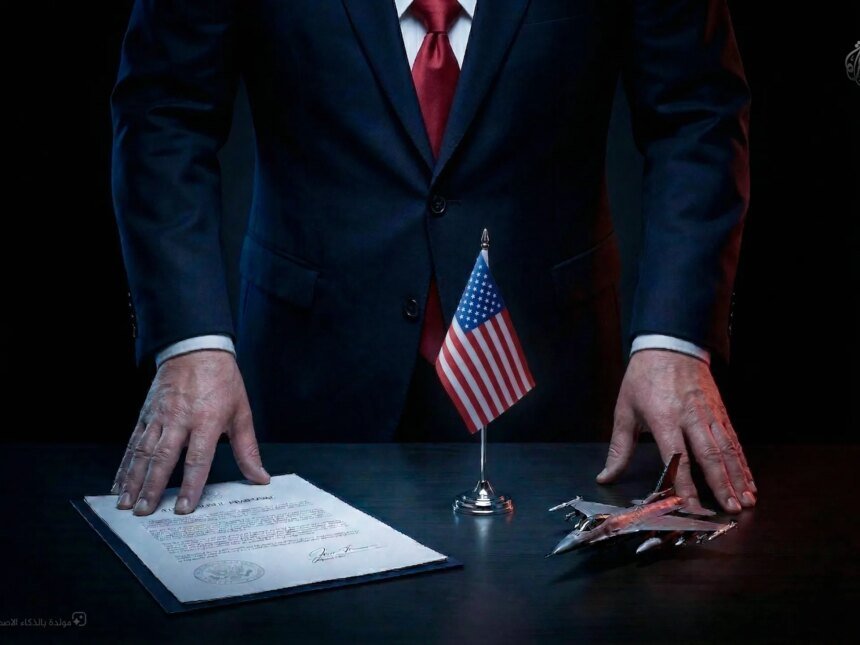
Since the end of World War II, the United States has been the power leading the world order politically, economically, and militarily. But with the escalation of economic crises, the widening of internal divisions, and the decline of international alliances, there has been a recurring question in recent years: Has American hegemony really begun to decline?
Two articles published by the British newspapers, the Financial Times and iPaper, answer that the international system is entering a new era that is not limited by loyalties, and is dominated by technology and artificial intelligence.
Read also
list of 2 itemsend of list
Politics drives empires
It is important to begin by refuting the theory of the decline of American hegemony, which is what American writer and investor Bill Gross discusses in his article in the Financial Times.
The power of the United States was based not only on its military superiority, but also on free trade, a strong dollar, and open markets
Gross believes that the American hegemony that has led the world since the end of World War II faces a real threat today, as a result of the accumulation of economic imbalances and policies that he considers destructive in the long term.

He explains that major empires throughout history have maintained their influence thanks to policies that enhance economic stability and global confidence. The power of the United States was based not only on its military superiority, but also on free trade, a strong dollar, and open markets.
But now, in light of American economic policies in the past decades, the model of American hegemony has begun to collapse, and this has accelerated under the rule of US President Donald Trump, according to the article.
Economic indicators
Gross supports his theory with statistics, noting that the American financial and trade deficits have reached dangerous levels, due to increasing spending on wars – such as the Iran war – health care and social security.
He warns that indicators suggest that US public debt will rise to unprecedented levels over the next decade, threatening confidence in the dollar itself.
He also criticizes the tariff policies adopted by Trump, stressing that they did not achieve the promised “industrial revolution” and did not reduce the economic deficit, according to economic indicators.
Political and social indicators
In turn, writer and geopolitical analyst Yasmine El-Gammal pays attention to the political and social changes in Washington, which indicate the decline of the star of American hegemony.
It confirms that the world has entered a new phase in which the United States will not return to its traditional role even after the end of Trump’s era, because the shift towards political isolationism is no longer a phenomenon linked to his person only, but has become a deeply rooted trend within American politics among Republicans and Democrats alike.
The United States is no longer willing to bear the burdens of the international system as it has done since the end of World War II
Al-Jamal, a former Pentagon advisor, says that many treated the hostility shown by Trump in his first term with allies as a passing exception. But his offensive rhetoric toward the North Atlantic Treaty Organization (NATO), and his policies based on pressure and coercion, were in fact an early indicator of a deeper change in Washington’s vision of its global role.
His return to power, and then the policies he followed during his second term, proved that the United States was no longer willing to bear the burdens of the international system as it had done since the end of World War II, according to the article.

The author points out that Americans have become exhausted from foreign wars and from bearing the responsibilities of their allies, especially with the increasing internal economic pressures and the difficulty of maintaining a stable standard of living.
Therefore, the American popular mood does not completely reject global leadership, but it rejects Washington remaining solely responsible for the world’s crises.
Traditional alliances are being shaken
According to the article, the United States has not only become less committed to protecting the international order, but has sometimes become a factor in destabilizing it.
This is evident in the way the Trump administration dealt with the war in Ukraine, as he made clear since his return to power that Europe must bear the greatest financial and military burden, while Washington focuses on its domestic economic priorities.
This shift alarmed European allies and prompted them to rethink their complete dependence on the United States, according to the article.
Al-Jammal believes that the Gulf states have also begun to realize that their security dependence on Washington is no longer guaranteed, especially after the tensions associated with the American-Israeli war on Iran, and the Israeli attack on a meeting of the Islamic Resistance Movement (Hamas) in Qatar.
Towards a new system
The author concludes that the world is moving towards a more fluid international system, in which alliances move according to interests, not fixed values.
In turn, Gross believes that American policies have led to a weakening of the dollar, which threatens Washington’s economic hegemony. The situation is made worse – in the author’s opinion – by investors’ concern about “the erosion of American hegemony.”
With the change of the current hegemon, Gross turns to the question of the potential successor, answering that future hegemony may not belong to America or other great powers such as China, but rather to artificial intelligence itself, and to the powers that will succeed in controlling it in the future.
As for Al-Gammal, she confirms that in light of the decline in confidence in the traditional American role, countries need greater flexibility in managing their relations, and that dealing with the new America requires a policy based on interests and precise calculations, not on courtesy or direct confrontation.