Published On 5/28/2026
The Euphrates River in Syria is witnessing a noticeable rise in its water levels, which is among the highest in recent years, which prompted the authorities to declare a widespread state of field alert in the provinces of Raqqa and Deir ez-Zor, with the aim of containing the repercussions of the floods and protecting the areas at risk.
The Syrian Ministry of Energy announced the opening of three gates in the Euphrates Dam in Raqqa Governorate, for the first time in more than three decades, to ensure the safety of the dam after the river’s water level rose above its normal level.
The Director General of the General Organization of the Euphrates Dam, Haitham Bakour, confirmed today, Thursday, that the water situation on the riverbed is currently witnessing stability, noting in a statement to SANA that the rate of water passing from the Kediran Dam is about 1,800 cubic meters per second.
He explained that the current indicators do not show any expected changes in the level of discharge or the rise in the level until next Sunday, pointing to the continuation of technical follow-up and continuous monitoring of water levels along the course of the river.
Bakour revealed that there are several dangers caused by the rise in the level of the Euphrates River to the areas near it, including damage to crops, damage to homes located in areas of encroachment on the stream, in addition to people drowning if swimming.
The Syrian Minister of Emergency and Disaster Management, Raed Al-Saleh, confirmed that the ministry’s teams were fully prepared to deal with the rise in the level of the Euphrates River in the governorates of Raqqa and Deir ez-Zor during the past two days, noting the implementation of urgent field measures to strengthen the earthen berms and protect the threatened areas.
Al-Saleh said in a post on the X platform that the ministry sent reinforcements supported by heavy machinery from Aleppo and Idlib, in addition to hiring other mechanisms to speed up the response and fortify the points most vulnerable to flooding.
In Raqqa Governorate, the measures included strengthening an earthen berm in the Al-Mazyouna area to protect a water station serving a number of villages, in addition to raising berms in Hawija Zahra, Al-Anoun, Al-Badr, and Al-Hamada of varying lengths. The governorate also witnessed the flooding of homes, a school, a mosque, and agricultural land in Al-Jamasah, Al-Jumaili, and Al-Ajil neighborhoods.
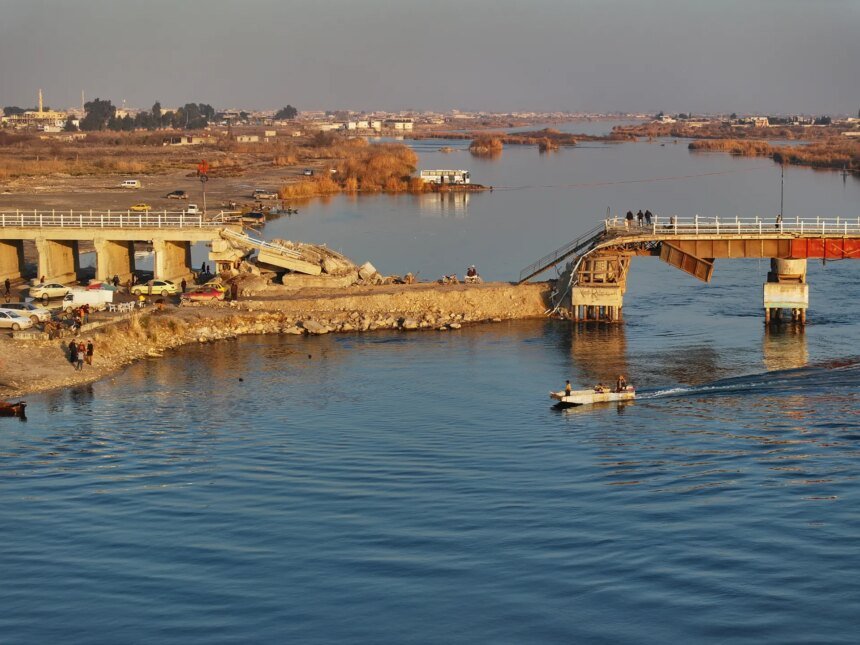
In Deir ez-Zor, responses included raising 700-meter-long dirt berms near the Dhiban water station, and in the Zaghir Shamiya and Al-Bunasir areas in the Harabesh neighborhood, in addition to removing parts of an earthen bridge in the city to facilitate water drainage and prevent its collapse, and towing a ferry that had been swept away by the current and returning it to its course.

3 children died by drowning
The governorate recorded the death of 3 children who drowned while swimming in the Euphrates River, with the loss of a fourth child, in addition to the Al-Mariyah, Al-Mariyah Al-Tarabi and Al-Ashara bridges being out of service, and homes and agricultural lands were submerged in a number of areas.
The local authorities had formed a joint operations room between the Ministry of Emergencies, the governorates of Raqqa and Deir ez-Zor, and the Ministry of Water Resources, to fortify the areas of the river along its course from Raqqa to Albukamal.
In this context, the Syrian Civil Defense warned of the danger of swimming in the river with its high level and strong current, after deaths among children were recorded during the past days.
The Director General of the Euphrates Dam Foundation, Haitham Bakour, explained that the river level witnessed a noticeable rise as a result of the increase in water supply and heavy rains, indicating that the reserve of the Euphrates Dam Lake exceeded 97%, and that water flows reached about 2,000 cubic meters per second with the opening of the spillway gates.
He added that the dams were almost full before the latest wave of flows, with what he described as one of the heaviest rainy seasons in about 30 years, which increased the challenges of managing water imports and warnings for residents residing downstream.
The water level in the Euphrates River witnessed a significant increase as a result of the increase in the amounts of water passed through the dams built on the river, after the stock of the Euphrates lakes reached more than 97%, and the increase in water imports from Turkey via the river as a result of the high rates of rain witnessed by Turkey and the regions of northern and eastern Syria during the current season.
The Euphrates Dam – also called Tabqa Dam – is located on the Euphrates River in the city of Tabqa, located 50 kilometers west of Raqqa.
The dam is 4.5 kilometers long, 20 meters wide at the top and 60 meters at the base. The dam’s body was built of cement and steel, and was designed to withstand earthquakes of up to 7 degrees on the Richter scale. Behind it, the dam holds a storage lake with a capacity of more than 10 billion cubic meters of water.