Every year in Dhul-Hijjah, souls rush to the ancient House before setting foot there, where millions of Muslims from all over the world respond to an ancient call broadcast by Abraham Al-Khalil, peace be upon him, across the horizons of time, and its echo continues to renew in the consciences of believers year after year.
Hajj, in this majestic scene of faith, does not appear to be a passing religious season, but rather a unifying ritual that involves major divine purposes, and brings together in one ritual what is separated in all other acts of worship, from the reverence of prayer, the giving of zakat, and the struggle of fasting, to the hardship of travel and separation from one’s family, in a meaning approaching jihad.
Read also
list of 2 items
end of list
In the “Days of God” program broadcast by Al Jazeera Mubasher, this ritual unfolds as a journey of faith, education, and sentiment, starting from a lack of God, passing through self-struggle and renewing faith, and culminating in evoking the afterlife and preparing to meet God.
Imam Al-Ghazali described Hajj as “the worship of a lifetime, the final matter, the completion of Islam and the perfection of religion,” a description that opens the door to asking about the secret of this status: What is the secret of that transformation that this ritual makes in everyone who performs it with a present heart and a disinterested spirit? How can a few days carry all this spiritual and faith weight?
A ritual that brings together the purposes of worship
The “Days of God” program poses a fundamental question at the beginning of its episodes about Hajj: Why was this worship imposed once in a lifetime, in contrast to prayer, which is repeated every day, and fasting, which returns every year? The answer of the participating scholars does not stop at jurisprudential wisdom alone, but rather holds that Hajj is an exceptional act of worship, because it combines within it what is separated in other acts of worship.
Sheikh Ahmed Al-Shanqeeti believes that praying for its great virtue does not include sacrifice, slaughter, and circumambulation, which are forms of worship that are only found during Hajj. This is evidenced by the words of the Prophet, may God bless him and grant him peace, describing Hajj as “a jihad without a problem,” emphasizing that Hajj is not only a spatial transition, but rather a journey of struggle for the soul, enduring hardship, and shorn of the trappings of the world.
advertisement
Al-Shanqeeti identifies three major circles within which the purposes of Hajj are distributed, and it is difficult to separate one of them from the other two:
The first nodal circle: In it, the meaning of monotheism is renewed, living and not theoretical. Since Abraham, peace be upon him, was commanded to build the House, the command came coupled with monotheism in the Almighty’s saying: “And when We appointed for Abraham the place of the House, ‘Do not associate anything with Me.’” These meanings are evident in the talbiyah that the pilgrims repeat: “At your service, you have no partner at your service.” The historical dimension of Hajj is also evident as a renewed connection to the chain of prophets, as the pilgrim follows in his rituals in the footsteps of Abraham, Ishmael, Hagar, and the Prophet Muhammad, peace and blessings be upon them.
The second educational circle: The meanings of venerating the rituals, strengthening the hearts, breaking arrogance, patience, and sincerity are highlighted in it, based on the Almighty’s saying: “And whoever venerates the rituals of God, then indeed they are from the piety of hearts.”
The third circle is a social international: In it, Hajj is read as the nation’s great annual conference. The Almighty’s saying: “That they may witness benefits for themselves” came to open horizons for benefits broader than devotional benefits alone, including social, economic, and general affairs of the nation.
A number of scholars participating in the program believe that the nation, at one level, with one dress, and with one rite, possesses reasons for unity that no other nation possesses, if it reads this season well and realizes what God has deposited in it.
Lack of God…a meaning that applies to all rituals
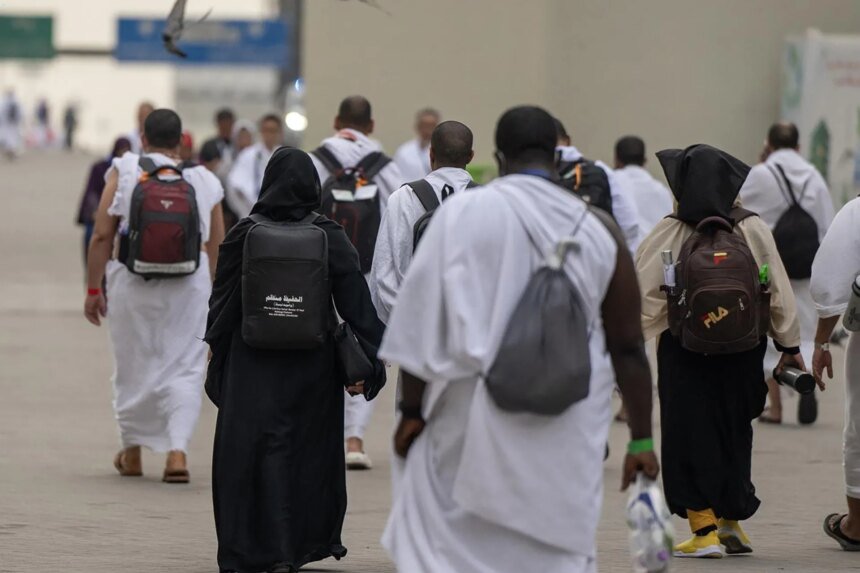
From this comprehensive meaning of Hajj, the program moves to a central goal that is evident in all rituals, which is lack of God. At the moment of putting on the ihram clothes, the pilgrim is stripped of the trappings of status, prestige, and wealth, to stand before God stripped of everything that the world has added to him.
“Oh God, a proof in which there is no hypocrisy or reputation.”
In this sense, the program is based on what was narrated on the authority of the Prophet, may God bless him and grant him peace, when he said when entering ihram: “O God, perform a Hajj without hypocrisy or reputation,” then he entered ihram on a modest backpack and velvet that was not worth two dirhams, in a scene that embodies the meaning of pure servitude and complete humility to God.
Al-Shanqeeti believes that lack does not appear in ihram alone, but is distributed throughout every ritual. The talbiyah is a constant declaration of the need for God, the circumambulation attaches the heart to God and not to stones, and the quest between Safa and Marwah is a glorification of certainty in God’s mercy. In this sense, the story of Hagar, peace be upon her, and her quest between Safa and Marwah in search of water, stands out as an example of good faith in God and certainty in His mercy, which was embodied in the eruption of Zamzam water.
Thus, Hajj rebuilds the meaning of slavery in the heart of the pilgrim. The more the heart is stripped of the vanity of the world in the midst of rituals, the more it expands to the meaning of lack, and becomes more capable of tasting the sweetness of faith.
School of self-jihad
From the lack of God, the program moves to another of the major purposes of Hajj: struggling with oneself. He treats Hajj as a school of patience, endurance, discipline, and abandoning the ordinary, based on the Prophet’s description of it, may God bless him and grant him peace, as “a jihad without a thorn.”
Dr. Ahmed Al-Muhammadi believes that jihad begins with fighting oneself, then fighting Satan, then fighting enemies, then fighting hypocrites, stressing that whoever fails in the first will fail in all of the following.
advertisement
The episodes deal with Ihram as the first practical test of self-discipline. The pilgrim stands with millions of people in one body that does not distinguish the rich from the poor, and he is prevented from doing things that were permissible to him moments before, in training in self-control and abandoning what he desires in compliance with God’s command.
In addition to this, what the program describes as “surrender jihad.” It is complete submission to God in rituals whose detailed wisdom the mind may not comprehend at first glance, in addition to the hardship that accompanies Hajj in terms of travel, crowding, and waiting, which form in a person the meaning of patience and endurance.
Hajj…the image of the nation when it is united
If Hajj trains a Muslim to be patient, surrender, and struggle with the soul, then its impact does not stop with the individual alone, but rather extends to a broader horizon in which the unity of the nation is evident. Hence, the “Days of God” program poses a direct question: How does the nation succeed in coming together every year inside the holy sites, while outside of them it seems more dispersed and turbulent?
This unity in Hajj reaches its peak in the scene of Arafat, as an embodiment of the Almighty’s saying: “And this is your nation, one nation, and I am your Lord, so fear Me,” where millions of Muslims stand with one dress and one call, transcending the boundaries of language, race, and geography.
“The meetings of scholars during the Hajj season during the Crusader occupation of Jerusalem established schools and movements that gave birth to Saladin Al-Ayyubi.” – Dr. Ali Al-Qardaghi.
Dr. Ali Al-Qardaghi believes that the Hajj at the origin of its legislation is an annual conference for the nation in which scholars, leaders, merchants, and the common people meet. He cites what was reported by Ibn Kathir that the meetings of scholars during the Hajj season during the Crusader occupation of Jerusalem established schools and movements that gave birth to Saladin Al-Ayyubi.
The episodes recall the farewell sermon in Arafat as a comprehensive human charter. In it, the Prophet, may God bless him and grant him peace, affirmed the sanctity of blood and honor, abolished usury and pre-Islamic revenge, recommended goodness to women, and established the principle of brotherhood among Muslims. It concludes that if these principles found their way into practice, they would make Hajj a renewed starting point towards a more cohesive and united nation.
A journey that revives faith
From the horizon of the nation and its unity, the program returns to the purification of the soul, as you see that the fruit of Hajj appears in the increase in faith and uprightness in behavior that it leaves behind, based on the Almighty’s saying: “And those who are guided – He gives them guidance.”
Dr. Akram Kassab divides this impact into three levels:
“The Revived Monotheism”: He sees that when the pilgrim repeats, “At your service, you have no partner, here you are,” he is not only moving his tongue with it, but rather renewing his declaration of monotheism. Love, obedience and servitude to God, in fulfillment of the unification of divinity, divinity, names and attributes.
Deepening the connection with the prophets: The pilgrim walks in the same places that Abraham, Ishmael, Hagar, and Muhammad, peace and blessings be upon them, passed through, which creates an emotional state in which the Muslim feels extended within the legacy of prophecy.
Atonement of sins and renewal of the soul: Based on the saying of the Prophet, may God bless him and grant him peace: “Whoever performs Hajj and does not commit obscenity or immorality, his return will be like the day his mother gave birth to him.”
Sheikh Nashat Ahmed describes the Day of Arafat as a “cosmic celebration” in which mercy and forgiveness descend, and in which the meaning of faith renewal reaches its peak. The rings determine the sign of acceptance of Hajj according to one criterion: Did the pilgrim increase in obedience, piety, and righteousness after his return? Obedience after obedience is evidence of acceptance of the first obedience.
Scenes from the afterlife on the Hajj journey
This renewal of faith is inseparable from another meaning that appears in Hajj, which is a reminder of the afterlife. Some rituals make the pilgrim experience images close to the meanings of departure, gathering, and standing before God.
Al-Shanqeeti believes that the first of these scenes begins with Ihram. When the pilgrim takes off his clothes and wears the ihram clothes, he conjures the image of the shroud, and is stripped of what he will be forced to strip of while he is alive after his death. Dr. Al-Muhammadi points out that the timings in Hajj are not only geographical boundaries, but also carry existential connotations. As a person throughout his life is governed by times that he cannot exceed.
advertisement
As for the Day of Arafat, the episodes describe it as the Hajj scene most similar to the Day of Resurrection. Millions of people gather in one place, disheveled and dusty, devoid of worldly distinctions. Sheikh Nashat Ahmad cites the words of the Prophet, may God bless him and grant him peace: “There is no day on which God frees a servant from Hell more than the Day of Arafat.”
Al-Shanqeeti reads the stoning of stones as a declaration of permanent enmity against Satan and a continuous battle with oneself that does not end with the end of the rituals. As for the Farewell Tawaf, the episodes stop at it as a moment of departure in which the pilgrim leaves Mecca in body while the impact of the journey remains in his heart and soul.
The episodes conclude that the accepted Hajj is not merely a performance of the rituals in their outward form, but rather a profound transformational experience that the pilgrim lives with a present heart, rebuilding his relationship with God, himself, and people. This is the meaning summarized by the Prophet, may God bless him and grant him peace: “The accepted Hajj has no reward except Paradise.”