Published On 5/16/2026
|
Last update: 5/17/2026 01:55 (Mecca time)
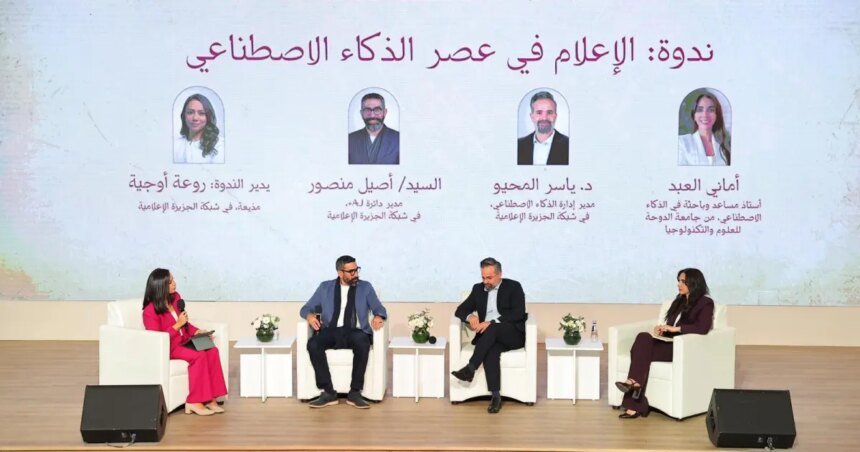
Experts in the field of artificial intelligence unanimously agreed, during a symposium at the 35th Doha International Book Fair, entitled “Media in the Age of Artificial Intelligence,” that some biases in artificial intelligence against Arab and Palestinian issues in particular are intentional, while others result from the extreme weakness of Arab participation on the Internet.
The director of the artificial intelligence team at Al Jazeera Network, Yasser Al Mahio, the director of the network’s AJ+ channels, Aseel Mansour, and the researcher in artificial intelligence at Doha University of Science and Technology, Amani Al Abed, explained that profitability and directing content to raise interaction rates overshadowed the expense of news and knowledge content, stressing that what is most dangerous in the matter is that the deliberate biases come against Palestinian issues, while the others result from the weakness of Arabic content on the Internet, which represents 3%.
In response to a question from Al Jazeera Net about the errors of artificial intelligence and the necessity of verifying the information it provides us, Al-Mahio said that effective use of artificial intelligence technologies requires a deeper understanding of use strategies, despite the biases in shaping content and the challenges of trust and credibility emphasized by the three speakers.
Yasser Al-Mahio: A reality that requires adaptation
At the beginning of the symposium presented by Rawaa Oger, broadcaster on Al Jazeera, Yasser Al Mahio said that the work that began with the Al Jazeera network required adaptation to reality, and based on previous experiences, the problem before us was how to use artificial intelligence, differently.
He gave, for example, the life cycle of news from the moment it occurs to the moment it appears on the screen or phone screen through three stations. The first is how we monitor the news, as its sources are multiple on social media platforms, and the public as well. Artificial intelligence carries out the initial sorting of the news and sends it as raw material.
I do not see that artificial intelligence threatens the disappearance of entire professions, but what will happen is a shift in some of the variety of these professions, for example, the idea of writing reports and translation by 80%. As for the broadcaster and his role, it is not expected to disappear because it is linked to the audience. A study found that the closer the robot comes to resembling a human, the “lonely valley” curve begins to fall. The broadcaster, because he is linked to the field and the changing interaction, cannot be replaced by the automated broadcaster.
In the second station, this news goes to the newsrooms, and artificial intelligence allows the journalist to focus on editorial value, extracting meaning and linking context, and in the third station, the news goes to the audience, and here artificial intelligence also has a role in allocating this single news to multiple audiences in terms of geographical location and economic interests.
Regarding the professions expected to disappear, he said that he does not see that artificial intelligence threatens the disappearance of entire professions, but what will happen is a shift in some of the variety of these professions, for example, the idea of writing reports and translation by 80%.
As for the broadcaster, he does not expect his role to disappear, because it is related to the audience, as a study found that the closer the robot comes to resembling a human, the curve begins to fall, which is known as the “wild valley.” The broadcaster, because he is linked to the field and the changing interaction, cannot be replaced by the automated broadcaster.
Aseel Mansour: A challenge to man
For his part, Aseel Mansour explained that artificial intelligence reduced time on the one hand and on the other hand built on the accumulation of knowledge for newsrooms based on everything that had been accomplished before, which led to an increase in productivity and effectiveness and an increase in access to people, but at the same time it had disadvantages.
Regarding the role of man if artificial intelligence reaches the level of simulating the essence or spirit, he said that so far it has not yet arrived, but if we assume that, what will happen? Will the human disappear completely when his soul or essence is simulated? He replied, “I do not believe that, and I see that man is always capable, even in the media, of reshaping his place,” citing as an example ancient drawing and the emergence of photographs.
He pointed out the problem of the bias of publishing algorithms, as there are temptations to promote individual entertainment content in search of profit instead of providing news content about Palestine, for example, and the most difficult part here is related to political matters by suppressing some voices and trying to conceal some narratives, especially with regard to the Palestinian issue and Arab issues in general.
We must separate the strengths of humans, which are the context and moral judgment on what should be published and what should not be published, and the strengths of the machine, which are speed, news analysis, translation, and proofreading. There is a red line, which is when artificial intelligence takes power and publishes news, as the latest study from the BBC says that about 45% of artificial intelligence’s news answers have errors or problems with the source.
Amani Al-Abed: Ethical controls
For her part, Amani Al-Abed said that there is a need to adhere to ethical controls for the use of artificial intelligence in newsrooms, whether in terms of collecting information, sorting it and then analyzing it, and the materials in which we can use artificial intelligence and other materials in which we must be careful.
She pointed out that we must separate the strengths of humans, which are the context and moral judgment on what should be published and what should not be published, and the strengths of the machine, which are speed, news analysis, translation, and verification. There is a red line, which is when artificial intelligence takes power and publishes the news, as the latest study from the BBC says that about 45% of artificial intelligence news answers have errors or problems with the source.
She stressed the necessity of human control over the final decision of what is published and what is not published, as there are risks in completely relying on artificial intelligence, and it is also necessary to build critical thinking in education, as the problem is not in the use of artificial intelligence, but in the absolute trust in it and the absence of critical awareness.