


Published On 9/5/2026
|
Last update: 10:43 (Mecca time)
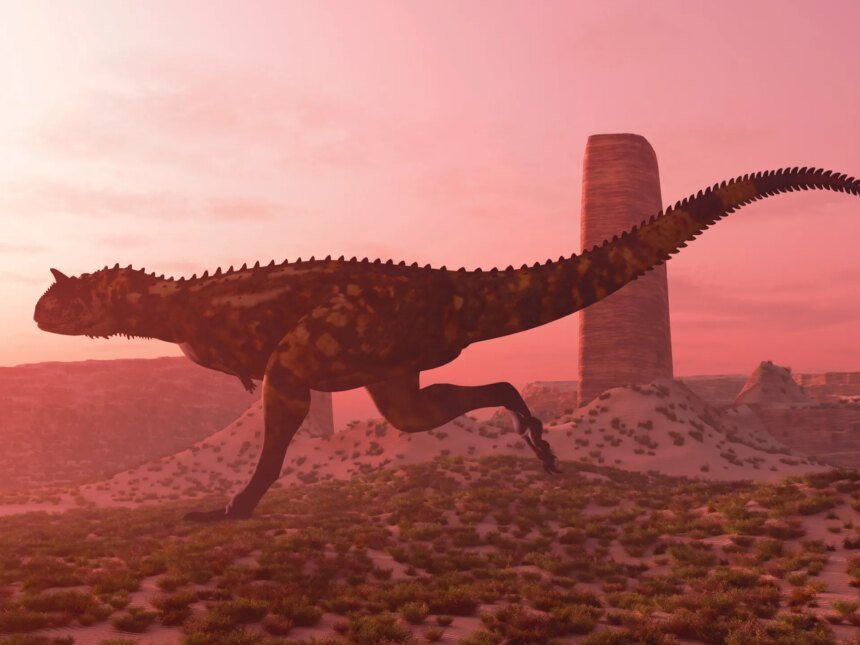
In a semi-arid riverine environment during the Early Cretaceous period in what is known today as Thailand, about 125 million years ago, one of the oldest known giant predatory dinosaurs in Asia, a dinosaur known as Siamraptor swati, lived alongside other creatures such as reptiles, fish, and various dinosaurs.
In a new study, researchers have revealed unprecedented details of this creature’s brain and skull. This provides important evidence of the early stages of the history of a group of large carnivorous dinosaurs known as the “carcharodontosaurs,” a lineage that later included some of the largest predators that lived on land.
The study, published on April 29 in the journal PLOS One, was based on the analysis of two partial skull fossils found in the Khok Kruat geological formation in northeastern Thailand.
The researchers used high-resolution computed tomography technology, which is similar to medical x-rays used to examine the human body, but here it is used to examine fossils from the inside without breaking or damaging them.
Thanks to this technology, scientists were able to reconstruct the internal shape of the brain box, that is, the cavity that contained the dinosaur’s brain, with an accuracy that was not possible before.

Discovering the beginning of a predatory race
Siamraptor is one of the oldest known members of the carcharodontosaur group, a group that later included famous predatory dinosaurs such as Giganotosaurus and Carcharodontosaurus, said study lead author Suki Hattori, an associate professor at the Dinosaur Research Institute at Fukui Regional University in Japan.
These dinosaurs were known for their large size, sharp teeth, and ability to occupy the top of the food chain in their environments. But available information about the beginnings of this group, especially in Asia, has remained limited due to the scarcity of complete fossils.
The study showed that Siamraptor had a mixture of ancient and newer traits, meaning that it was not entirely primitive, nor was it completely similar to the giant predators that appeared later, but rather represented an important stage in the history of this breed.
One of the most prominent things that the researchers revealed was the presence of new anatomical features in the front of the skull, and in the area of contact between some of its bones, that had not been previously recorded in its known relatives.
Hattori explains in statements to Al Jazeera Net that these small details in paleontology help determine the location of the organism within the tree of life, as every difference in the shape of the bones or the way they are connected can reveal a kinship relationship or a certain stage in its history.
He added: “Hence the importance of this study, because it adds new information about an early branch of predatory dinosaurs that later spread to more than one continent.”

Long and narrow brain
The researcher points out that one of the most important results of the study is that the brain cavity of Siamraptor was relatively long and narrow, a shape similar to what was found in some later giant predators from the same group. This does not mean that scientists have found the brain itself, because soft tissue does not usually fossilize, but the shape of the internal cavity of the skull allows an approximate picture of the size and shape of the brain and the locations of the nerves associated with it.
This finding suggests that some of the basic neurological features of these dinosaurs appeared early in their history, before carcharodontosaurs became widespread in the Old World.
The study also revealed details related to the cranial nerves and inner ear cavities, which are important parts because they help scientists understand some of the dinosaur’s sensory and motor capabilities, such as balance, and perhaps the way to move the head and respond to the surroundings.
“These findings are particularly important because the Asian fossil record for this group remains less complete than what is known from Africa and South America,” Hattori says. “Therefore, the presence of Siamraptor in Southeast Asia reinforces the idea that Asia may have played an important role in the early stages of the history of these giant predatory dinosaurs, rather than simply being a region to which they spread later.”
Despite the importance of the results, the researchers say that they are based on only two partial samples of the skull, and not two complete skulls, which means that some anatomical interpretations will still be subject to revision if more complete fossils are found in the future.
Some parts of the bones were missing or damaged, forcing researchers to compare them with nearby dinosaurs to reconstruct the missing picture. Therefore, Siamraptor’s exact position within the carcharodontosaur tree of life may change as new discoveries emerge.
In terms of funding, the researchers explained that the study was supported by Nakhon Ratchasima Rajabhat University (NRRU) in Thailand through its research fund, and that the funding body did not interfere in the study design, data collection, analysis, or decision to publish. The study also did not receive additional external funding.


