


Pakistani citizen Aisha Amin was preparing to leave her home in Karachi last week to run errands, when her three-year-old daughter, Zimal, clung to the edges of her clothes and innocently asked her: “Are you finally going to the airport to receive my father?”
Aisha (26 years old) told Al Jazeera: “How do you explain to a three-year-old girl that her father is a prisoner and cannot return? How can anyone answer this question?”
For about two weeks, Amin Bin Shams (29 years old), Aisha’s husband and Zimal’s father, has been held hostage on board an oil tanker off the coast of Somalia. He is one of 10 Pakistani sailors among the 17-member crew of the ship MT Honor 25, which was seized by Somali pirates on April 21.
In addition to the Pakistanis, the crew includes 4 Indonesians – including the captain – and one person each from Sri Lanka, Myanmar and India.
Zimal has not stopped asking about her father since he has been gone, and his infant son, Rahim, who was born on December 24 – just two weeks after Amin left on his first contract in the Merchant Navy – has never met his father.
![Several crew members of Honor 25 on board the ship before their vessel was hijacked. Ameen bin Shams is second from right in the front row. Mehmood Ansari is third from left standing [Courtesy Muzammil Ahmed Ansari]](https://www.aljazeera.net/wp-content/uploads/2026/05/adasd863-1777975096.jpeg?w=770&resize=770%2C513&quality=80)
“It was his dream”
Amin spent years working in a Karachi shipyard before landing his first opportunity on a merchant ship, joining the crew of the MT Honor 25 on December 9 as a technician. The family lives in Malir Khokhrapar, a lower-middle-class neighborhood in Pakistan’s largest city.
Aisha says that the months before the kidnapping were the happiest in Amin’s life. He would call constantly, often via video technology, to show her the sunrise over the open waters. He would also send clips of the dolphins, sharing details of his food, where he was sitting, and what the ship looked like at different hours of the day.
She added: “He always said: This is a good life. I’m really enjoying it. It was his life’s dream to be part of the merchant marine.”
Amin was contributing from his savings to the preparations for Aisha’s sister’s wedding, scheduled for May 9, 2026, as he received a salary higher than what he earned at the shipyard. The family also used to shop for wedding preparations and send pictures of clothes and gifts to Amin, who responded with great enthusiasm despite knowing that he would not be able to attend.
In late April, Amin mentioned to his wife that he was filling out a routine form for sailors if something bad happened at sea. Aisha then asked him to stop saying that and not worry, but his ship was hijacked by pirates the next day.
![****Interior**** Ameen bin Shams celebrating his daughter Zimal's third birthday [Courtesy Ayesha Ameen]](https://www.aljazeera.net/wp-content/uploads/2026/05/adasd862-1777975093.jpeg?w=770&resize=770%2C771&quality=80)
Last call
On April 23, two days after the ship was hijacked off the coast of Somalia, a phone call came from Amin, during which he told his wife about the hijacking incident, and he was in a state of panic and distress. Aisha says her husband was crying, expressed his love for his family during the call, and asked her to kiss their two children.
According to the families of the detained sailors who were on board the ship, the pirates allowed short calls and surveillance in the first days of the kidnapping, which allowed some crew members to talk to their families, then communications began to gradually decrease and then were completely cut off.
In another final call the following week, which did not exceed 3 minutes, Amin asked his wife to contact civil society organizations, charities, and anyone who could pressure the government to take action to save him and his colleagues. In that last call, Amin used the captain’s phone to speak to his father, confirming that he was fine and asking the family to pray for him.
Panic and getting lost
Also in Karachi, a young Pakistani man, Muzammil Ahmed Ansari (23 years old), learned of the news of his father being captured 3 days after the ship was hijacked. His father, Mahmoud Ahmed Ansari (55 years old), spent three decades of his life at sea, during which he roamed the oceans and worked on countless ships and companies.
On this voyage, he was the ship’s third engineer, in charge of the engine room. He had joined the ship’s crew from Dubai on January 17, and his contract was due to expire in July.
Muzamil told Al Jazeera: “My father sent a voice message in which he said: We have been kidnapped, contact the company, with the people, with the government. He mentioned that there were pirates on board the ship, and they were all armed. It seemed from his voice that he was terrified.” Despite Ansari’s more than 30 years of experience, nothing prepared the family for such a moment.
Muzamil reports that the days have become heavy and similar, and he adds: “When we wake up in the morning, we wonder what news this day will bring for us? And when we go to sleep, we wonder what news tomorrow will bring? We live in a state of confusion, we never know what will happen later.”
![****Interior***** Captured vessel MT Honor 25 as seen from the EUNAVFOR Operation Atalanta's Japanese Maritime Patrol aircraft from the Combined Maritime Forces. The plane flew over the area, confirming the location of the vessel inside Somalia's territorial waters [Courtesy EUNAVFOR]](https://www.aljazeera.net/wp-content/uploads/2026/05/adasd864-1777975099.jpeg?w=770&resize=770%2C462&quality=80)
Decreased communications and uncertain demands
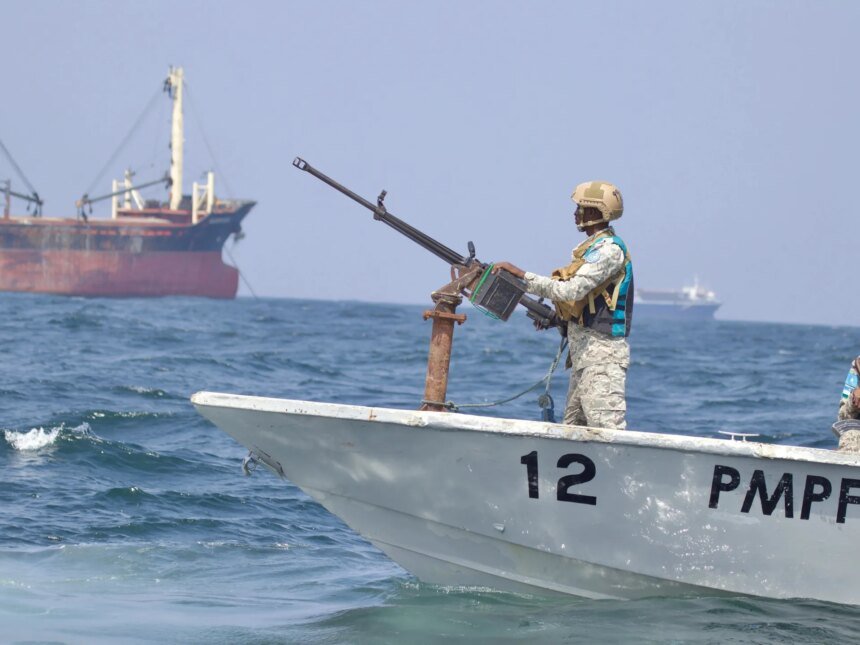
The MT Honor 25, a Palau-flagged oil derivatives tanker carrying approximately 18,000 barrels of oil, was hijacked about 30 nautical miles (56 kilometers) off the semi-autonomous Puntland region in Somalia.
The operation began with six armed men boarding the ship, before reinforcements arrived, raising their number to at least 11 pirates. A Japanese maritime patrol aircraft belonging to the Combined Maritime Forces confirmed the ship’s location in Somali territorial waters.
A European Union naval force later deployed at least two warships to the area on April 25, and these two ships are still in the area according to official data.
The Pakistani embassy in Djibouti said that the tanker is now anchored off the coast of Ile in Puntland.
Information indicates that the ship is operated by Wharf Chartering, registered in Indonesia, while the Pakistani Foreign Ministry stated that the ship is owned by a businessman from Puntland.
The families of the detained sailors say that the pirates instructed the crew to appeal to their governments to meet the pirates’ demands, stressing that the demands will be delivered directly to the official authorities. Officials in Pakistan or Somalia have not yet confirmed the amount of ransom they may demand.
According to the families of the victims, conditions on board the ship have deteriorated, as food and water supplies have run out, the ship’s fuel is reportedly running out, and some crew members have run out of necessary medications.
“The government is busy saving the world.”
In the latest official Pakistani statements regarding the kidnapped sailors crisis, Pakistani Foreign Ministry spokesman Tahir Andarabi said on April 30 that Islamabad is in contact with the Somali Foreign Ministry, which has provided written assurances that it is monitoring the situation and communicating with the pirates and Puntland authorities.
Andarabi considered that the ship’s ownership by a Somali businessman and its presence in familiar waters represents a “ray of hope.”
Andrabi said: “Based on these discussions with the Somali Ministry of Foreign Affairs, we have good reason to believe that our crew members are safe, and that there are existing communications between the pirates and the ship owner.”
The families of the hostage sailors demanded more direct government intervention, during a press conference held in Karachi at the end of last month. The families appeared holding up pictures of the missing persons with their children next to them, calling for the formation of a high-level committee and the appointment of an official who would be a liaison to provide them with updates on a regular basis.
The statements of the sailors’ families indicate a state of frustration. For Aisha, what is being issued by officials regarding dealing with the crisis are empty promises. She adds bitterly: “What frustrates us most is how cruel and cold the government is. They have not issued a single tweet, not a video, or a message. Nothing at all, not even moral support.”
Referring to Pakistani mediation efforts between the United States and Iran, she adds: “They are busy saving the world from war, but they cannot reach their citizens in this difficult hour. We cannot expect help from strangers. We are Pakistanis, so who should we turn to if we do not turn to our government?”
As for Muzammil, he was more conservative in his speech, but his words were not devoid of harshness, as he said: “Nothing came from the ministry, nor did anything come from the government, not even a word on social media. We held a press conference attended by all major media outlets, but the issue did not receive sufficient coverage.”


