If you hold a “wooden ruler” and try to pull both ends very slowly, what happens is that it does not break, but rather expands by a very small amount that the eye does not notice, but if you provide additional pressure force, it may cause a sudden crack in the middle of the ruler.
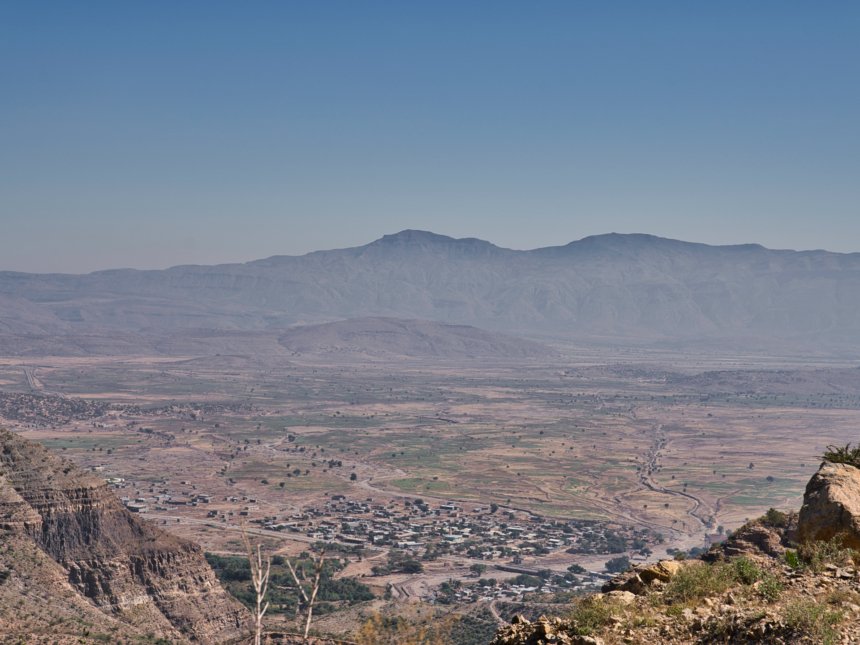
This is exactly what is happening in the Afar region, in the northeastern corner of Ethiopia, which is the point of interaction between three tectonic plates, namely the Arab, African and Somali plate.
A study by researchers from the Department of Geological Sciences at the University of Missouri, published by the journal Geomorphology, two years ago, observed that the ground is slowly tearing apart in that region (at a rate of 5 to 20 mm annually) as a result of the movement of those plates and their distance from each other, creating an effect similar to your trying to tighten the ends of a wooden ruler.
However, a recent study by researchers from the Geological Survey published by the Geophysical Journal International revealed an additional force, which occurred between late December 2024 and mid-March 2025, causing the Earth to tear apart by 60 centimetres, a rate that is supposed to be achieved within 120 years, but that force shortened years of quiet tearing, in rapid and sudden events within 3 months.

To approximate the tear rates indicated by the two studies, we can take a living example that you monitor regularly in your life. While your nails grow at a rate of 3 to 4 mm per month, which is equivalent to about 36 to 48 mm per year, the speed of separation of the plates under normal circumstances is 5 to 20 mm per year, meaning that your nails grow 2 to 9 times faster than them annually.
But while nails grow in 3 months by only approximately 12 millimeters (1.2 cm), in Ethiopia during the extraordinary event, the earth moved apart by 600 millimeters (60 centimetres), meaning that the earth was tearing apart at a speed 50 times faster than your fingernails grow.
Under normal circumstances, the displacement and the exceptional events that occur will lead to the thinning of the continental crust in the end until it is completely cut off. Once the land drops due to these displacements to a level below sea level, the waters of the Red Sea and the Gulf of Aden will flow to submerge this region, turning the Afar and Ethiopia regions into a new ocean floor, which will be the sixth ocean after the Pacific, Atlantic, Indian, Arctic, and Antarctic oceans.
What is an extraordinary event?
The exceptional event documented by researchers from the Geological Survey, which led to the displacement of 60 centimetres, was a sudden jump from a state of slow annual rupture to a movement of slightly more than half a meter (60 centimetres) within three months, due to a dynamic geological process known as “magmatic injection,” which is tantamount to the birth of a new ground fissure filled with magma.
The “dyke” is a huge vertical fracture in the earth’s crust into which magma rushes from the depths. What happened is that the magma rushed into a fissure extending 50 kilometers underground, specifically in the area between the “Vantali” and “Duven” volcanoes. This rushing magma not only fills the void, but acts as a huge steel “wedge” that pushes the two sides of the earth’s crust away from each other with tremendous force.
Because of the magma pushing the surrounding rocks forcefully, the earth’s crust could not bear this sudden pressure, and this led to the fracture of the rocks surrounding the dyke, generating more than 300 earthquakes. These earthquakes were like the “sound of tearing” of the earth’s crust as it made way for the magma to settle in its new place. The strength of the largest of these tremors reached 5.9 degrees, which is strong enough to cause surface cracks and evacuate residents.
As a result of the magma rushing into the fissure, the Earth swelled and expanded transversely, and jumped there by 60 centimeters away from the center of the fissure. The satellites whose data the researchers used, such as the Interferometric Synthetic Aperture Radar (InSAR) satellite, monitored this jump.
This rise led to a change in the paths of groundwater, the emergence of new springs and the disappearance of others, in addition to a subsidence in the craters of nearby volcanoes (such as the Ventali crater) as a result of the withdrawal of magma from its deep reservoirs to feed this new fissure.
This event proved the existence of an interconnected “volcanic plumbing system” underground, where magma migrates from one volcano to another under the surface without having to explode outside. What was surprising was that all this pressure and earthquakes did not lead to a volcanic eruption, as the magma froze inside the crack under the surface and did not emerge as lava, which turned it into a “new earth’s crust” that would be added to the future ocean floor.
What happened in Ethiopia is not exceptional
A professor at the Faculty of Natural and Computer Sciences at Mada Walabo University in Ethiopia, Dr. Abdisa Kawu – who did not participate in the study – said: “Although there is a limited margin of error in the technical data (interferometric synthetic aperture radar), resulting from weather conditions and the nature of the rugged terrain in the Afar region, measurements of the height of the Earth’s surface of about 60 centimeters are considered scientifically reliable to a large extent, especially since they were based on repeated data.”
He pointed out in statements to Al Jazeera Net that what happened in Ethiopia is not an exceptional case, but rather is consistent with geological patterns previously recorded in active regions such as Iceland and the Red Sea, where the separation of tectonic plates occurs in the form of intermittent and violent “pulses” instead of slow, continuous change.
He stressed that the movement of magma between different volcanic regions does not necessarily mean the imminence of a volcanic eruption or a devastating earthquake, explaining that the magma remained in the depths and did not reach the surface of the Earth, while the recorded earthquakes remained within the average range in terms of strength.
He pointed out that the study, despite its importance, still needs additional data to more accurately understand what is happening deep in the Earth’s crust, especially with regard to magma paths, temperature, and gaseous emissions, stressing the importance of strengthening ground monitoring networks and linking them to satellite monitoring to obtain early warning and reduce potential risks in the future.
He also explained that ground deformations may leave gradual effects on groundwater and infrastructure, by changing underground water paths or increasing pressure on roads, pipelines and facilities near fault areas, which requires continued scientific and environmental follow-up in the long term.