



In mid-May 2026, the world’s eyes will turn to the Chinese capital, Beijing, where the postponed meeting will be held between US President Donald Trump and his Chinese counterpart, Xi Jinping.
This historic summit comes at a very complex time, as the US-Israeli war on Iran casts its shadow on the global scene, turning a regional crisis into a stifling economic shock in energy markets.
Here the pivotal question arises: Did this war and its repercussions make Xi have the upper hand over Trump in the awaited meeting?
Many analyzes suggest that the crisis has relatively weakened Washington’s position and expanded Beijing’s room for maneuver, but it is difficult to assert a complete reversal in the balance of power, as the tools of mutual pressure are still in place.
How does Beijing benefit from American confusion?
This shift in the balance of power does not surprise some analysts, as Trump’s policies, including the war on Iran, have begun to act as a factor accelerating Beijing’s rise instead of containing it, by dismantling traditional alliances and disrupting Washington’s image as a leading force, according to researcher Ashraf Ibrahim in the “Economic Informant” program.
The facts have proven that Beijing prepared for war early. According to a Bloomberg analysis, since 2023, Xi has ordered his leaders to prepare for “extreme scenarios,” which has resulted in China’s energy self-sufficiency today reaching about 80%. By diversifying its oil imports to include Russia (17.5%) and Saudi Arabia (15%), China absorbed the first shock of the disruption to Middle East supplies.
The matter is not limited to securing oil, but the war has accelerated the global shift towards green alternatives, a playground completely dominated by Beijing, as estimates by “The Diplomat” magazine indicate that China’s clean energy exports jumped in March 2026 to $26 billion.
This scene prompted Jörg Woettke, a partner at the Albright Stonebridge Group, to describe the situation to CNN, saying: “The United States of America fights without winning, and China wins without fighting,” considering the Chinese are “the political winners, because they seem like the adults in the room.”
In parallel with the shift in the balance of negotiations between the two leaders, broader shifts are emerging in Asia, as Christopher Harding’s analysis in the Times indicates that many in Southeast Asia now see “Washington’s unreliability” as a threat greater than Chinese expansionism, especially in countries like Malaysia and Indonesia that were affected by the energy shock, which gives the Chinese president a convenient negotiating card to receive his American guest.

Chinese gains burdened by risks
Despite these gains, CNN reports from Chinese sources that there is a division within Beijing over how to manage the conflict, especially the “post-visit” dilemma, as Beijing fears a political trap if Trump launches a military escalation against Iran immediately after he leaves China, making it appear as if it has abandoned Tehran.
In addition, China faces economic threats if the conflict prolongs. According to The Diplomat, the disruption of navigation in Hormuz causes the detention of 13 million barrels of oil per day.
Chinese newspapers such as the Global Times monitor this blockade as a political impasse that puts Beijing between protecting its oil interests and maintaining its diplomatic balance, amid estimates that the timing of the blockade may be a “negotiating tactic” from Trump to extract concessions from Beijing.
The global recession resulting from the energy crisis could also hit China’s export-dependent economy.
The sensitivity is not limited to official numbers, as there are independent refinery networks known as “teapots” in Shandong, which account for the bulk of Iranian oil that circumvents the sanctions. The US Treasury Department – which is a party to this file – estimates that China actually buys 90% of Iran’s oil exports.
This entanglement has recently emerged in Washington’s imposition of sanctions on major Chinese refineries, and Beijing’s response by preventing compliance with them, in a confrontation that adds a layer of complexity to the calculations of the upcoming summit.

Strategic lessons
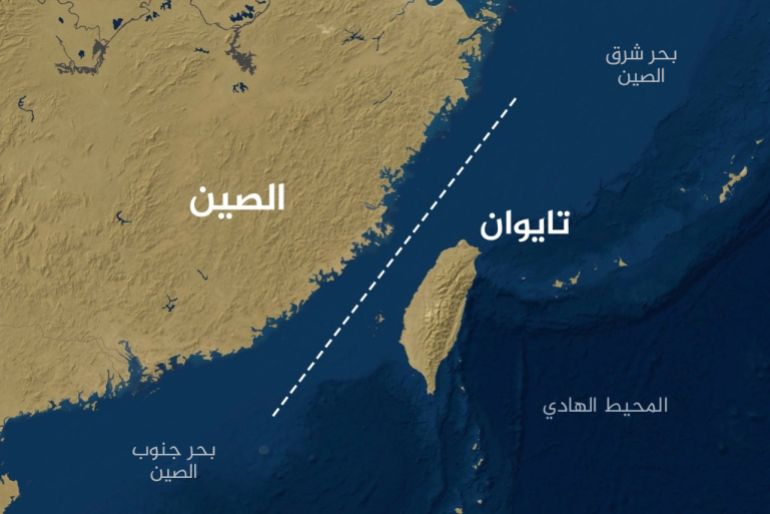
Beyond the numbers, the war provided profound lessons that will cast a shadow at the summit table. For Beijing, Bloomberg points out that the closure of the Strait of Hormuz provided a practical model for a “naval blockade” as an alternative to a comprehensive invasion of Taiwan.
Harding explains that the lesson relates to the effectiveness of economic strangulation, as 40% of global container trade passes through the Taiwan Strait, making it a deadly weapon that intersects with the calculations of the “Hormuz Model,” which will be strongly present in Xi Jinping’s mind during his negotiations with his American counterpart.
As for America, the Guardian brought up a scathing comparison, likening Trump to Britain in the Suez Crisis in 1956, considering that the war reveals “the exposure of American power” in an era of geopolitical transformation more than it proves it. This is a conclusion that means that the American president will enter the meeting hall in Beijing lacking the aura of absolute power that he tried to impose.
What awaits the two leaders at the summit table?
With Trump’s domestic popularity falling by about 34% and his desperate need to lower fuel prices, the summit will be an attempt to “manage competition” rather than end it, as The Diplomat points out.
Economically, Henry Huiyao Wang told Forbes magazine that he expects the two leaders to agree to establish a “trade and investment council” to regulate exchange away from sensitive sectors.
Politically, Washington will seek to exploit China’s influence to calm the Middle East, while Beijing will demand an American position that opposes Taiwan’s independence.
In the end, Trump will arrive in Beijing burdened by a war that has exhausted his cards, while Xi sits backed by a resilient economy. Although China’s victory does not seem entirely clear, the way it has managed the crisis has made it the party least affected and the most ready to reap the gains.
It is a conclusion that intersects with what researcher Ashraf Ibrahim argues that Trump’s short-term decisions have practically turned into a factor that accelerates China’s rise and expands its margin of maneuver, instead of being a tool to contain it.


